• Fri frakt över 249 kr
  • •
  • Snabba leveranser
  • •
  • Billiga böcker
Kundservice

Du är på sajten för privatpersoner.

Företag, bibliotek eller offentlig verksamhet?

Du handlar på classic.bokus.com, där alla dina funktioner finns intakta.
Till classic.bokus.com
Bokus logotyp. Gå till startsidan.
  • Erbjudanden
  • Nyheter
  • Student
  • Topplistor
  • Barn & ungdom
  • Bokus Play
  • E-böcker
  • Pocketböcker
  • Spel & pussel

10% rabatt på allt med kod: NYSTART10 →

Sidfot

Mina sidor

    Hjälp

    • Kundservice
    • Vanliga frågor och svar
    • Frakt och leverans
    • Retur vid ångerrätt
    • Reklamera vara
    • Betalning
    • Köpvillkor
    • Allmänna villkor
    • Information om webbplatsens tillgänglighet

    Om Bokus

    • Om oss
    • Pressrum
    • För studenter
    • För företag
    • För bibliotek och offentlig verksamhet
    • För leverantörer
    • Hållbarhet

    Populärt

    • Aktuella erbjudanden
    • Presentkort
    • Studentlitteratur
    • Nya böcker
    • Topplistor
    • Signerade böcker
    • Engelska böcker

    Inspiration

    • Boktips
    • BookTok
    • Populära bokserier
    • Barnbokskaraktärer
    • Populära författare
    Logotyp för Bokus
    Följ oss på Facebook (extern länk)Följ oss på Instagram (extern länk)Följ oss på YouTube (extern länk)Följ oss på TikTok (extern länk)
    bokus @ CookiesAnpassa cookiesIntegritetspolicyKöpvillkor
    Till Citymail hemsida (extern länk)Till Budbee hemsida (extern länk)Till Postnord hemsida (extern länk)Till Schenker hemsida (extern länk)Till Early Bird hemsida (extern länk)Till Walleys hemsida (extern länk)
    1. Ekonomi och Ledarskap
    2. Nationalekonomi
    3. Mikroekonomi

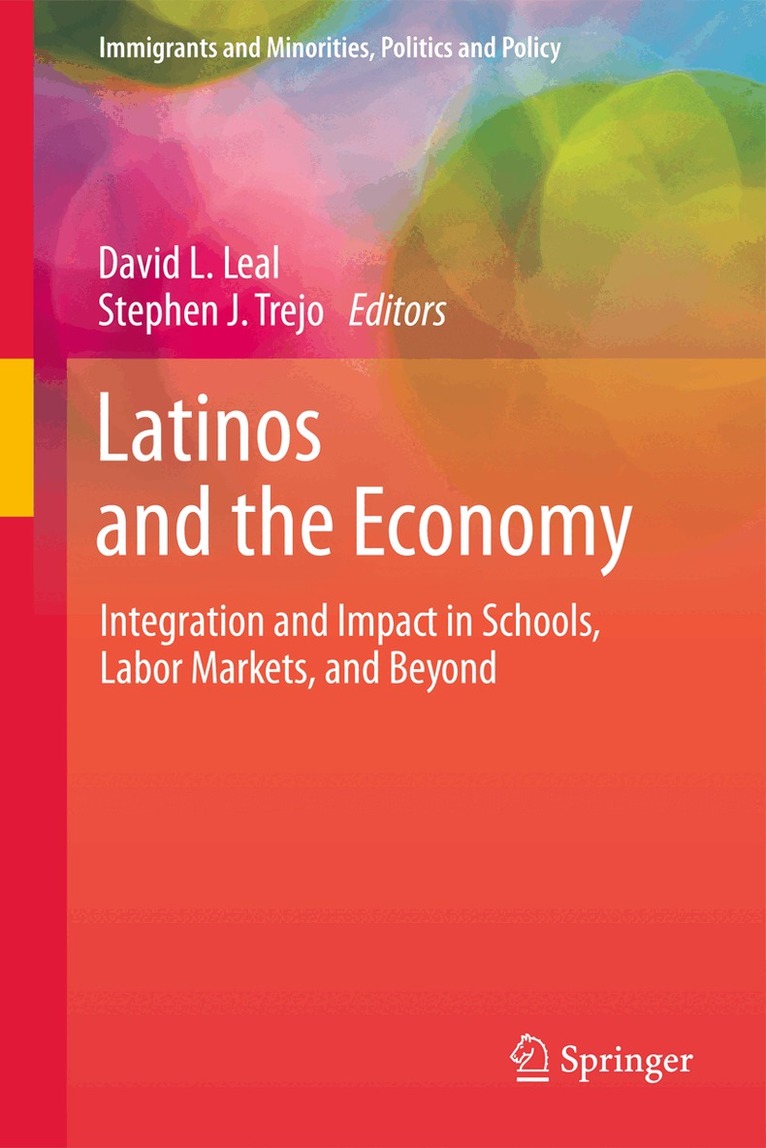
    Latinos and the Economy

    Integration and Impact in Schools, Labor Markets, and Beyond

    AvDavid L. Leal,Stephen J. Trejo

    Häftad, Engelska, 2013

    Del i serien Immigrants and Minorities, Politics and Policy

    1 626 kr

    Beställningsvara. Skickas inom 10-15 vardagar. Fri frakt över 249 kr.

    Beskrivning

    At 15.4 percent of the population, Latinos are the largest minority group in the United States. They are a growing presence in all sectors of the economy, play an increasingly important role in government and politics, and are influential across a wide range of cultural domains. Despite the growing attention paid to Latinos in recent years, this population is characterized by relatively low socio-economic status, and Latinos frequently rank behind the majority white population and other minority groups when it comes to education, finances, and employment.This book contributes to the understanding of these issues by addressing a comprehensive range of topics on Latino economic incorporation, outcomes, and impact over an individual's lifetime. The volume starts with the foundational issue of education, and then moves to immigrant integration and adjustment, Latino and immigrant earnings, the economic impact of Latinos, and inter-generational incorporation and long-term integration issues. The contributions provide wide-ranging perspectives on the key factors that determine whether Latinos will be able to achieve their economic potential. The substantial individual, national, and international implications of these studies make this book of interest to scholars and policy-makers alike, particularly those concerned with the issues of education, immigration, employment, and earnings.The rapid and continuing growth of the Hispanic population ensures that the debate over social policy in the next few decades will increasingly focus on how best to alleviate the economic and social problems facing this population and perhaps encourage rapid assimilation. The studies in the volume edited by David Leal and Stephen Trejo provide an excellent foundation for this discussion. The conceptual issues and findings in these papers are sure to be valuable to both policy makers and researchers.George Borjas, Robert W. Scrivner Professor of Economics and Social Policy, John F. Kennedy School of Government, Harvard UniversityLatinos and the Economy provides a truly authoritative but accessible compilation of first-rate scholarship on Hispanic incorporation, educational and political gains, and ongoing economic and cultural impacts. It is "must reading" for anyone concerned about the future, especially as America moves inexorably towards becoming a majority-minority society by mid-century.Daniel T. Lichter, Ferris Family Professor, Department of Policy Analysis and Management, Cornell UniversityThis is the volume to read for anyone interested in current American immigration issues or the role of Hispanics in the U.S. economy."Daniel S. Hamermesh, Killam Professor of Economics, University of Texas at Austin"The future of America is closely intertwined with the successful integration--economically, politically, and socially--of the Latino population. Latinos now comprise one of every seven workers and almost one of every five students in the United States. The research reported in this volume describes the challenges faced by Latinos in schools, the labor market, and in communities and explains their prospects for upward mobility. These studies suggest that a significant investment in expanding educational opportunities may be the single most important policy lever to incorporate Latinos into the American mainstream."Charles Hirschman, Professor of Public Affairs and Boeing International Professor of Sociology, University of Washington

    Produktinformation

    • Utgivningsdatum:2013-01-25
    • Mått:155 x 235 x 19 mm
    • Vikt:517 g
    • Format:Häftad
    • Språk:Engelska
    • Serie:Immigrants and Minorities, Politics and Policy
    • Antal sidor:328
    • Upplaga:2011
    • Förlag:Springer-Verlag New York Inc.
    • ISBN:9781461427865

    Utforska kategorier

    • Mikroekonomi inom Ekonomi och Ledarskap
    • Sociologi inom Samhälle och politik
    • Statsvetenskap och politisk teori inom Samhälle och politik

    Recensioner i media

    "The rapid and continuing growth of the Hispanic population ensures that the debate over social policy in the next few decades will increasingly focus on how best to alleviate the economic and social problems facing this population and perhaps encourage rapid assimilation. The studies in the volume edited by David Leal and Stephen Trejo provide an excellent foundation for this discussion. The conceptual issues and findings in these papers are sure to be valuable to both policy makers and researchers." - George Borjas Robert W. Scrivner Professor of Economics and Social Policy John F. Kennedy School of Government Harvard University "Latinos and the Economy provides a truly authoritative but accessible compilation of first-rate scholarship on Hispanic incorporation, educational and political gains, and ongoing economic and cultural impacts. It is 'must reading' for anyone concerned about the future, especially as America moves inexorably towards becoming a majority-minority society by mid-century." - Daniel T. Lichter Ferris Family Professor Department of Policy Analysis and Management Cornell University "This is the volume to read for anyone interested in current American immigration issues or the role of Hispanics in the U.S. economy." Daniel S. Hamermesh Killam Professor of Economics University of Texas at Austin "The future of America is closely intertwined with the successful integration-economically, politically, and socially-of the Latino population. Latinos now comprise one of every seven workers and almost one of every five students in the United States. The research reported in this volume describes the challenges faced by Latinos in schools, the labor market, and in communities and explains their prospects for upward mobility. These studies suggest that a significant investment in expanding educational opportunities may be the single most important policy lever to incorporate Latinos into the American mainstream." - Charles Hirschman Professor of Public Affairs and Boeing International Professor of Sociology University of Washington

    Innehållsförteckning

    • Latinos and the U.S. Economy.- The Hispanic Diaspora and the Public Schools: Educating Hispanics.- System of Elections, Latino Representation, and School Policy in Central California Schools.- Does Reducing College Costs Improve Educational Outcomes for Undocumented Immigrants? Evidence from State Laws Permitting Undocumented Immigrants to Pay In-State Tuition at State Colleges and Universities.- Hispanic and First Generation College Students: How do They Fare in Postecondary Education? The Effects of Legalization on Migrant Remittances.- Naturalization and its Determinants Among Immigrants from Latin America: The Role of Dual Citizenship Rights.- The LEP Earnings Penalty Among Hispanic Men in the US: 1980 to 2005.- The Minimum Wage and Latino Workers.- Latino Veterans and Income: Is There a Penalty for Military Service?- Do Recent Latino Immigrants Compete for Jobs with Native Hispanics and Earlier Latino Immigrants?- Immigrants, Hispanics, and the Evolution of Housing Prices in the US.- The Effects of English Proficiency on Economic and Social Outcomes: Summary of Evidence from Childhood Immigration in the U.S. Census- Who Remains Mexican? Selective Ethnic Attrition and the Intergenerational Progress of Mexican Americans