• Fri frakt över 249 kr
  • •
  • Snabba leveranser
  • •
  • Billiga böcker
Kundservice

Du är på sajten för privatpersoner.

Företag, bibliotek eller offentlig verksamhet?

Du handlar på classic.bokus.com, där alla dina funktioner finns intakta.
Till classic.bokus.com
Bokus logotyp. Gå till startsidan.
  • Erbjudanden
  • Nyheter
  • Student
  • Topplistor
  • Barn & ungdom
  • Bokus Play
  • E-böcker
  • Pocketböcker
  • Spel & pussel

10% rabatt på allt med kod: NYSTART10 →

Sidfot

Mina sidor

    Hjälp

    • Kundservice
    • Vanliga frågor och svar
    • Frakt och leverans
    • Retur vid ångerrätt
    • Reklamera vara
    • Betalning
    • Köpvillkor
    • Allmänna villkor
    • Information om webbplatsens tillgänglighet

    Om Bokus

    • Om oss
    • Pressrum
    • För studenter
    • För företag
    • För bibliotek och offentlig verksamhet
    • För leverantörer
    • Hållbarhet

    Populärt

    • Aktuella erbjudanden
    • Presentkort
    • Studentlitteratur
    • Nya böcker
    • Topplistor
    • Signerade böcker
    • Engelska böcker

    Inspiration

    • Boktips
    • BookTok
    • Populära bokserier
    • Barnbokskaraktärer
    • Populära författare
    Logotyp för Bokus
    Följ oss på Facebook (extern länk)Följ oss på Instagram (extern länk)Följ oss på YouTube (extern länk)Följ oss på TikTok (extern länk)
    bokus @ CookiesAnpassa cookiesIntegritetspolicyKöpvillkor
    Till Citymail hemsida (extern länk)Till Budbee hemsida (extern länk)Till Postnord hemsida (extern länk)Till Schenker hemsida (extern länk)Till Early Bird hemsida (extern länk)Till Walleys hemsida (extern länk)
    1. Psykologi och pedagogik
    2. Psykologi
    3. Biologisk psykologi och neuropsykologi

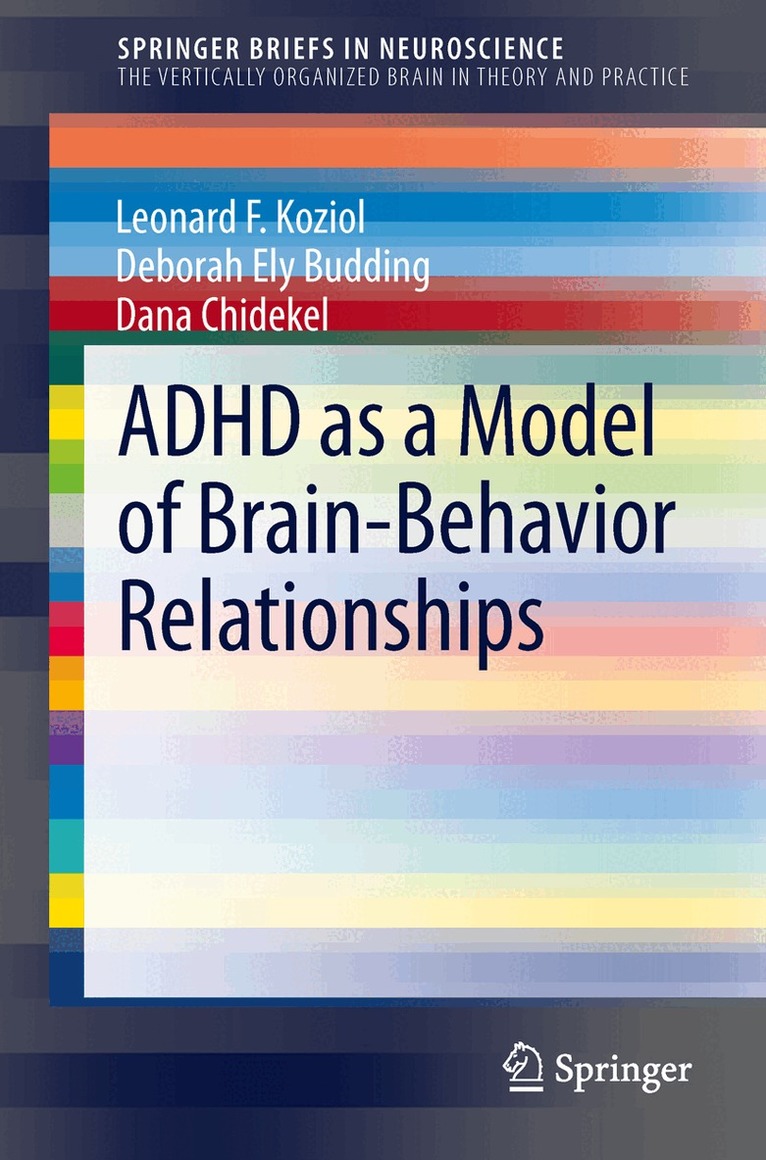
    ADHD as a Model of Brain-Behavior Relationships

    AvLeonard F. Koziol,Deborah Ely Budding

    Häftad, Engelska, 2013

    Del i serien SpringerBriefs in Neuroscience

    785 kr

    Beställningsvara. Skickas inom 10-15 vardagar. Fri frakt över 249 kr.

    Beskrivning

    ADHD as a Model of Brain-Behavior RelationshipsLeonard F. Koziol, Deborah Ely Budding, and Dana ChidekelSeries Title: Springer Briefs in NeuroscienceSubseries: The Vertically Organized Brain in Theory and PracticeIt's been a basic neurological given: the brain does our thinking, and has evolved to do the thinking, as controlled by the neocortex. In this schema, all dysfunction can be traced to problems in the brain’s lateral interactions. But in scientific reality, is this really true? Challenging this traditional cortico-centric view is a body of research emphasizing the role of the structures that control movement-the brain's vertical organization-in behavioral symptoms. Using a well-known, widely studied disorder as a test case, ADHD as a Model of Brain-Behavior Relationships offers an innovative framework for integrating neuroscience and behavioral research to refine diagnostic process and advance the understanding of disorders. Identifying a profound disconnect between current neuropsychological testing and the way the brain actually functions, this revision of the paradigm critiques the DSM and ICD in terms of the connectedness of brain structures regarding cognition and behavior. The authors argue for a large-scale brain network approach to pathology instead of the localizing that is so common historically, and for an alternate set of diagnostic criteria proposed by the NIMH. Included in the coverage:The diagnosis of ADHD: history and context.ADHD and neuropsychological nomenclatureResearch Domain Criteria: a dimensional approach to evaluating disorderThe development of motor skills, executive function, and a relation to ADHDThe role of the cerebellum in cognition, emotion, motivation, and dysfunctionHow large-scale brain networks interactHeralding a more accurate future of assessment, diagnosis, and treatment of neurodevelopmentaldisorders, ADHD as a Model of Brain-Behavior Relationships represents a major step forward for neuropsychologists, child psychologists, and psychiatrists, or any related profession interested in a neuroscientific understanding of brain function. ​

    Produktinformation

    • Utgivningsdatum:2013-09-23
    • Mått:155 x 235 x 7 mm
    • Vikt:172 g
    • Format:Häftad
    • Språk:Engelska
    • Serie:SpringerBriefs in Neuroscience
    • Antal sidor:93
    • Förlag:Springer-Verlag New York Inc.
    • ISBN:9781461483816

    Utforska kategorier

    • Biologisk psykologi och neuropsykologi inom Psykologi och pedagogik
    • Pedagogisk psykologi inom Psykologi och pedagogik
    • Biovetenskap inom Naturvetenskap och teknik

    Recensioner i media

    From the reviews: "This is a concise review of the current literature on large-scale brain networks and how they explain the heterogeneity, diagnostic limitations, and pitfalls of current neuropsychological tests for ADHD. ... Anyone interested in brain networks and clinical presentations of neuropsychiatric disorders could benefit from reading this book, and its content is extremely salient for trainees, clinicians, and researchers as they navigate the interface among brain-behavior relationships, diagnosis, and treatment." (Brain P. Gomoll, Doody's Book Reviews, January, 2014)

    Innehållsförteckning

    • Neuroscience, Neuropsychology, and Attention Deficit Hyperactivity Disorder: ADHD as a Model of Brain-Behavior Relationships.- ADHD, Attention, and DSM Diagnosis: History and Context.- ADHD and Neuropsychological Nomenclature.- Diagnostic Systems and Etiological Models.- Neuropsychological Models Of Attention and ADHD.- Broad-Based Neuropsychological Test Batteries and ADHD.- Preliminary Answers to the Question.- Dimensional Approaches for Evaluating Disorders: Research Domain Criteria.- The Neocortex, Regional Functional Specialization, and Cognitive Networks.- Large Scale Brain Networks and Functional Connectivity.- The Ontogeny of Functional Brain Networks.- Large Scale Brain Network Disturbances in ADHD.- The Selection Problem.- The Basal Ganglia.-The Basal Ganglia and Intention Programs.- The Basal Ganglia: Focused Attention and Learning Through Integrative Networks.- Reward Circuitry and the Basal Ganglia.-The Cerebellum.- The Modular Organization of the Cerebellum.- The Development of Motor Skills, Executive Functions, and a Relationship to ADHD: A Preliminary Review.- Revisiting Neuropsychological Testing and The Paradox of ADHD.- Neural Network Dynamics: How Large Scale Brain Networks Interact.- Concluding Remarks.