• Fri frakt över 249 kr
  • •
  • Snabba leveranser
  • •
  • Billiga böcker
Kundservice

Du är på sajten för privatpersoner.

Företag, bibliotek eller offentlig verksamhet?

Du handlar på classic.bokus.com, där alla dina funktioner finns intakta.
Till classic.bokus.com
Bokus logotyp. Gå till startsidan.
  • Erbjudanden
  • Nyheter
  • Student
  • Topplistor
  • Barn & ungdom
  • Bokus Play
  • E-böcker
  • Pocketböcker
  • Spel & pussel

10% rabatt på allt med kod: NYSTART10 →

Sidfot

Mina sidor

    Hjälp

    • Kundservice
    • Vanliga frågor och svar
    • Frakt och leverans
    • Retur vid ångerrätt
    • Reklamera vara
    • Betalning
    • Köpvillkor
    • Allmänna villkor
    • Information om webbplatsens tillgänglighet

    Om Bokus

    • Om oss
    • Pressrum
    • För studenter
    • För företag
    • För bibliotek och offentlig verksamhet
    • För leverantörer
    • Hållbarhet

    Populärt

    • Aktuella erbjudanden
    • Presentkort
    • Studentlitteratur
    • Nya böcker
    • Topplistor
    • Signerade böcker
    • Engelska böcker

    Inspiration

    • Boktips
    • BookTok
    • Populära bokserier
    • Barnbokskaraktärer
    • Populära författare
    Logotyp för Bokus
    Följ oss på Facebook (extern länk)Följ oss på Instagram (extern länk)Följ oss på YouTube (extern länk)Följ oss på TikTok (extern länk)
    bokus @ CookiesAnpassa cookiesIntegritetspolicyKöpvillkor
    Till Citymail hemsida (extern länk)Till Budbee hemsida (extern länk)Till Postnord hemsida (extern länk)Till Schenker hemsida (extern länk)Till Early Bird hemsida (extern länk)Till Walleys hemsida (extern länk)
    1. Psykologi och pedagogik
    2. Pedagogik
    3. Utbildningsstrategier och utbildningspolitik

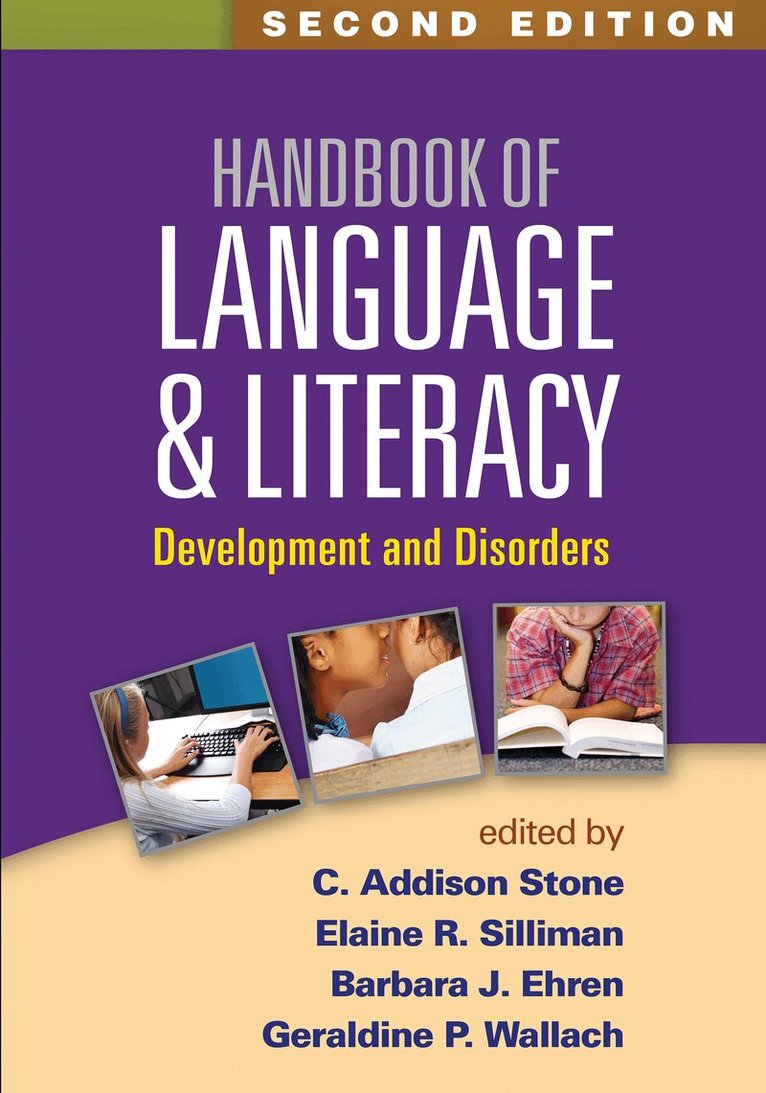
    Handbook of Language and Literacy, Second Edition

    Development and Disorders

    AvC. Addison Stone,Elaine R. Silliman

    Inbunden, Engelska, 2013

    1 358 kr

    Beställningsvara. Skickas inom 3-6 vardagar. Fri frakt över 249 kr.

    Beskrivning

    An acclaimed reference that fills a significant gap in the literature, this volume examines the linkages between spoken and written language development, both typical and atypical. Leading authorities address the impact of specific language-related processes on K-12 literacy learning, with attention to cognitive, neurobiological, sociocultural, and instructional issues. Approaches to achieving optimal learning outcomes with diverse students are reviewed. The volume presents research-based practices for assessing student needs and providing effective instruction in all aspects of literacy: word recognition, reading comprehension, writing, and spelling.New to This Edition*Chapters on digital literacy, disciplinary literacy, and integrative research designs.*Chapters on bilingualism, response to intervention, and English language learners. *Incorporates nearly a decade's worth of empirical and theoretical advances.*Numerous prior edition chapters have been completely rewritten.

    Produktinformation

    • Utgivningsdatum:2013-12-10
    • Mått:178 x 254 x 38 mm
    • Vikt:1 460 g
    • Format:Inbunden
    • Språk:Engelska
    • Antal sidor:715
    • Upplaga:2
    • Förlag:Guilford Publications
    • ISBN:9781462511853

    Utforska kategorier

    • Utbildningsstrategier och utbildningspolitik inom Psykologi och pedagogik
    • Språkvetenskap och lingvistik inom Språk och ordböcker
    • Specialundervisning inom Psykologi och pedagogik

    Mer om författaren

    C. Addison Stone, PhD, is Professor Emeritus in the School of Education at the University of Michigan. He served previously as Professor and Head of the Learning Disabilities Program in the Department of Communication Sciences and Disorders at Northwestern University. Dr. Stone's research interests center on the social contexts of typical and atypical language, cognitive, and social development, with a particular interest in children with learning disabilities and language disorders. Elaine R. Silliman, PhD, CCC-SLP, is Professor Emeritus of Communication Sciences and Disorders and Courtesy Professor of Psychology at the University of South Florida. She is a Fellow of the American Speech-Language-Hearing Association (ASHA) and the International Academy for Research in Learning Disabilities (IARLD). Dr. Silliman's research focuses on academic language proficiency in children and adolescents who are struggling with reading, writing, and spelling, including monolingual English-speaking children with social dialect variations and bilingual (Spanish-English) children. Barbara J. Ehren, EdD, CCC-SLP, is Professor and Chair of Communication Sciences and Disorders at the University of Central Florida, where she directs the doctoral program that focuses on language and literacy for learners who struggle. She is a Fellow of the ASHA and the IARLD, and is a Board Recognized Specialist in Child Language. Dr. Ehren's research focuses on adolescent literacy, with a special interest in schoolwide initiatives, including RTI. Geraldine P. Wallach, PhD, CCC-SLP, is Professor and the Clinic Director in the Department of Communicative Disorders at California State University, Long Beach. An ASHA Fellow, she has received Outstanding Achievement Awards from the Massachusetts and California Speech-Language-Hearing Associations. Dr. Wallach has published and presented widely on language learning disabilities.Â

    Recensioner i media

    "This second edition of the Handbook of Language and Literacy is a timely follow-up to the well-received first edition. The contributors provide a welcome balance of researchers and practitioners. The book integrates theoretical and practical issues in both spoken and written language and their relationships to literacy learning, including second-language learning. Covering both typical development and disorders in the same handbook makes this an ideal text for programs in general and special education; language sciences; and psychology. My graduate students lit up with enthusiasm when I shared this volume with them."--Virginia W. Berninger, PhD, Department of Educational Psychology, University of Washington "A rerun is rarely better than the first run, but the second edition of the Handbook of Language and Literacy surpasses a very good first showing by a country mile. I appreciate the comprehensive coverage provided by the contributing authors, especially their attention to new topics such as digital literacy, RTI, interdisciplinary literacy, and ELL instruction."--Steve Graham, EdD, Warner Professor, Mary Lou Fulton Teachers College, Arizona State University"The volume provides an exceptionally broad and thorough review of current research concerning the theoretical, methodological, and service delivery issues involved in treating individuals with language and literacy challenges. The impressive group of contributors represents the wide range of disciplines with interest in these individuals. The editors have produced a seminal reference that will be indispensable for professionals in the field."--Alan Kamhi, PhD, Department of Communication Sciences and Disorders, University of North Carolina at Greensboro"A state-of-the-art resource for educators who recognize the power and potential of an interdisciplinary approach to language development and literacy learning, this handbook has been a trusted source since its original publication. Cutting-edge topics in the second edition include digital literacy, disciplinary literacy, RTI, and second-language acquisition, all carefully contextualized for 21st-century educators and learners. This is an important text for graduate-level education courses and a 'must' for the preparation of reading specialists, reading teachers, and literacy coaches. Understanding the critical relationship between language and literacy is the only path to effective reading instruction and intervention."--Barbara A. Marinak, PhD, School of Education and Human Services, Mount St. Mary's University -This handbook provides an extensive resource in all aspects of typical and atypical literacy development....Practitioners, researchers, and students in the fields of language science and disorders, literacy, speech/n-/language pathology, special education, and educational psychology especially will benefit from the comprehensive examination of how language-related processes integrate with literacy instruction....Covers all aspects of literacy....It would be of great value to college and university departments and reference sections. (on the first edition)--Education Libraries, 12/1/2004ƒƒChallenges the literacy community to rethink the meaning of difference, particularly as it relates to students' language and literacy acquisition in U.S. public schools....Provides insights into the politics of difference [and] helps us to recast our vision of effective instruction for atypical language and literacy learners....The Handbook has important messages for literacy teacher educators. (on the first edition)--Reading Research Quarterly, 4/1/2006

    Innehållsförteckning

    • I. Theoretical and Methodological Issues in the Study of Language and Literacy Disorders1. Atypical Language and Literacy Development: Toward an Integrative Framework, C. Addison Stone and Julie E. Learned2. Genetics of Language and Literacy Impairments, Jeffrey W. Gilger3. Neurobiological Basis of Language and Reading: Typical and Impaired Processing, Maria Mody and Joanna A. Christodoulou4. Cognitive Processes Underlying Typical and Atypical Second-Language and Literacy Development, Kathleen F. Peets5. In the Service of Questions: From Mixed-Methods to Question-Based Integrative Designs in Social Research, Elizabeth Birr MojeII. The Political and Social Contexts of Language and Literacy Acquisition6. Policy and Practice Issues for Students at Risk in Language and Literacy Learning: Back to the Future, Elaine R. Silliman and Louise C. Wilkinson7. Reframing Literacy for a Screen-Based Age: A Case for Digital Mindsets, Claire Wyatt-Smith and Kay Kimber8. Becoming Bilingual and Biliterate: Sociolinguistic and Sociopolitical Considerations, Ofelia García9. The Case for Increasing Emphasis on Vocabulary Instruction in the Early Years, Susan B. Neuman and Tanya S. Wright10. Social and Affective Factors in Children with Language Impairment: Implications for Literacy Learning, Bonnie Brinton and Martin Fujiki11. Fostering Children’s Emergent Literacy Development: The Role of Family Practices, Christina Yeager Pelatti, Laura M. Justice, Jill M. Pentimonti, and Mary Beth Schmitt12. Language Variation and Literacy Learning: The Case of African American English, Julie A. Washington, Nicole Patton Terry, and Mark S. SeidenbergIII. Language Processes Underlying Atypical Literacy Learning: Complementary Perspectives 13. Phonological Processing Deficits and Literacy Learning: Current Evidence and Future Directions, Gary A. Troia14. Individual Differences in Word Learning and Reading Ability, Suzanne M. Adlof and Charles A. Perfetti15. Morphemes Matter: How Morphological Knowledge Contributes to Reading and Writing, Joanne F. Carlisle and Amanda P. Goodwin16. Syntactic Contributions to Literacy Learning, Cheryl M. Scott and Nicole M. Koonce17. The Linguistic Challenges of Learning across Academic Disciplines, Zhihui Fang, Mary J. Schleppegrell, and Jason Moore18. Perspective-Taking and Reading Comprehension of Narratives: Lessons Learned from The Bean, Mavis L. Donahue19. A Language Perspective on Executive Functioning, Metacognition, and Self-Regulation in Reading, Carol E. Westby20. Bilingual Children with Language Learning Disabilities: Convergence in Conceptual, Linguistic, and Cultural Circles of Knowledge, María Brea-SpahnIV. Addressing the Needs of Individuals with Language and Literacy ChallengesWord Recognition21. Developmental Variation in Reading Words, Linnea C. Ehri, Cláudia Cardoso-Martins, and Julia M. Carroll22. Word Recognition Assessment Frameworks, Froma P. Roth23. Teaching Students with Reading Disability to Read Words, Rollanda E. O’Connor and Sean J. DavidsonReading Comprehension24. Difficulties with Reading Comprehension, Nell K. Duke, Kelly B. Cartwright, and Katherine R. Hilden25. Assessment of Reading Comprehension, Janice M. Keenan26. The Spoken-Written Comprehension Connection: Constructive Intervention Strategies, Geraldine P. Wallach, Stephen Charlton, and Julie Christie BartholomewWriting Composition27. Developmental Variations in the Production of Written Text: Challenges for Students Who Struggle with Writing, Julie E. Dockrell28. Classroom-Based Writing Assessment, Nickola Wolf Nelson 29. Learning and Instruction in Writing, Gert Rijlaarsdam, Tanja Janssen, Martine Braaksma, Elke Van Steendam, Kris Van den Branden, Michel Couzijn, and Lieve VerheydenSpelling 30. Spelling Development and Disability in English, Derrick C. Bourassa, and Rebecca Treiman31. Spelling Assessment Frameworks, Julie J. Masterson and Kenn Apel32. Spelling: Instructional and Intervention Frameworks, Julie A. Wolter and Katie SquiresSpecial Considerations33. Adolescents Who Struggle and 21st-Century Literacy, Barbara J. Ehren, B. Keith Ben Hanania Lenz, and Donald D. Deshler34. Response to Intervention for Teaching and Learning in Language and Literacy, Karen K. Wixson, Marjorie Y. Lipson, and Sheila W. Valencia35. English Language Learners: Instructional Practices to Promote Literacy Development, Lucinda Soltero-González, Janette K. Klingner, and Edilberto Cano-Rodríquez