• Fri frakt över 249 kr
  • •
  • Snabba leveranser
  • •
  • Billiga böcker
Kundservice

Du är på sajten för privatpersoner.

Företag, bibliotek eller offentlig verksamhet?

Du handlar på classic.bokus.com, där alla dina funktioner finns intakta.
Till classic.bokus.com
Bokus logotyp. Gå till startsidan.
  • Erbjudanden
  • Nyheter
  • Student
  • Topplistor
  • Barn & ungdom
  • Bokus Play
  • E-böcker
  • Pocketböcker
  • Spel & pussel

10% rabatt på allt med kod: NYSTART10 →

Sidfot

Mina sidor

    Hjälp

    • Kundservice
    • Vanliga frågor och svar
    • Frakt och leverans
    • Retur vid ångerrätt
    • Reklamera vara
    • Betalning
    • Köpvillkor
    • Allmänna villkor
    • Information om webbplatsens tillgänglighet

    Om Bokus

    • Om oss
    • Pressrum
    • För studenter
    • För företag
    • För bibliotek och offentlig verksamhet
    • För leverantörer
    • Hållbarhet

    Populärt

    • Aktuella erbjudanden
    • Presentkort
    • Studentlitteratur
    • Nya böcker
    • Topplistor
    • Signerade böcker
    • Engelska böcker

    Inspiration

    • Boktips
    • BookTok
    • Populära bokserier
    • Barnbokskaraktärer
    • Populära författare
    Logotyp för Bokus
    Följ oss på Facebook (extern länk)Följ oss på Instagram (extern länk)Följ oss på YouTube (extern länk)Följ oss på TikTok (extern länk)
    bokus @ CookiesAnpassa cookiesIntegritetspolicyKöpvillkor
    Till Citymail hemsida (extern länk)Till Budbee hemsida (extern länk)Till Postnord hemsida (extern länk)Till Schenker hemsida (extern länk)Till Early Bird hemsida (extern länk)Till Walleys hemsida (extern länk)
    1. Psykologi och pedagogik
    2. Pedagogik
    3. Pedagogisk psykologi

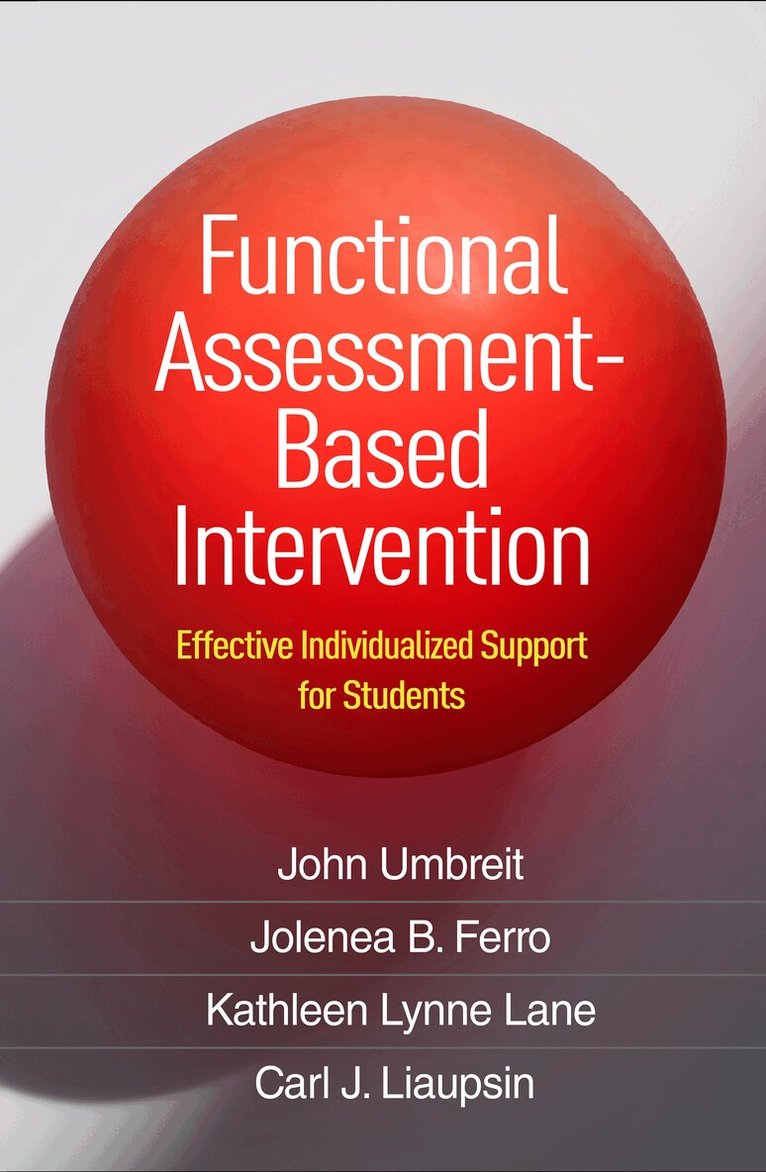
    Functional Assessment-Based Intervention

    Effective Individualized Support for Students

    AvJohn Umbreit,Jolenea B. Ferro

    Häftad, Engelska, 2024

    715 kr

    Beställningsvara. Skickas inom 10-15 vardagar. Fri frakt över 249 kr.

    Fler format och utgåvor

    Inbunden

    897 kr

    Beskrivning

    From noted authorities, this book presents a comprehensive approach to designing and implementing evidence-based Tier 3 behavior interventions for K-12 students. The authors' functional assessment-based intervention (FABI) process has been supported by multiple peer-reviewed studies conducted in authentic educational environments. Step by step, chapters spell out proven methods to define target behaviors, determine the function of the undesirable behavior, identify appropriate replacement behaviors, and deliver and monitor intensive interventions. Illustrated with real-world case examples, the book shows how to embed FABI within a school's integrated tiered system of supports. Guidance for scaling FABI district- and statewide is also provided. Ethical issues, professional standards, equity concerns, and cultural and linguistic considerations are addressed throughout. In a convenient large-size format, the book includes reproducible checklists and forms that can also be downloaded for ease of use.

    Produktinformation

    • Utgivningsdatum:2024-04-15
    • Mått:267 x 204 x 20 mm
    • Vikt:700 g
    • Format:Häftad
    • Språk:Engelska
    • Antal sidor:324
    • Förlag:Guilford Publications
    • ISBN:9781462553815

    Utforska kategorier

    • Pedagogisk psykologi inom Psykologi och pedagogik
    • Psykoterapi som behandlingsmetod inom Medicin
    • Specialundervisning inom Psykologi och pedagogik

    Mer om författaren

    John Umbreit, PhD, is Professor Emeritus of Special Education at the University of Arizona, where he previously served as Professor of Special Education in the College of Education and as Professor of Family and Community Medicine in the College of Medicine. Dr. Umbreit specializes in the areas of behavioral analysis and positive behavioral supports. His research focuses on functional assessment-based intervention and positive behavioral interventions and supports in natural environments such as schools, homes, and the workplace. He has been a visiting professor in special education at the University of Washington, an editorial board member or manuscript reviewer for 17 professional journals, a frequent reviewer of grant proposals for the U.S. Department of Education, and Principal Investigator for 18 research and personnel preparation grants.Jolenea B. Ferro, PhD, BCBA-D, is Research Associate Professor in the Department of Child and Family Studies at the University of South Florida and Training Director for the Florida Center for Inclusive Communities, the University's Center for Excellence in Developmental Disabilities. Dr. Ferro has developed interventions and supports for learners with severe behavior problems and has extensive experience in inservice and preservice education. Her research focuses on functional assessment and implementation of positive behavioral interventions and supports (PBIS) in natural settings. Dr. Ferro is the author of many journal articles and chapters related to functional behavioral assessment, treatment integrity, and PBIS leadership training.Kathleen Lynne Lane, PhD, BCBA-D, is a Roy A. Roberts Distinguished Professor in the Department of Special Education and Associate Vice Chancellor for Research at the University of Kansas. Dr. Lane’s research interests focus on designing, implementing, and evaluating comprehensive, integrated, three-tiered (Ci3T) models of prevention to prevent the development of learning and behavior challenges and to respond to existing instances, with an emphasis on systematic screening. She is coeditor of Remedial and Special Education and has published 14 books, more than 230 refereed journal articles, and 55 book chapters.Carl J. Liaupsin, EdD, is Professor and Department Head of the Department of Disability and Psychoeducational Studies at the University of Arizona. Dr. Liaupsin has workedas a teacher of students with emotional and behavioral disorders, as a full-time behavior specialist for a midwestern school district, and as a research associate for the National Center on Positive Behavioral Interventions and Supports and the National Center on Education, Disability, and Juvenile Justice. His research interests include the validation of function-based behavior intervention methods, development and evaluation of effective training in intervention practices, and use of technology-based tools to support teachers who work with students who exhibit challenging behavior. He is the author or coauthor of numerous peer-reviewed publications and media-based professional development products, and has served as the coordinator and editor for leading journals in his field.

    Recensioner i media

    "Many schools and districts have a solid foundation for implementing tiered systems of support, but are seeking a standardized process for Tier 3--specifically, a process for developing FABI plans. Look no further! This book provides valuable resources, insights, and practical steps forward. Jump in and check out the research-validated tools and step-by-step process to support children with intensive intervention needs."--Lisa J. Powers, PhD, Department of Special Education, University of Missouri–Columbia"This indispensable resource is theoretically and empirically grounded as well as highly practical and accessible for preservice and inservice educators and behavior analysts. The authors provide an effective, step-by-step approach to facilitate high-fidelity interventions that promote positive and prosocial behavioral outcomes. The authors explain complex behavior analytic principles and illustrate them with authentic school-based examples. The book is unique in situating FABI within a comprehensive, integrated, three-tiered model of prevention, as part of a full continuum of supports."--Wendy Peia Oakes, PhD, Mary Lou Fulton Teachers College, Arizona State University"Umbreit and colleagues provide a comprehensive, accessible overview of their five-step FABI model. The book includes a wealth of practical tools and implementation guidance. This is an integral resource for anyone providing intensive intervention for students engaging in challenging behaviors."--Eric Alan Common, PhD, BCBA-D, Department of Education, University of Michigan–Flint"This book crafts a roadmap for implementers and includes helpful examples, descriptions, tools, and checklists. The authors emphasize equitable, culturally responsive, and strengths-based approaches that center the student and family and value the community. Unpacking the components of FABI, this is an essential resource for anyone responsible for supporting students with intensive needs across general and special education settings. This excellent book will enhance the training and technical assistance we provide to schools, districts, regional educational service centers, and state education agency staff. It is a preeminent resource to support and extend the learning of practitioners at any level."--Kelcey Schmitz, MSEd, Director of Training and Technical Assistance, School Mental Health Assessment, Research, and Training (SMART) Center, University of Washington-

    Innehållsförteckning

    • I. Introduction and Overview1. An Introduction to Functional Assessment-Based Interventions2. Primer on Behavior AnalysisII. Step 1--Identifying Students Who May Need a Functional Assessment-Based Intervention3. Working in Tiered Systems of Support: A Focus on Tier 3 considerations4. Identifying Students Who May Benefit from a FABIIII. Step 2--Conducting the Functional Assessment5. Getting Started: Understanding the Context6. Functional Assessment Interviews: Identifying the Problem and Establishing the Target Behaviors7. Functional Assessment: Direct Observation8. Determining the Function of the Behavior: The Function MatrixIV. Step 3--Collecting Baseline Data9. Identifying the Dimension of Interest and Selecting an Appropriate Measurement System10. Getting Started: Collecting Baseline DataV. Step 4--Designing the Functional Assessment-Based Intervention11. Designing and Testing the Intervention12. Intervention Method 1: Teach the Replacement Behavior13. Intervention Method 2: Adjust the Environment14. Intervention Method 3: Shift the Contingencies15. Intervention Methods 1 and 2: Teach the Replacement Behavior and Adjust the Environment16. Treatment Integrity17. Social Validity18. Generalization and Maintenance19. Designing Your InterventionVI. Step 5--Testing the Intervention20. Determining Intervention Outcomes21. Wrapping It Up: Ending with a Defensible FABIVII. Getting Started in Your Own Context22. Implementation Considerations23. A Step-by-Step Training Model: One Approach to Building CapacityAppendix. Published Research on the FABI ModelFABI Completion Checklists- Completion Checklist. Step 1: Identifying Students Who Need a FABI- Completion Checklist. Step 2: Conducting the Functional Assessment- Completion Checklist. Step 3: Collecting Baseline Data- Completion Checklist. Step 4: Designing the Intervention- Completion Checklist. Step 5: Testing the InterventionReferencesIndex