• Fri frakt över 249 kr
  • •
  • Snabba leveranser
  • •
  • Billiga böcker
Kundservice

Du är på sajten för privatpersoner.

Företag, bibliotek eller offentlig verksamhet?

Du handlar på classic.bokus.com, där alla dina funktioner finns intakta.
Till classic.bokus.com
Bokus logotyp. Gå till startsidan.
  • Erbjudanden
  • Nyheter
  • Student
  • Topplistor
  • Barn & ungdom
  • Bokus Play
  • E-böcker
  • Pocketböcker
  • Spel & pussel

10% rabatt på allt med kod: NYSTART10 →

Sidfot

Mina sidor

    Hjälp

    • Kundservice
    • Vanliga frågor och svar
    • Frakt och leverans
    • Retur vid ångerrätt
    • Reklamera vara
    • Betalning
    • Köpvillkor
    • Allmänna villkor
    • Information om webbplatsens tillgänglighet

    Om Bokus

    • Om oss
    • Pressrum
    • För studenter
    • För företag
    • För bibliotek och offentlig verksamhet
    • För leverantörer
    • Hållbarhet

    Populärt

    • Aktuella erbjudanden
    • Presentkort
    • Studentlitteratur
    • Nya böcker
    • Topplistor
    • Signerade böcker
    • Engelska böcker

    Inspiration

    • Boktips
    • BookTok
    • Populära bokserier
    • Barnbokskaraktärer
    • Populära författare
    Logotyp för Bokus
    Följ oss på Facebook (extern länk)Följ oss på Instagram (extern länk)Följ oss på YouTube (extern länk)Följ oss på TikTok (extern länk)
    bokus @ CookiesAnpassa cookiesIntegritetspolicyKöpvillkor
    Till Citymail hemsida (extern länk)Till Budbee hemsida (extern länk)Till Postnord hemsida (extern länk)Till Schenker hemsida (extern länk)Till Early Bird hemsida (extern länk)Till Walleys hemsida (extern länk)
    1. Naturvetenskap och teknik
    2. Matematik och naturvetenskap
    3. Matematik
    4. Tillämpad matematik

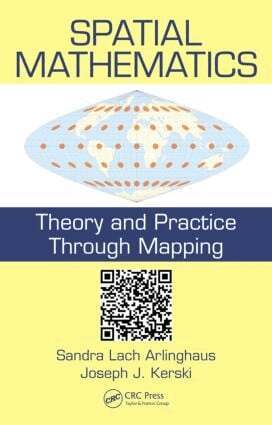
    Spatial Mathematics

    Theory and Practice through Mapping

    AvSandra Lach Arlinghaus,Joseph J. Kerski

    Inbunden, Engelska, 2013

    2 056 kr

    Beställningsvara. Skickas inom 10-15 vardagar. Fri frakt över 249 kr.

    Fler format och utgåvor

    Häftad

    835 kr

    Beskrivning

    In terms of statistics, GIS offers many connections. With GIS, data are gathered, displayed, summarized, examined, and interpreted to discover patterns. Spatial Mathematics: Theory and Practice through Mapping uses GIS as a platform to teach mathematical concepts and skills through visualization of numbers. It examines theory and practice from disparate academic disciplines such as geography, mathematics, physics, and general social science. This approach allows students to grapple with biodiversity, crime, natural hazards, climate, energy, water, and other relevant real-world issues of the twenty-first century.Includes QR Codes Linked to Animated Maps, a Mapping Activity Site, or to an Interactive Webpage, Creating an Interactive Resource That Stays RelevantThe book integrates competing philosophical views of the world: synthesis and analysis. These two approaches yield different results and employ different tools. This book considers both approaches to looking at real-world issues that have mathematics as a critical, but often unseen, component. This approach shows readers how to use mathematics to consider the broad problem at hand and to explore diverse realms in the worlds of geography and mathematics and in their interface. A truly interdisciplinary text, the book bridges the worlds of mathematics and geography and demonstrates how they are inextricably linked. It takes advantage of the convergence in citizen science, STEM education, and mapping that help readers become critical consumers of data—understanding its content, quality, limitations, and benefits. It provides thorough grounding in the analytical, statistical, and computational skills required for working in any field that uses geospatial technologies—not just surveyors and remote sensing analysts.

    Produktinformation

    • Utgivningsdatum:2013-06-26
    • Mått:156 x 234 x 17 mm
    • Vikt:720 g
    • Format:Inbunden
    • Språk:Engelska
    • Antal sidor:300
    • Förlag:Taylor & Francis Inc
    • ISBN:9781466505322

    Utforska kategorier

    • Tillämpad matematik inom Naturvetenskap och teknik
    • Geografi inom Naturvetenskap och teknik

    Mer om författaren

    Sandra Lach Arlinghaus is an American educator who is Adjunct Professor in the School of Natural Resources and Environment at the University of Michigan.

    Recensioner i media

    "…this book does not contain any equations or math, as one would expect from the title… As such, this book will be of use to those who want to start out with an effort to learn GIS, without having to struggle through the actual mathematics behind it all."—Harold Schuch, GeoCounsel, Inc., Littleton, Colorado, USA"this colourful book should be useful for complementing technical geography lectures using Google Earth and Esri’s software explorations in view of attracting high-school and general science students to spatial geography and computer mapping."—Rod Blais, GEOMATICA, Vol. 67, No. 4, 2013 "In this important work, Drs. Arlinghaus and Kerski fill an important need in the geospatial literature with their accessible introduction to spatial mathematics. … this book frames concepts in a way that is accessible to new learners who may not have an advanced math background. This accessibility should not be confused with simplicity, however. In successive chapters, the authors build an intellectually challenging description of the math underlying geospatial analysis. Throughout, easy-to-follow activities help make the concepts clear and relevant. If we are to build a generation of spatial thinkers (and not just people trained in GIS and GPS), we need foundational understanding like this book supports. Highly recommended!"—Bob Coulter, Missouri Botanical Garden"Two ancient texts had a profound and lasting impact on the literate world. … Now, in this book, additional insight for the mathematical solution of geographical tasks is provided. The pedagogical orientation is especially worthy of comment."—Waldo Tobler, Professor Emeritus of Geography, University of California at Santa Barbara"If a picture is worth a thousand words, then a map is worth exponentially more. Underneath the colors of a modern electronic map is an enormous amount of math and science, from how to represent a three dimensional globe on a two

    Innehållsförteckning

    • Geometry of the Sphere. Location, Trigonometry, and Measurement of the Sphere. Transformations: Analysis and Raster/Vector Formats. Replication of Results: Color and Number. Scale. Partitioning of Data: Classification and Analysis. Visualizing Hierarchies. Distribution of Data: Selected ConceptsMap Projections. Integrating Past, Present, and Future Approaches. Glossary. References, Further Reading, and Related Materials.