• Fri frakt över 249 kr
  • •
  • Snabba leveranser
  • •
  • Billiga böcker
Kundservice

Du är på sajten för privatpersoner.

Företag, bibliotek eller offentlig verksamhet?

Du handlar på classic.bokus.com, där alla dina funktioner finns intakta.
Till classic.bokus.com
Bokus logotyp. Gå till startsidan.
  • Erbjudanden
  • Nyheter
  • Student
  • Topplistor
  • Barn & ungdom
  • Bokus Play
  • E-böcker
  • Pocketböcker
  • Spel & pussel

10% rabatt på allt med kod: NYSTART10 →

Sidfot

Mina sidor

    Hjälp

    • Kundservice
    • Vanliga frågor och svar
    • Frakt och leverans
    • Retur vid ångerrätt
    • Reklamera vara
    • Betalning
    • Köpvillkor
    • Allmänna villkor
    • Information om webbplatsens tillgänglighet

    Om Bokus

    • Om oss
    • Pressrum
    • För studenter
    • För företag
    • För bibliotek och offentlig verksamhet
    • För leverantörer
    • Hållbarhet

    Populärt

    • Aktuella erbjudanden
    • Presentkort
    • Studentlitteratur
    • Nya böcker
    • Topplistor
    • Signerade böcker
    • Engelska böcker

    Inspiration

    • Boktips
    • BookTok
    • Populära bokserier
    • Barnbokskaraktärer
    • Populära författare
    Logotyp för Bokus
    Följ oss på Facebook (extern länk)Följ oss på Instagram (extern länk)Följ oss på YouTube (extern länk)Följ oss på TikTok (extern länk)
    bokus @ CookiesAnpassa cookiesIntegritetspolicyKöpvillkor
    Till Citymail hemsida (extern länk)Till Budbee hemsida (extern länk)Till Postnord hemsida (extern länk)Till Schenker hemsida (extern länk)Till Early Bird hemsida (extern länk)Till Walleys hemsida (extern länk)
    1. Naturvetenskap och teknik
    2. Matematik och naturvetenskap
    3. Matematik
    4. Talteori

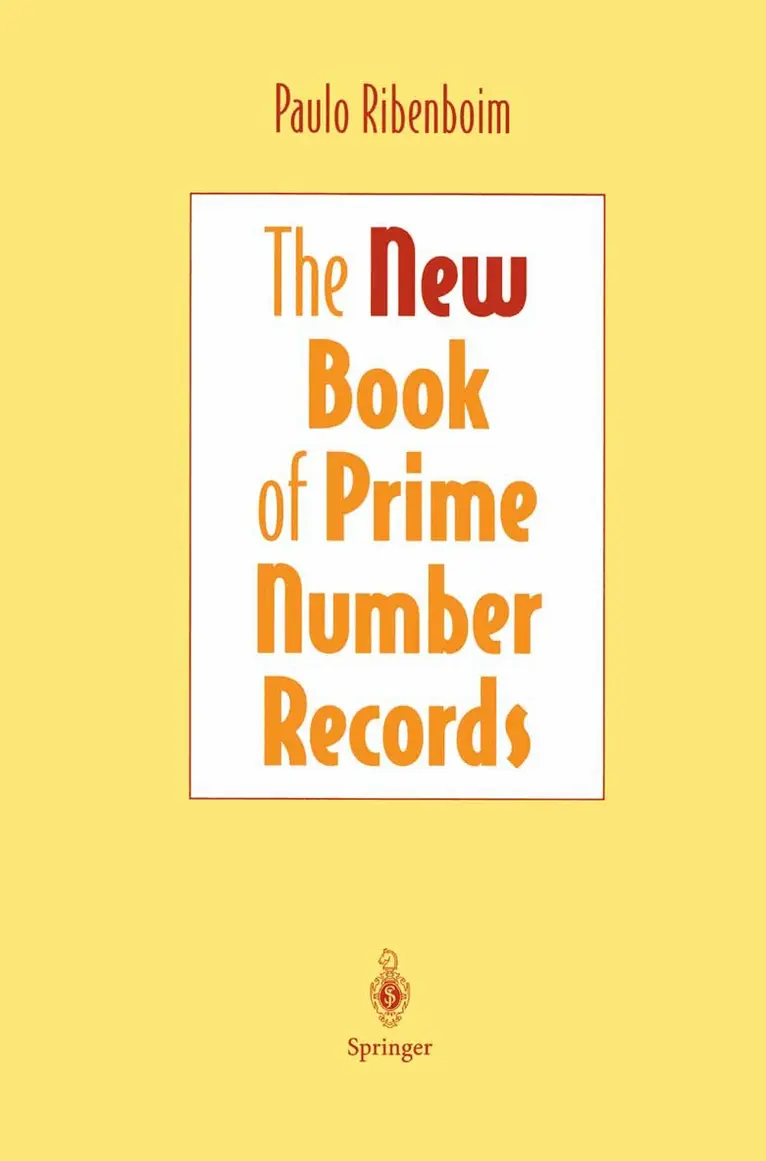
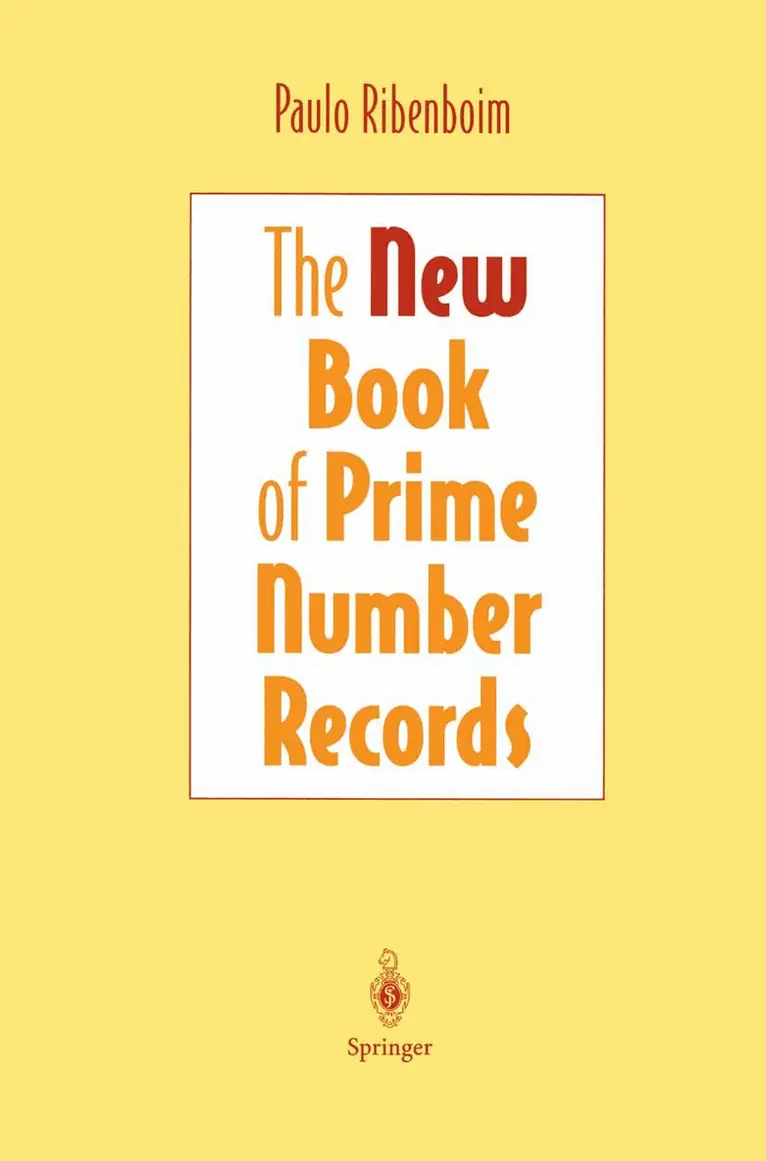
    Book of Prime Number Records

    AvPaulo Ribenboim

    Häftad, Engelska, 2012

    1 466 kr

    Beställningsvara. Skickas inom 5-8 vardagar. Fri frakt över 249 kr.

    Fler format och utgåvor

    E-bok

    1 456 kr

    E-bok

    1 136 kr

    Beskrivning

    This text originated as a lecture delivered November 20, 1984, at Queen's University, in the undergraduate colloquim series established to honor Professors A. J. Coleman and H. W. Ellis and to acknow­ ledge their long lasting interest in the quality of teaching under­ graduate students. In another colloquim lecture, my colleague Morris Orzech, who had consulted the latest edition of the Guilllless Book oj Records, remainded me very gently that the most "innumerate" people of the world are of a certain tribe in Mato Grosso, Brazil. They do not even have a word to express the number "two" or the concept of plurality. "Yes Morris, I'm from Brazil, but my book will contain numbers different from 'one.' " He added that the most boring 800-page book is by two Japanese mathematicians (whom I'll not name), and consists of about 16 million digits of the number 11. "I assure you Morris, that in spite of the beauty of the apparent randomness of the decimal digits of 11, I'll be sure that my text will include also some words." Acknowledgment. The manuscript of this book was prepared on the word processor by Linda Nuttall. I wish to express my appreciation for the great care, speed, and competence of her work.

    Produktinformation

    • Utgivningsdatum:2012-02-05
    • Mått:155 x 235 x 28 mm
    • Vikt:756 g
    • Format:Häftad
    • Språk:Engelska
    • Antal sidor:479
    • Upplaga:2
    • Förlag:Springer-Verlag New York Inc.
    • ISBN:9781468405095

    Utforska kategorier

    • Talteori inom Naturvetenskap och teknik

    Recensioner i media

    Third Edition P. Ribenboim The New Book of Prime Number Records "A number-theoretical version of the Guinness Book of Records ... There is much mathematics to be found in these pages. These are records given here as well. This book is written with much wit. Experts may not find much that is new, but it is always worthwhile to view the history of a subject as a whole rather than a collection of isolated results."-MATHEMATICAL REVIEWS

    Innehållsförteckning

    • 1. How Many Prime Numbers Are There?.- I. Euclid’s Proof.- II. Kummer’s Proof.- III. Polya’s Proof.- IV. Euler’s Proof.- V. Thue’s Proof.- VI. Two-and-a-Half Forgotten Proofs.- VII. Washington’s Proof.- VIII. Fiirstenberg’s Proof.- 2. How to Recognize Whether a Natural Number Is a Prime?.- I. The Sieve of Eratosthenes.- II. Some Fundamental Theorems on Congruences.- III. Classical Primality Tests Based on Congruences.- IV. Lucas Sequences.- V. Classical Primality Tests Based on Lucas Sequences.- VI. Fermat Numbers.- VII. Mersenne Numbers.- VIII. Pseudoprimes.- Addendum on the Congruence an?k ? bn?k (mod n).- IX. Carmichael Numbers.- X. Lucas Pseudoprimes.- XI. Last Section on Primality Testing and Factorization!.- 3. Are There Functions Defining Prime Numbers?.- I. Functions Satisfying Condition (a).- II. Functions Satisfying Condition (b).- III. Functions Satisfying Condition (c).- 4. How Are the Prime Numbers Distributed?.- I. The Growth of ?(x).- II. The nth Prime and Gaps.- III. Twin Primes.- IV. Primes in Arithmetic Progression.- V. Primes in Special Sequences.- VI. Goldbach’s Famous Conjecture.- VII. The Waring-Goldbach Problem.- VIII. The Distribution of Pseudoprimes and of Carmichael Numbers.- 5. Which Special Kinds of Primes Have Been Considered?.- I. Regular Primes.- II. Sophie Germain Primes.- III. Wieferich Primes.- IV. Wilson Primes.- V. Repunits and Similar Numbers.- VI. Primes with Given Initial and Final Digits.- VII. Numbers k × 2n ± 1.- VIII. Primes and Second-Order Linear Recurrence Sequences.- IX. The NSW-Primes.- 6. Heuristic and Probabilistic Results About Prime Numbers.- I. Prime Values of Linear Polynomials.- II. Prime Values of Polynomials of Arbitrary Degree.- III. Some Probabilistic Estimates.- IV. The Density of theSet of Regular Primes.- Conclusion.- Dear Reader.- Citations for Some Possible Prizes for Work on the Prime Number Theorem.- A. General References.- B. Specific References.- 1.- 2.- 3.- 4.- 5.- 6.- Conclusion.- Primes up to 10,000.- Index of Names.- Gallimaufries.- Addenda to the Second Edition.