• Fri frakt över 249 kr
  • •
  • Snabba leveranser
  • •
  • Billiga böcker
Kundservice

Du är på sajten för privatpersoner.

Företag, bibliotek eller offentlig verksamhet?

Du handlar på classic.bokus.com, där alla dina funktioner finns intakta.
Till classic.bokus.com
Bokus logotyp. Gå till startsidan.
  • Erbjudanden
  • Nyheter
  • Student
  • Topplistor
  • Barn & ungdom
  • Bokus Play
  • E-böcker
  • Pocketböcker
  • Spel & pussel

10% rabatt på allt med kod: NYSTART10 →

Sidfot

Mina sidor

    Hjälp

    • Kundservice
    • Vanliga frågor och svar
    • Frakt och leverans
    • Retur vid ångerrätt
    • Reklamera vara
    • Betalning
    • Köpvillkor
    • Allmänna villkor
    • Information om webbplatsens tillgänglighet

    Om Bokus

    • Om oss
    • Pressrum
    • För studenter
    • För företag
    • För bibliotek och offentlig verksamhet
    • För leverantörer
    • Hållbarhet

    Populärt

    • Aktuella erbjudanden
    • Presentkort
    • Studentlitteratur
    • Nya böcker
    • Topplistor
    • Signerade böcker
    • Engelska böcker

    Inspiration

    • Boktips
    • BookTok
    • Populära bokserier
    • Barnbokskaraktärer
    • Populära författare
    Logotyp för Bokus
    Följ oss på Facebook (extern länk)Följ oss på Instagram (extern länk)Följ oss på YouTube (extern länk)Följ oss på TikTok (extern länk)
    bokus @ CookiesAnpassa cookiesIntegritetspolicyKöpvillkor
    Till Citymail hemsida (extern länk)Till Budbee hemsida (extern länk)Till Postnord hemsida (extern länk)Till Schenker hemsida (extern länk)Till Early Bird hemsida (extern länk)Till Walleys hemsida (extern länk)
    1. Samhälle och politik
    2. Sociologi och antropologi
    3. Antropologi

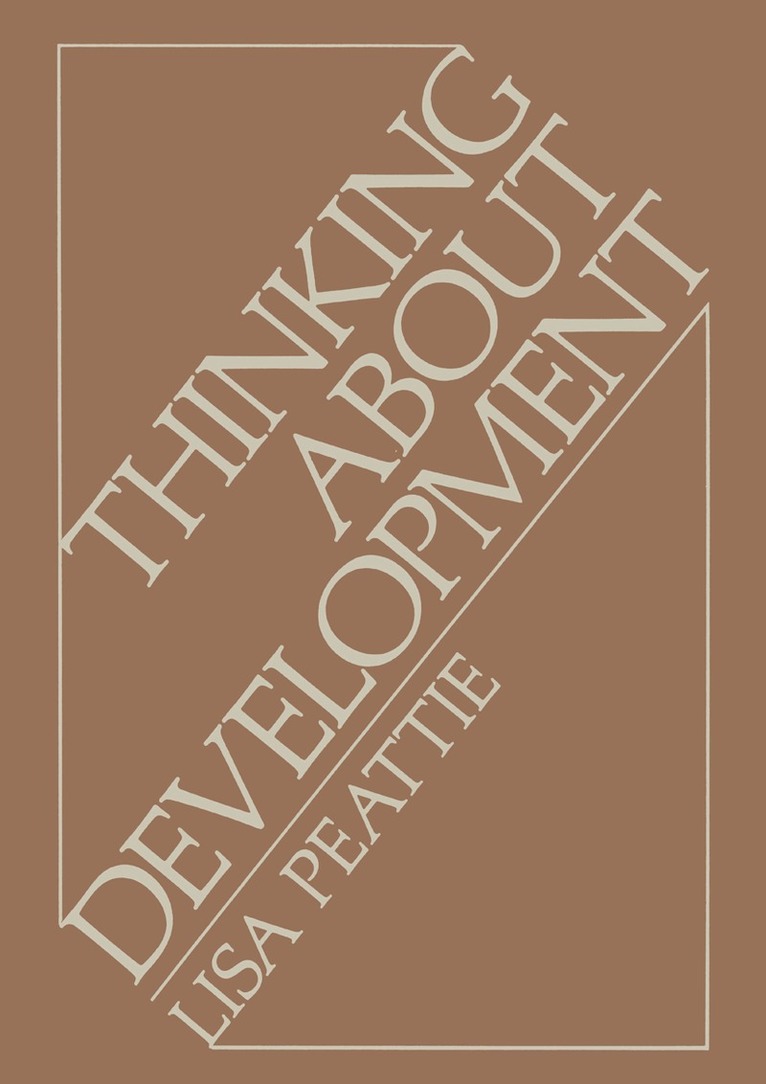
    Thinking About Development

    AvLisa Peattie

    Häftad, Engelska, 2012

    Del i serien Environment, Development and Public Policy: Cities and Development

    547 kr

    Beställningsvara. Skickas inom 10-15 vardagar. Fri frakt över 249 kr.

    Fler format och utgåvor

    E-bok

    710 kr

    Beskrivning

    This book intends to be helpful to people-students and oth­ ers-who are beginning to think about how to change the world via that activity we call development planning. The issues of What is Progress? and How do we get it? are world-wide, although they appear in different form in societies like our own from the way they do in the Third World countries with their explicit development planning. These are two very big questions and have no easy or final answers. However, we can think about them in more rather than less effective ways. Thinking about them can be both a way of beginning to take action on issues of growth and change, and a way of understanding our own situation. vii viii I PREFACE This book argues that thinking about development plan­ ning has gotten into trouble by dividing economy from so­ ciety, and misconstruing moral-social-political issues as tech­ nical ones. Development planning has centered on economic planning, treating social issues as obstacles to growth, or as problems arising out of economic change. The book takes up a number of specific topics which enter into development planning-topics such as the organization of work, educa­ tional planning, family policy-to show how in reality the social and the economic, the moral and the technical, are one, and how thinking about policy in each area should therefore take an integrated perspective.

    Produktinformation

    • Utgivningsdatum:2012-03-02
    • Mått:148 x 210 x 12 mm
    • Vikt:281 g
    • Format:Häftad
    • Språk:Engelska
    • Serie:Environment, Development and Public Policy: Cities and Development
    • Antal sidor:198
    • Förlag:Springer-Verlag New York Inc.
    • ISBN:9781468411034

    Utforska kategorier

    • Antropologi inom Samhälle och politik
    • Sociologi inom Samhälle och politik

    Innehållsförteckning

    • 1/ The Moral Order and the Technical Order.- 2/ Anthropological Perspectives: The Human Species and the Production of Culture.- 3/ Development Economics as a Social Study.- 4/ Social Planning: The Attempt to Enter the Moral Order via the Technical Order.- 5/ Moral Incentives in Cuba: The Politicizing of Work.- 6/ Family in Development.- 7/ Education, Learning, Development, and Related Issues.- 8/ Development Planning and the Quality of Life.