• Fri frakt över 249 kr
  • •
  • Snabba leveranser
  • •
  • Billiga böcker
Kundservice

Du är på sajten för privatpersoner.

Företag, bibliotek eller offentlig verksamhet?

Du handlar på classic.bokus.com, där alla dina funktioner finns intakta.
Till classic.bokus.com
Bokus logotyp. Gå till startsidan.
  • Erbjudanden
  • Nyheter
  • Student
  • Topplistor
  • Barn & ungdom
  • Bokus Play
  • E-böcker
  • Pocketböcker
  • Spel & pussel

10% rabatt på allt med kod NYSTART10 →

Sidfot

Mina sidor

    Hjälp

    • Kundservice
    • Vanliga frågor och svar
    • Frakt och leverans
    • Retur vid ångerrätt
    • Reklamera vara
    • Betalning
    • Köpvillkor
    • Allmänna villkor
    • Information om webbplatsens tillgänglighet

    Om Bokus

    • Om oss
    • Pressrum
    • För studenter
    • För företag
    • För bibliotek och offentlig verksamhet
    • För leverantörer
    • Hållbarhet

    Populärt

    • Aktuella erbjudanden
    • Presentkort
    • Studentlitteratur
    • Nya böcker
    • Topplistor
    • Signerade böcker
    • Engelska böcker

    Inspiration

    • Boktips
    • BookTok
    • Populära bokserier
    • Barnbokskaraktärer
    • Populära författare
    Logotyp för Bokus
    Följ oss på Facebook (extern länk)Följ oss på Instagram (extern länk)Följ oss på YouTube (extern länk)Följ oss på TikTok (extern länk)
    bokus @ CookiesAnpassa cookiesIntegritetspolicyKöpvillkor
    Till Citymail hemsida (extern länk)Till Budbee hemsida (extern länk)Till Postnord hemsida (extern länk)Till Schenker hemsida (extern länk)Till Early Bird hemsida (extern länk)Till Walleys hemsida (extern länk)
    1. Naturvetenskap och teknik
    2. Matematik och naturvetenskap
    3. Biologi
    4. Biokemi

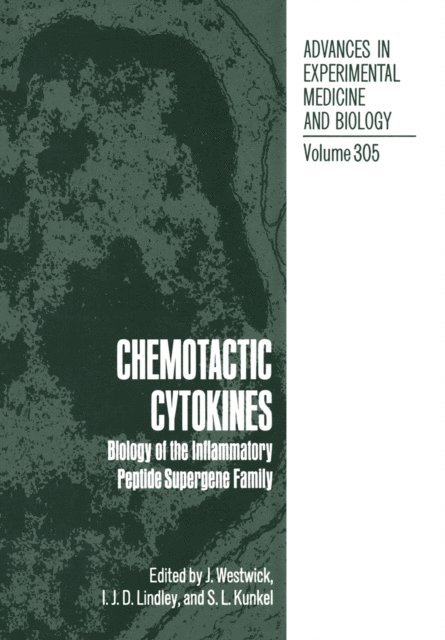
    Chemotactic Cytokines

    Biology of the Inflammatory Peptide Supergene Family

    AvJ. Westwick,I.J.D. Lindley

    Häftad, Engelska, 2012

    Del i serien Advances in Experimental Medicine and Biology

    562 kr

    Beställningsvara. Skickas inom 10-15 vardagar. Fri frakt över 249 kr.

    Beskrivning

    The existence of a new family of chemotactic cytokines was realised in 1987 following the isolation and structural determination by several groups of a peptide consisting of 72 amino acids which was a potent activator of neutrophils and a chemotactic agent for lymphocytes. The first symposium of this series was held at the Royal College of Surgeons of England in December 1988, entitled Novel Neutrophil Stimulating Peptides, and brought together the majority of the laboratories which had published in this area, see Immunology Today 10: 146-147(1989). Since the first symposium there has been a dramatic increase in our knowledge of the biology of this family of structurally related peptides. The Second International Symposium on Chemotactic Cytokines was held at the Royal College of Surgeons of England in June 1990. The aim of this symposium was to provide both a forum for discussion and to determine whether this knowledge can be utilised in the design of novel therapeutic strategies for the treatment of inflammatory disorders. Although the majority of studies have been concerned with the regulation of these peptides at the molecular and cellular level, there is now evidence to suggest that specific members of this superfamily have a role in the pathogenesis of a number of diverse diseases including arthritis, psoriasis, atherosclerosis, wound repair, inflammatory lung diseases and glomerulonephritis.

    Produktinformation

    • Utgivningsdatum:2012-04-06
    • Mått:178 x 254 x 12 mm
    • Vikt:395 g
    • Format:Häftad
    • Språk:Engelska
    • Serie:Advances in Experimental Medicine and Biology
    • Antal sidor:180
    • Förlag:Springer-Verlag New York Inc.
    • ISBN:9781468460117

    Utforska kategorier

    • Biokemi inom Naturvetenskap och teknik
    • Onkologi inom Medicin
    • Farmakologi inom Medicin

    Innehållsförteckning

    • Granulocyte and Monocyte Chemotactic Factors: Stimuli and Producer Cells.- Activation of Human Neutrophils by NAP-1 and Other Chemotactic Agonists.- Induction and Regulation of Interleukin-8 Gene Expression.- Regulation of Human Interleukin-8 Gene Expression and Binding of Several Other Members of the Intercrine Family to Receptors for Interleukin-8.- Formation and Biological Properties of Neutrophil Activating Peptide 2 (NAP-2).- Human Monocyte Chemoattractant Protein-1 (MCP-1).- Biological Aspects of Monocyte Chemoattractant Protein-1 (MCP-1).- Stimulus Specific Induction of Monocyte Chemotactic Protein-1 (MCP-1) Gene Expression.- GRO: A Novel Chemotactic Cytokine.- PDGF and the Small Inducible Gene (SIG) Family: Roles in the Inflammatory Response.- Human Neutrophil Granule Cationic Protein CAP37 is a Specific Macrophage Chemotaxin that Shares Homology with Inflammatory Proteinases.- Biochemical and Biological Characterization of NAP-1/IL-8-related Cytokines in Lesional Psoriatic Scale.- Chemotactic Cytokines in Inflammatory Skin Disease.- Interleukin-8 — A Mediator of Inflammatory Lung Disease?.- Some Aspects of NAP-1 Pathophysiology: Lung Damage Caused by a Blood-borne Cytokine.- Human Mesangial Cell-derived Interleukin 8 and Interleukin 6: Modulation by an Interleukin 1 Receptor Antagonist.- NAP-1/IL-8 in Rheumatoid Arthritis.- Abstracts.- Cloning of CAP37, a Monocyte-specific Chemotactic Factor Released from Azurophilic Granules of PMN Leukocytes.- Three Human Homologs of Murine Macrophage Inflammatory Protein-1 (MIP-1).- Synthesis of LD78 Protein and its Binding to Myelomonocytic Leukemia Cell Lines.- Cloning and Characterization of cDNAs for Murine MIP-2 and Human MIP-2 Homologs.- ACT-2 Genomic Structure, Chromosomal Localization and Identification of ACT-2Receptors.- Biological Properties of the RANTES/SIS Cytokine Family.- Endothelial and Leukocyte Forms of Interleukin-8: Conversion by Thrombin and Interaction with Neutrophils.- Interleukin 8 Acts on Monocytes to Increase Their Attachment to Cultured Endothelium and Enhance Their Expression of Surface Adhesion Molecules.- Novel Neutrophil Chemoattractants Generated in Response to Zymosan In Vivo.- Different Pro-inflammatory Profiles of Macrophage Derived Interleukin-1, -8 and Tumour Necrosis Factor.- Interleukin-8 Enhances the Intracellular Killing of Mycobacterium fortuitum by Human Granulocytes.- Inhibitors of Protein Kinase C Activation Inhibit Interleukin-8-induced In Vitro Human Lymphocyte Migration.- Tumour Necrosis Factor (TNF?), the Inflammatory Component of HIV-related Lung Disease?.- Macrophage Heterogeneity and Tumour Necrosis Factor-? Release.- Conditions for the Demonstration of Tumour Necrosis Factor mRNA in Reactive and Neoplastic Cell Populations.- The Structure of Tumour Necrosis Factor.- IL-8 is a Potent Stimulator of Neutrophil Aggregation and Chemotaxis in Canine and Human Neutrophils.- Endogenous and Synthetic Inhibitors of the Production of Chemotactic Cytokines.- Induction of Haptotactic Migration of Melanoma Cells by Neutrophil Activating Protein/IL-8.- Chemotactic Cytokine Production by Vascular Cells.- In Vivo Inflammatory Activity of Neutrophil-activating Peptide-1.- IL-8 Produces Inflammatory Hyperalgesia via a Sympathetic Component.- Interleukin-4 Inhibits the Expression of Interleukin-8 from Stimulated Human Monocytes.- In Vivo Neutrophil Migration Induced by Tumor Necrosis Factor, Interferon-gamma and Interleukins 1 or 8.- Adherence to Plastic Induces IL-8 Expression from Mononuclear Phagocytes.- Monocyte Chemoattractants in StratumCorneum from Psoriatic Lesions.- Inhibition of IL-8 by Protein Kinase C (pkC) Inhibitors in Human Keratinocytes.- Monocyte Chemotaxis and Activating Factor Production by Cytokine-activated Human Epidermal Keratinocytes.- Differential Effects of Protein Kinase C Inhibitors on Interleukin 8 - induced Exocytosis in Human Neutrophils.- Interleukin 8 Stimulates an Increase in Cytosolic Free Calcium in HaCat Epidermal Cells and Neutrophils.- Interleukin 8 Priming of Human Neutrophils for an Enhanced Respiratory Burst: Role of Cytosolic Free Calcium.- Molecular Cloning and the Expression of Monocyte Chemotactic Protein, MCP-1, in Arterial Endothelium.- Modulation of IL-8 Generation in the Pre-monocytic Cell Line, U937.- Selective Inhibition of Cytokine Generation in Human Cells by an IL-1 Receptor Antagonist.- Invited Speakers.