• Fri frakt över 249 kr
  • •
  • Snabba leveranser
  • •
  • Billiga böcker
Kundservice

Du är på sajten för privatpersoner.

Företag, bibliotek eller offentlig verksamhet?

Du handlar på classic.bokus.com, där alla dina funktioner finns intakta.
Till classic.bokus.com
Bokus logotyp. Gå till startsidan.
  • Erbjudanden
  • Student
  • Topplistor
  • Barn & ungdom
  • Bokus Play
  • E-böcker
  • Ljudböcker
  • Pocketböcker
  • Spel och pussel

Pocketfynda! Hundratals böcker för 49 kr/st →

Sidfot

Mina sidor

    Hjälp

    • Kundservice
    • Vanliga frågor och svar
    • Frakt och leverans
    • Retur vid ångerrätt
    • Reklamera vara
    • Betalning
    • Köpvillkor
    • Allmänna villkor
    • Information om webbplatsens tillgänglighet

    Om Bokus

    • Om oss
    • Pressrum
    • För studenter
    • För företag
    • För bibliotek och offentlig verksamhet
    • För leverantörer
    • Hållbarhet

    Populärt

    • Aktuella erbjudanden
    • Presentkort
    • Studentlitteratur
    • Nya böcker
    • Topplistor
    • Signerade böcker
    • Engelska böcker

    Inspiration

    • Boktips
    • BookTok
    • Barnbokskaraktärer
    • Populära författare
    Logotyp för Bokus
    Följ oss på Facebook (extern länk)Följ oss på Instagram (extern länk)Följ oss på YouTube (extern länk)Följ oss på TikTok (extern länk)
    bokus @ CookiesAnpassa cookiesIntegritetspolicyKöpvillkor
    Till Citymail hemsida (extern länk)Till Budbee hemsida (extern länk)Till Postnord hemsida (extern länk)Till Schenker hemsida (extern länk)Till Early Bird hemsida (extern länk)Till Walleys hemsida (extern länk)
    1. Naturvetenskap och teknik
    2. Matematik och naturvetenskap
    3. Matematik
    4. Tillämpad matematik

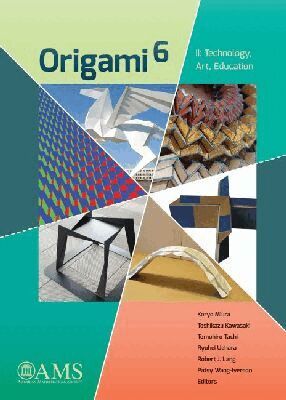
    Origami 6

    II. Technology, Art, Education

    AvKoryo Miura,Toshikazu Kawaskai

    Häftad, Engelska, 2015

    1 013 kr

    Beställningsvara. Skickas inom 11-20 vardagar. Fri frakt över 249 kr.

    Beskrivning

    A unique collection of papers illustrating the connections between origami and a wide range of fields. The papers compiled in this two-part set were presented at the 6th International Meeting on Origami in Science, Mathematics and Education (10-13 August 2014, Tokyo, Japan). They display the creative melding of origami (or, more broadly, folding) with fields ranging from cell biology to space exploration, from education to kinematics, from abstract mathematical laws to the artistic and aesthetics of sculptural design.This two-part book contains papers accessible to a wide audience, including those interested in art, design, history, and education and researchers interested in the connections between origami and science, technology, engineering, and mathematics. This Part 1 contains papers on various aspects of mathematics of origami: coloring, constructability, rigid foldability, and design algorithms.

    Produktinformation

    • Utgivningsdatum:2015-12-30
    • Mått:178 x 254 x undefined mm
    • Vikt:737 g
    • Format:Häftad
    • Språk:Engelska
    • Antal sidor:368
    • Förlag:American Mathematical Society
    • ISBN:9781470418762

    Utforska kategorier

    • Tillämpad matematik inom Naturvetenskap och teknik
    • Utbildningsstrategier och utbildningspolitik inom Psykologi och pedagogik

    Mer om författaren

    Koryo Miura and Toshikazu Kawaskai, Anan National College of Technology, Tokushima, Japan.Tomohiro Tachi, University of Tokyo, Japan.Ryuhei Uehara, Japan Advanced Institute of Science and Technology, Ishikawa, Japan.Robert J. Lang, Langorigami, Alamo, CA, USA.Patsy Wang-Iverson, Gabriella & Paul Rosenbaum Foundation, Bryn Mawr, PA, USA.

    Innehållsförteckning

    • Mathematics of origami: Comparison of compressive properties of periodic non-flat tessellations by Y. Klett, M. Grzeschik, and P. MiddenhorfNumerical analysis of origami structures through modified frame elements by K. Fuchi, P. R. Buskohl, J. J. Joo, G. W. Reich, and R. A. VaiaA study on crash energy absorption ability of lightweight structures with truss core panel by Y. Yang, X. Zhao, S. Tokura, and I. HagiwaraToward optimization of stiffness and flexibility of rigid, flat-foldable origami structures by E. T. Filipov, T. Tachi, and G. H. PaulinoStructural engineering applications of morphing sandwich structures by J. M. Gattas and Z. YouSound-insulting performance of origami-based sandwich trusscore panels by S. Ishida, H. Morimura, and I. HagiwaraThin-walled deployable grid structures by J. Ho and Z. YouDeployable linear folded stripe structures by R. MaleczekGravity and friction-driven self-organized folding by G. H. Filz, G. Grasser, J. Ladinig, and R. MaleczekMagnetic self-assembly of three-dimensional microstructures by E. Iwase and I. ShimoyamaFolding augmented: A design method to integrate structural folding in archietecture by P. D'Acunto and J. J. C. Castellon GonzalezDemands on an adapted design process for foldable structures by S. Hoffmann, M. Barej, B. Gunther, M. Trautz, B. Corves, and J. FeldhusenPlanning motions for shape-memory alloy sheets by M. Ghosh, D. Tomkins, J. Denny, S. Rodriguez, M. Morales, and N. M. AmatoSimple flat origami exploration system with random folds by N. Tsuruta, J. Mitani, Y. Kanamori, and Y. FukuiORICREATE: Modeling framework for design and manufacturing of folded plate structures by R. Chudoba, J. van der Woerd, and J. HeggerRotation erection system (res): Origami extended with cuts by Y. MiyamotoToward engineering biological tissues by directed assembly and origami folding by P. J. Mehner, T. Liu, A. B. Karimi, A. Brodeur, J. Paniagua, S. Giles, P. Richard, A. Nemtserova, S. Liu, R. C. Alperin, S. Bhatia, M. Culpepper, R. J. Lang, and C. LivermoreCosmological origami: Properties of cosmic-web components when a non-stretchy dark-matter sheet folds by M. C. NeyrinckModeling vaults in origami: A bridge between mathematics and architecture by C. Cumino, E. Frigerio, S. Gallina, M. L. Spreafico, and U. ZichOrigami in art, design, and history: Folding perspectives: Joys and uses of 3d anomorhic origami by Y. KlettMaster peace: An evolution of monumental origami by K. Box and R. J. LangWearable metal origami by T. de RuysserCrowdsourcing origami sculptures by J. MoselyOn the aesthetics of folding and technology: Scale, dimensionality, and materiality by M. GardinerComputational problems related to paper crane in the Edo period by J. MaekawaMitate and origami by H. KoshiroOrigami in education: The kindergarten origametria programme by M. Golan and J. ObermanArea and optimization problems by E. Frigerio and M. L. SpreaficoMathematics and art through the cubotahedron by S.-P. KwanOrigami-inspired deductive threads in pre-geometry by A. TubisUsing paper folding to solve problems in school geometry by H. Yanping and P.-Y. LeeUsing origami to enrich mathematical understanding of self similarity and fractals by A. Bahmani, K. Sharif, and A. HudsonUsing the Fujimoto approximation technique to teach chaos theory to high school students by L. PoladianIndex