• Fri frakt över 249 kr
  • •
  • Snabba leveranser
  • •
  • Billiga böcker
Kundservice

Du är på sajten för privatpersoner.

Företag, bibliotek eller offentlig verksamhet?

Du handlar på classic.bokus.com, där alla dina funktioner finns intakta.
Till classic.bokus.com
Bokus logotyp. Gå till startsidan.
  • Erbjudanden
  • Nyheter
  • Student
  • Topplistor
  • Barn & ungdom
  • Bokus Play
  • E-böcker
  • Pocketböcker
  • Spel & pussel

10% rabatt på allt med kod: NYSTART10 →

Sidfot

Mina sidor

    Hjälp

    • Kundservice
    • Vanliga frågor och svar
    • Frakt och leverans
    • Retur vid ångerrätt
    • Reklamera vara
    • Betalning
    • Köpvillkor
    • Allmänna villkor
    • Information om webbplatsens tillgänglighet

    Om Bokus

    • Om oss
    • Pressrum
    • För studenter
    • För företag
    • För bibliotek och offentlig verksamhet
    • För leverantörer
    • Hållbarhet

    Populärt

    • Aktuella erbjudanden
    • Presentkort
    • Studentlitteratur
    • Nya böcker
    • Topplistor
    • Signerade böcker
    • Engelska böcker

    Inspiration

    • Boktips
    • BookTok
    • Populära bokserier
    • Barnbokskaraktärer
    • Populära författare
    Logotyp för Bokus
    Följ oss på Facebook (extern länk)Följ oss på Instagram (extern länk)Följ oss på YouTube (extern länk)Följ oss på TikTok (extern länk)
    bokus @ CookiesAnpassa cookiesIntegritetspolicyKöpvillkor
    Till Citymail hemsida (extern länk)Till Budbee hemsida (extern länk)Till Postnord hemsida (extern länk)Till Schenker hemsida (extern länk)Till Early Bird hemsida (extern länk)Till Walleys hemsida (extern länk)
    1. Samhälle och politik
    2. Samhälle och kultur
    3. Sociala och etiska frågor
    4. Migration

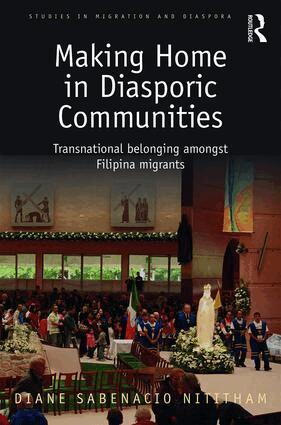
    Making Home in Diasporic Communities

    Transnational belonging amongst Filipina migrants

    AvDiane Sabenacio Nititham

    Inbunden, Engelska, 2016

    Del i serien Studies in Migration and Diaspora

    2 645 kr

    Beställningsvara. Skickas inom 10-15 vardagar. Fri frakt över 249 kr.

    Fler format och utgåvor

    Häftad

    667 kr

    E-bok

    788 kr

    E-bok

    790 kr

    Beskrivning

    Making Home in Diasporic Communities demonstrates the global scope of the Filipino diaspora, engaging wider scholarship on globalisation and the ways in which the dynamics of nation-state institutions, labour migration and social relationships intersect for transnational communities. Based on original ethnographic work conducted in Ireland and the Philippines, the book examines how Filipina diasporans socially and symbolically create a sense of ‘home’. On one hand, Filipinas can be seen as mobile, as they have crossed geographical borders and are physically located in the destination country. Yet, on the other hand, they are constrained by immigration policies, linguistic and cultural barriers and other social and cultural institutions. Through modalities of language, rituals and religion and food, the author examines the ways in which Filipinas orient their perceptions, expectations, practices and social spaces to ‘the homeland’, thus providing insight into larger questions of inclusion and exclusion for diasporic communities.By focusing on a range of Filipina experiences, including that of nurses, international students, religious workers and personal assistants, Making Home in Diasporic Communities explores the intersectionality of gender, race, class and belonging. As such, it will appeal to scholars of sociology and anthropology as well as those with interests in gender, identity, migration, ethnic studies, and the construction of home.

    Produktinformation

    • Utgivningsdatum:2016-11-11
    • Mått:156 x 234 x 15 mm
    • Vikt:490 g
    • Format:Inbunden
    • Språk:Engelska
    • Serie:Studies in Migration and Diaspora
    • Antal sidor:180
    • Förlag:Taylor & Francis Ltd
    • ISBN:9781472455208

    Utforska kategorier

    • Migration inom Samhälle och politik
    • Genusvetenskap inom Samhälle och politik
    • Statsvetenskap och politisk teori inom Samhälle och politik

    Mer om författaren

    Diane Nititham is a professor of sociology at Murray State University, USA. She specialises in migration, diaspora, and transnational communities, and is the co-editor of Heritage, Diaspora and the Consumption of Culture.

    Recensioner i media

    ‘This book illuminates the lived experiences of an underrepresented group in Ireland and complicates discussions of globalization, migration, (national) identity and notions of home. It is a significant contribution to the field of Irish Studies and discourses on globalization, migration, and diaspora. Dr. Nititham gives a human face to seemingly abstract global economic and political forces.’ - Dr. Tanya Saroj Bakhru, San Jose State University, USA 'The first book to examine the lives of Filipina migrants in Ireland, Making Home in Diasporic Communities poignantly captures their day-to-day social practices, as they negotiate the politics of belonging in both Ireland and the Philippines. A must-read for all those interested in globalization and transnational belonging.' - Professor Yen Le Espiritu, University of California, San Diego, USA 'As one of the largest diasporas in the world, the Filipino diaspora is especially ripe for exploring questions of racialization, identity formation, transnationalism and belonging. Nititham provides a richly textured portrait of Filipina diasporans’ complex home-making strategies in Ireland. Her work is a unique contribution to Filipino diaspora studies that can serve as the basis for exciting comparative research.' - Robyn Rodriguez, University of California, Davis, USA

    Innehållsförteckning

    • Introduction 1. Conceptualising Home and Diaspora 2. Landscapes of Dislocation 3. ‘Our Noses Will Bleed and Then We Die’: Using Language as a Borderland Strategy 4. ‘Hey! Are you Filipino?’ Adapting Rituals, Religion and Routine 5. ‘As Long as You Have Your Food, You Feel at Home’: Eating, Gathering and Socializing 6. Romanticizing the Homeland 7. Working towards Home References Appendix A: Profile of Participants Appendix B: Interview Questions Appendix C: Notes on Terminology