• Fri frakt över 249 kr
  • •
  • Snabba leveranser
  • •
  • Billiga böcker
Kundservice

Du är på sajten för privatpersoner.

Företag, bibliotek eller offentlig verksamhet?

Du handlar på classic.bokus.com, där alla dina funktioner finns intakta.
Till classic.bokus.com
Bokus logotyp. Gå till startsidan.
  • Erbjudanden
  • Nyheter
  • Student
  • Topplistor
  • Barn & ungdom
  • Bokus Play
  • E-böcker
  • Pocketböcker
  • Spel & pussel

10% rabatt på allt med kod NYSTART10 →

Sidfot

Mina sidor

    Hjälp

    • Kundservice
    • Vanliga frågor och svar
    • Frakt och leverans
    • Retur vid ångerrätt
    • Reklamera vara
    • Betalning
    • Köpvillkor
    • Allmänna villkor
    • Information om webbplatsens tillgänglighet

    Om Bokus

    • Om oss
    • Pressrum
    • För studenter
    • För företag
    • För bibliotek och offentlig verksamhet
    • För leverantörer
    • Hållbarhet

    Populärt

    • Aktuella erbjudanden
    • Presentkort
    • Studentlitteratur
    • Nya böcker
    • Topplistor
    • Signerade böcker
    • Engelska böcker

    Inspiration

    • Boktips
    • BookTok
    • Populära bokserier
    • Barnbokskaraktärer
    • Populära författare
    Logotyp för Bokus
    Följ oss på Facebook (extern länk)Följ oss på Instagram (extern länk)Följ oss på YouTube (extern länk)Följ oss på TikTok (extern länk)
    bokus @ CookiesAnpassa cookiesIntegritetspolicyKöpvillkor
    Till Citymail hemsida (extern länk)Till Budbee hemsida (extern länk)Till Postnord hemsida (extern länk)Till Schenker hemsida (extern länk)Till Early Bird hemsida (extern länk)Till Walleys hemsida (extern länk)
    1. Data och IT
    2. Programmeringsböcker
    3. Programvaruutveckling

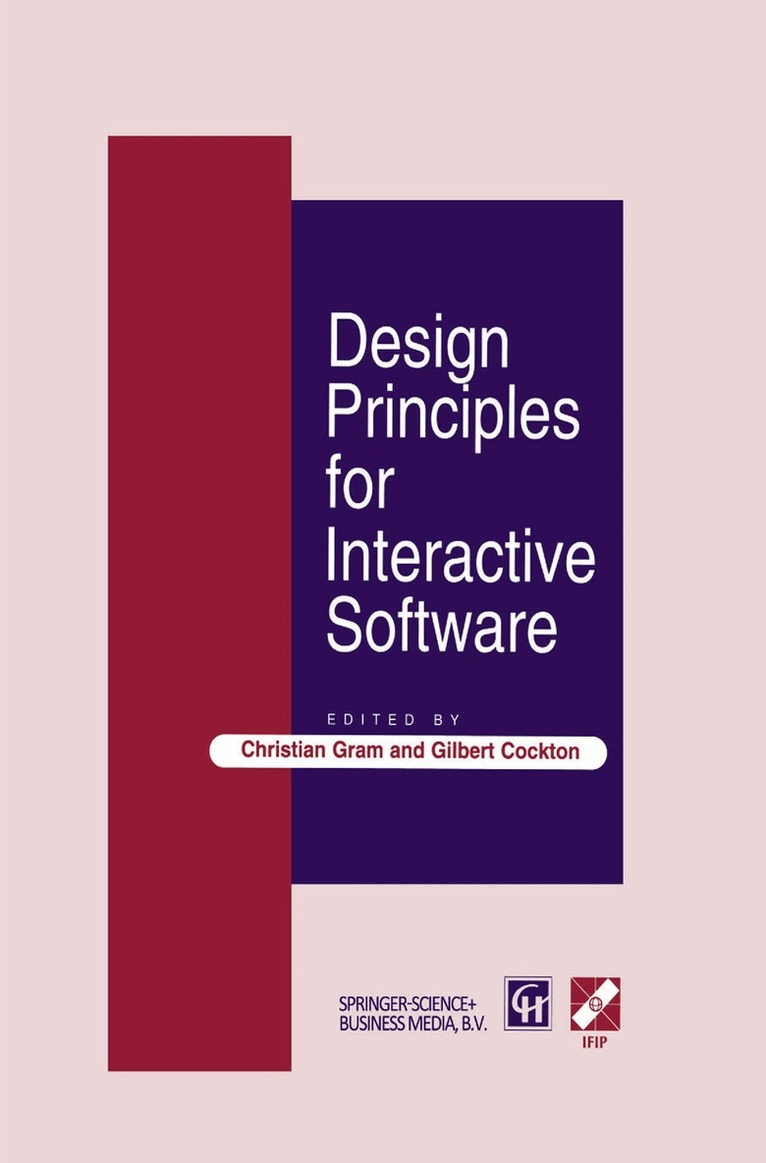
    Design Principles for Interactive Software

    AvGilbert Cockton,Christian Gram

    Häftad, Engelska, 2013

    Del i serien IFIP Advances in Information and Communication Technology

    1 117 kr

    Beställningsvara. Skickas inom 10-15 vardagar. Fri frakt över 249 kr.

    Beskrivning

    IFIP's Working Group 2.7(13.4)* has, since its establishment in 1974, con­ centrated on the software problems of user interfaces. From its original interest in operating systems interfaces the group has gradually shifted em­ phasis towards the development of interactive systems. The group has orga­ nized a number of international working conferences on interactive software technology, the proceedings of which have contributed to the accumulated knowledge in the field. The current title of the Working Group is 'User Interface Engineering', with the aim of investigating the nature, concepts, and construction of user interfaces for software systems. The scope of work involved is: - to increase understanding of the development of interactive systems; - to provide a framework for reasoning about interactive systems; - to provide engineering models for their development. This report addresses all three aspects of the scope, as further described below. In 1986 the working group published a report (Beech, 1986) with an object-oriented reference model for describing the components of operating systems interfaces. The modelwas implementation oriented and built on an object concept and the notion of interaction as consisting of commands and responses. Through working with that model the group addressed a number of issues, such as multi-media and multi-modal interfaces, customizable in­ terfaces, and history logging. However, a conclusion was reached that many software design considerations and principles are independent of implemen­ tation models, but do depend on the nature of the interaction process.

    Produktinformation

    • Utgivningsdatum:2013-03-21
    • Mått:155 x 235 x 15 mm
    • Vikt:411 g
    • Format:Häftad
    • Språk:Engelska
    • Serie:IFIP Advances in Information and Communication Technology
    • Antal sidor:248
    • Förlag:Springer-Verlag New York Inc.
    • ISBN:9781475749441

    Utforska kategorier

    • Programvaruutveckling inom Data och IT
    • Artificiell intelligens inom Data och IT

    Innehållsförteckning

    • 1 The Context of Interactive Systems Development.- 2 External Properties: the User’s Perspective.- 3 Internal Properties: The Software Developer’s Perspective.- 4 Software Architecture Models.- 5 Tools and Materials.- 6 Example: Interface for Air Traffic Controllers.- 7 Conclusions.- Appendix A Glossary.- Appendix B Summary Tables.- References.