• Fri frakt över 249 kr
  • •
  • Snabba leveranser
  • •
  • Billiga böcker
Kundservice

Du är på sajten för privatpersoner.

Företag, bibliotek eller offentlig verksamhet?

Du handlar på classic.bokus.com, där alla dina funktioner finns intakta.
Till classic.bokus.com
Bokus logotyp. Gå till startsidan.
  • Erbjudanden
  • Nyheter
  • Student
  • Topplistor
  • Barn & ungdom
  • Bokus Play
  • E-böcker
  • Pocketböcker
  • Spel & pussel

10% rabatt på allt med kod: NYSTART10 →

Sidfot

Mina sidor

    Hjälp

    • Kundservice
    • Vanliga frågor och svar
    • Frakt och leverans
    • Retur vid ångerrätt
    • Reklamera vara
    • Betalning
    • Köpvillkor
    • Allmänna villkor
    • Information om webbplatsens tillgänglighet

    Om Bokus

    • Om oss
    • Pressrum
    • För studenter
    • För företag
    • För bibliotek och offentlig verksamhet
    • För leverantörer
    • Hållbarhet

    Populärt

    • Aktuella erbjudanden
    • Presentkort
    • Studentlitteratur
    • Nya böcker
    • Topplistor
    • Signerade böcker
    • Engelska böcker

    Inspiration

    • Boktips
    • BookTok
    • Populära bokserier
    • Barnbokskaraktärer
    • Populära författare
    Logotyp för Bokus
    Följ oss på Facebook (extern länk)Följ oss på Instagram (extern länk)Följ oss på YouTube (extern länk)Följ oss på TikTok (extern länk)
    bokus @ CookiesAnpassa cookiesIntegritetspolicyKöpvillkor
    Till Citymail hemsida (extern länk)Till Budbee hemsida (extern länk)Till Postnord hemsida (extern länk)Till Schenker hemsida (extern länk)Till Early Bird hemsida (extern länk)Till Walleys hemsida (extern länk)
    1. Naturvetenskap och teknik
    2. Matematik och naturvetenskap
    3. Biologi
    4. Biokemi

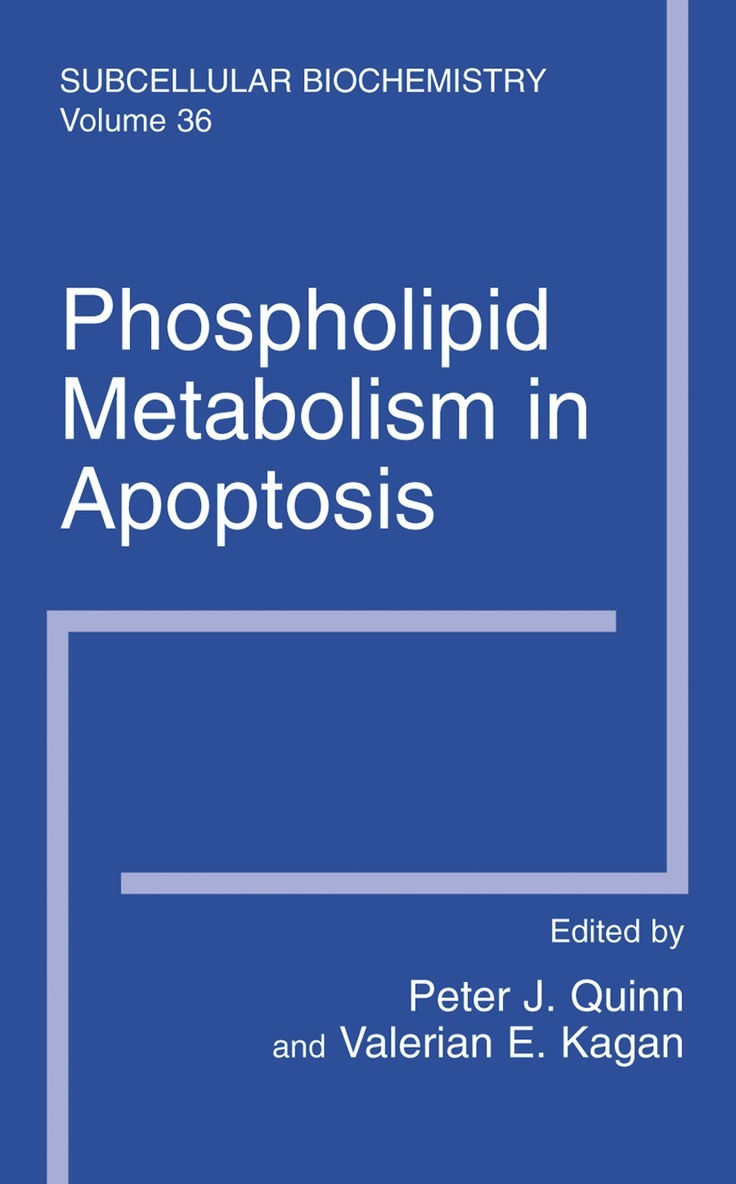
    Phospholipid Metabolism in Apoptosis

    AvPeter J. Quinn,Valerian E. Kagan

    Häftad, Engelska, 2013

    Del i serien Subcellular Biochemistry

    1 674 kr

    Beställningsvara. Skickas inom 10-15 vardagar. Fri frakt över 249 kr.

    Beskrivning

    The last few years have witnessed an explosion of both interest and knowledge about apoptosis, the process by which a cell actively commits suicide. The number of publications on the topic has increased from nothing in the early 1980s to more than 10,000 papers annually today. It is now well recognized that apoptosis is essential in many aspects of normal development and is required for maintaining tissue homeostasis. The idea that life requires death seems somewhat paradoxical, but cell suicide is essential for an animal to survive. For example, without selective destruction of “non-self” T cells, an animal would lack immunity. Similarly, meaningful neural connections in the brain are whittled from a mass of cells. Further, developmental cell remodeling during tissue maturation involves programmed cell death as the major mechanism for functional and structural safe transition of undifferentiated cells to more specialized counterparts. Apoptosis research, with roots in biochemistry, developmental and cell biology, genetics, and immunology, embraces this long-ignored natural law. Failure to properly regulate apoptosis can have catastrophic consequences. Cancer and many diseases (AIDS, Alzheimer’s disease, Parkinson’s disease, heart attack, stroke, etc. ) are thought to arise from deregulation of apoptosis. As apoptosis emerges as a key biological regulatory mechanism, it has become harder and harder to keep up with new developments in this field.

    Produktinformation

    • Utgivningsdatum:2013-05-31
    • Mått:155 x 235 x 20 mm
    • Vikt:552 g
    • Format:Häftad
    • Språk:Engelska
    • Serie:Subcellular Biochemistry
    • Antal sidor:340
    • Förlag:Springer-Verlag New York Inc.
    • ISBN:9781475782165

    Utforska kategorier

    • Biokemi inom Naturvetenskap och teknik
    • Anatomi inom Medicin
    • Medicinsk genetik inom Medicin

    Innehållsförteckning

    • Lipid Metabolism and Release of Cytochrome c from Mitochondria.- Interaction Between Cytochrome c and Oxidized Mitochondrial Lipids.- Plasma Membrane Phospholipid Asymmetry.- Apoptosis by Phosphatidylserine in Mammalian Cells.- Phosphatidylserine Peroxidation During Apoptosis.- Role of Nitric Oxide and Membrane Phospholipid Polyunsaturation in Oxidative Cell Death.- Oxidized LDL-Induced Apoptosis.- Induction of Apoptosis by Redox-Cycling Quinones.- Apoptosis Induced by Ionizing Radiation.- Ceramidases in the Regulation of Ceramide Levels and Function.- Effect of Ceramides on Phospholipid Biosynthesis and Its Implication for Apoptosis.- Acid Sphingomyelinase-derived Ceramide Signaling in Apoptosis.- Cellular Signaling by Sphingosine and Sphingosine 1-Phosphate.- Ceramide in Regulation of Apoptosis.- Lipid Signaling in CD95-mediated Apoptosis.- Phosphatidylinositol 3-kinase, Phosphoinositides and Apoptosis.