• Fri frakt över 249 kr
  • •
  • Snabba leveranser
  • •
  • Billiga böcker
Kundservice

Du är på sajten för privatpersoner.

Företag, bibliotek eller offentlig verksamhet?

Du handlar på classic.bokus.com, där alla dina funktioner finns intakta.
Till classic.bokus.com
Bokus logotyp. Gå till startsidan.
  • Erbjudanden
  • Nyheter
  • Student
  • Topplistor
  • Barn & ungdom
  • Bokus Play
  • E-böcker
  • Pocketböcker
  • Spel & pussel

10% rabatt på allt med kod NYSTART10 →

Sidfot

Mina sidor

    Hjälp

    • Kundservice
    • Vanliga frågor och svar
    • Frakt och leverans
    • Retur vid ångerrätt
    • Reklamera vara
    • Betalning
    • Köpvillkor
    • Allmänna villkor
    • Information om webbplatsens tillgänglighet

    Om Bokus

    • Om oss
    • Pressrum
    • För studenter
    • För företag
    • För bibliotek och offentlig verksamhet
    • För leverantörer
    • Hållbarhet

    Populärt

    • Aktuella erbjudanden
    • Presentkort
    • Studentlitteratur
    • Nya böcker
    • Topplistor
    • Signerade böcker
    • Engelska böcker

    Inspiration

    • Boktips
    • BookTok
    • Populära bokserier
    • Barnbokskaraktärer
    • Populära författare
    Logotyp för Bokus
    Följ oss på Facebook (extern länk)Följ oss på Instagram (extern länk)Följ oss på YouTube (extern länk)Följ oss på TikTok (extern länk)
    bokus @ CookiesAnpassa cookiesIntegritetspolicyKöpvillkor
    Till Citymail hemsida (extern länk)Till Budbee hemsida (extern länk)Till Postnord hemsida (extern länk)Till Schenker hemsida (extern länk)Till Early Bird hemsida (extern länk)Till Walleys hemsida (extern länk)
    1. Samhälle och politik
    2. Samhälle och kultur
    3. Kultur och medier
    4. Referensverk och tvärvetenskap

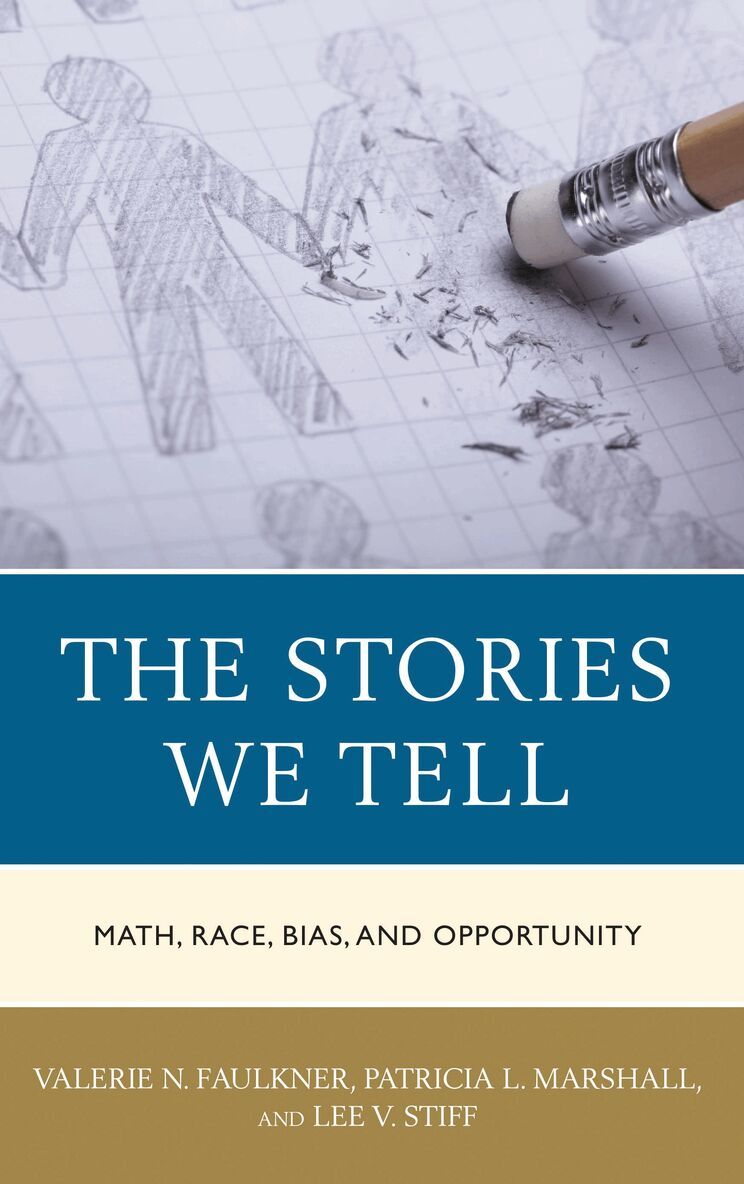
    Stories We Tell

    Math, Race, Bias, and Opportunity

    AvValerie N. Faulkner,Patricia L. Marshall

    Häftad, Engelska, 2019

    Del i serien Rowman & Littlefield Publishers

    493 kr

    Beställningsvara. Skickas inom 10-15 vardagar. Fri frakt över 249 kr.

    Fler format och utgåvor

    Inbunden

    952 kr

    Beskrivning

    The Stories We Tell: Math, Race, Bias, & Opportunity positions educators as professional decision-makers whose every day choices are deeply consequential. After exploring topics ranging from the early identification of talent, the use of demographic characteristics to make academic decisions, and the problematic casting of a ‘gap’ in mathematical performance as about the students themselves, the book explores how professional decision making, and a more precise use of data, can impact mathematical performance outcomes. With gentle precision, the book analyzes the patterns of practice in place as educators sort children according to perceived needs. Through case studies, the authors reconfigure the mathematics achievement gap as being about opportunity provided or denied at both the classroom and systemic levels. The book has implications for school personnel as well as others curious about how opportunity impacts outcomes and how data is (or is not) used to make decisions about children. Educators who challenge themselves to engage with the possibility of bias, and then face the stories we tell ourselves about the race/talent development/student merit relationship, will have the opportunity to write a powerful and equitable story going forward.

    Produktinformation

    • Utgivningsdatum:2019-08-29
    • Mått:152 x 231 x 9 mm
    • Vikt:236 g
    • Format:Häftad
    • Språk:Engelska
    • Serie:Rowman & Littlefield Publishers
    • Antal sidor:160
    • Förlag:Bloomsbury Publishing Plc
    • ISBN:9781475841633

    Utforska kategorier

    • Referensverk och tvärvetenskap inom Samhälle och politik
    • Pedagogik inom Psykologi och pedagogik
    • Utbildningsstrategier och utbildningspolitik inom Psykologi och pedagogik

    Mer om författaren

    Dr. Valerie N. Faulkner is a Teaching Associate Professor in Elementary Education in the Department of Teacher Education and Learning Sciences at NC State University. Her current work focuses on K-2 mathematics education and issues of access and equity within schools. Dr. Patricia L. Marshall is a Professor of Multicultural Studies in the Department of Teacher Education and Learning Sciences at NC State University. She is interested in the impact of elements of culture including race, class, language on the teaching-learning process and teachers’ acquisition of cross-cultural competency.Dr. Lee V. Stiff is Professor of Mathematics Education in the Department of Science, Technology, Engineering, and Mathematics Education and Associate Dean for Faculty and Academic Affairs in the College of Education at NC State University. He is interested in affecting change that promotes the mathematics education of all students by effectively using data to better align existing resources to address issues of equity, student access to high-quality math courses, and course placement disparities.

    Recensioner i media

    This thoughtful and carefully organized book draws on a rich network of evidence to demonstrate the harm done when students are placed in academic courses based on demographic data. Using numerous examples, authors Faulkner, Marshall, and Stiff (all, North Carolina State Univ.) demonstrate clearly that when well-meaning education professionals rely on their perceptions of student ability, achievement gaps are reinforced. They make a compelling case for the use of objective data to place students in courses designed to help them succeed, while also discussing the limitations of objective data. Addressing confirmation bias, confabulation, and other problematic behaviors, they offer practical solutions to overcome these obstacles. Overall, the book uses sources efficiently and employs them in a way that would not be overwhelming to undergraduates or in-service teachers. The discussion questions at the end of the book, organized by chapter, make this an excellent text for undergraduate methods-of-teaching courses, professional learning communities, and professional development for in-service teachers. The thorough reference list also makes this an excellent text for graduate study.Summing Up: Recommended. Lower-division undergraduates through graduate students; professionals

    Innehållsförteckning

    • Acknowledgements IntroductionSection I- The Gap-MakerChapter 1- The Farce of Early Identification: A Hidden Story in Gap-MakingThe Promise of PromiseTalent DevelopmentThe Flawed Pillars of Early IdentificationTalent is Detected in the YoungTalent is InnateA Restricted Talent Pool is DesirableThe Story of Early IdentificationChapter 2- Data Doppels: Professional Stories and Gap-MakingData and High-Stakes Decision-MakingBeware the Data DoppelDecision-Making and Data Doppels in ActionHeart Attacks and the Goldman IndexSymphony Orchestras and Blind AuditionsBaseball and MoneyballData Doppels in SchoolsWhat student data drives mathematics opportunities?The “At-Risk” ModelAn imagined conversationRemediation as ElevationData Doppels in Math ClassNational Data and Middle School Mathematics PlacementHow Should We Think About This?Section II- Academic Opportunity in Schools Chapter 3- Diversity in Our Schools: Cultural Preconceptions & Instructional ChoicesMultiple Dimensions of Student Diversity in SchoolsNew Normals, Societal Scourges and Childhoods Lost?Intersecting Social Axes and Opportunity Gaps for Other People’s Children Beyond Diversity & The Abyss of Accountability Homogeneous Ability Grouping: The Smoke and Mirrors of Effective Teaching?Early Identification and Mindset in Grouping for Instruction Perceptions and Scapegoats Gap-Making through Teacher Decision-MakingCultural Difference as a Factor In Teachers’ Decision MakingTeacher Preconceptions: Critical Indicators of Student Learning Potential?Heterogeneous Groups and Growth Mindset: Toward Neutralizing Problematic Decision MakingTroubling StratificationChapter 4- Follow the Data: Gifts, Access, Cuts, and The-GapRigor for AllDifferent StrokesA Brief History of GiftednessAccess to the GiftThe CutFollowing DataCampbell’s LawBeyond GiftedThe Referral PoolGap-logicThe Achievement-Gap MeanVariance and VarietyThe mean doesn’t mean what you think it meansFinding StudentsSection III- Decision Making in SchoolsChapter 5- When Teachers Push Back: Data vs. BeliefMathematics Course PlacementsThe Placement DecisionThe Professional BeliefsAdjustments: Changing the Terms of EngagementThe RulesThe Case of AlexanderThe Case of LailaThe Case of Inconsistent LeadershipCumulative ImpactData vs. BeliefsThe Path of Most ResistanceChapter 6- Unpacking Belief and Finding ChangeUnpacking Belief: Data & the BrainConfirmation BiasCertainty, Doubt & ConfabulationCultural Norms, Race, and BeliefFinding Change#1 Recognize Conceptual Race #2 Free the Data, Free the Mind(set)#3 Less is moreThe Discomfort, and Reward, of ChangeAppendix- Chapter by Chapter QuestionsBibliographyAbout the Authors