• Fri frakt över 249 kr
  • •
  • Snabba leveranser
  • •
  • Billiga böcker
Kundservice

Du är på sajten för privatpersoner.

Företag, bibliotek eller offentlig verksamhet?

Du handlar på classic.bokus.com, där alla dina funktioner finns intakta.
Till classic.bokus.com
Bokus logotyp. Gå till startsidan.
  • Erbjudanden
  • Nyheter
  • Student
  • Topplistor
  • Barn & ungdom
  • Bokus Play
  • E-böcker
  • Pocketböcker
  • Spel & pussel

10% rabatt på allt med kod: NYSTART10 →

Sidfot

Mina sidor

    Hjälp

    • Kundservice
    • Vanliga frågor och svar
    • Frakt och leverans
    • Retur vid ångerrätt
    • Reklamera vara
    • Betalning
    • Köpvillkor
    • Allmänna villkor
    • Information om webbplatsens tillgänglighet

    Om Bokus

    • Om oss
    • Pressrum
    • För studenter
    • För företag
    • För bibliotek och offentlig verksamhet
    • För leverantörer
    • Hållbarhet

    Populärt

    • Aktuella erbjudanden
    • Presentkort
    • Studentlitteratur
    • Nya böcker
    • Topplistor
    • Signerade böcker
    • Engelska böcker

    Inspiration

    • Boktips
    • BookTok
    • Populära bokserier
    • Barnbokskaraktärer
    • Populära författare
    Logotyp för Bokus
    Följ oss på Facebook (extern länk)Följ oss på Instagram (extern länk)Följ oss på YouTube (extern länk)Följ oss på TikTok (extern länk)
    bokus @ CookiesAnpassa cookiesIntegritetspolicyKöpvillkor
    Till Citymail hemsida (extern länk)Till Budbee hemsida (extern länk)Till Postnord hemsida (extern länk)Till Schenker hemsida (extern länk)Till Early Bird hemsida (extern länk)Till Walleys hemsida (extern länk)
    1. Samhälle och politik
    2. Samhälle och kultur
    3. Kultur och medier
    4. Kulturvetenskap

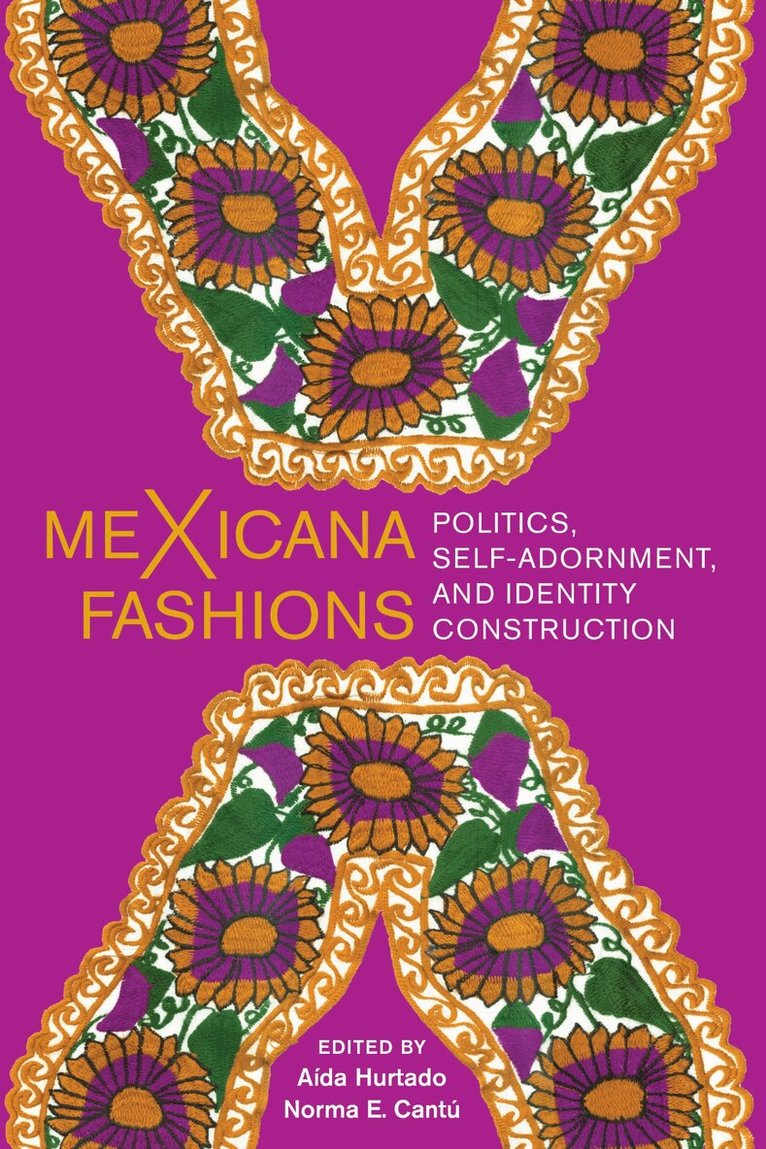
    MeXicana Fashions

    Politics, Self-Adornment, and Identity Construction

    AvAída Hurtado,Norma E. Cantú

    Häftad, Engelska, 2020

    377 kr

    Beställningsvara. Skickas inom 5-8 vardagar. Fri frakt över 249 kr.

    Beskrivning

    2020 Second Place, Best Nonfiction Multi Author, International Latino Book AwardsCollecting the perspectives of scholars who reflect on their own relationships to particular garments, analyze the politics of dress, and examine the role of consumerism and entrepreneurialism in the production of creating and selling a style, meXicana Fashions examines and searches for meaning in these visible, performative aspects of identity.Focusing primarily on Chicanas but also considering trends connected to other Latin American communities, the authors highlight specific constituencies that are defined by region (“Tejana style,” “L.A. style”), age group (“homie,” “chola”), and social class (marked by haute couture labels such as Carolina Herrera and Oscar de la Renta). The essays acknowledge the complex layers of these styles, which are not mutually exclusive but instead reflect a range of intersections in occupation, origin, personality, sexuality, and fads. Other elements include urban indigenous fashion shows, the shifting quinceaÑera market, “walking altars” on the Days of the Dead, plus-size clothing, huipiles in the workplace, and dressing in drag. Together, these chapters illuminate the full array of messages woven into a vibrant social fabric.

    Produktinformation

    • Utgivningsdatum:2020-01-10
    • Mått:152 x 226 x 23 mm
    • Vikt:499 g
    • Format:Häftad
    • Språk:Engelska
    • Antal sidor:336
    • Förlag:University of Texas Press
    • ISBN:9781477319598

    Utforska kategorier

    • Kulturvetenskap inom Samhälle och politik
    • Etnicitet inom Samhälle och politik

    Mer om författaren

    AÍda Hurtado is a professor and the Luis Leal Endowed Chair in the Department of Chicana and Chicano Studies at the University of California, Santa Barbara. She is the author and editor of numerous books, most recently Beyond Machismo: Intersectional Latino Masculinities.Norma E. CantÚ is the Norine R. and T. Frank Murchison Endowed Professor in Humanities at Trinity University in San Antonio. In addition to pursuing scholarly research in folklore and literary studies, she has published poetry and fiction, including the award-winning CanÍcula: Snapshots of a Girlhood en la Frontera. Her most recent coedited volume is Entre Guadalupe y Malinche: Tejanas in Literature and Art.

    Recensioner i media

    One of the greatest strengths of this work is its commitment to combatting a tendency toward essentialism in dress studies, particularly for what typically gets deemed 'ethnic,' 'minority," or 'subcultural' dress, by underscoring the complex, inconsistent, and sometimes contradictory ways we may experience self and how we variously perform those intersectional identities...The chapters of meXicana Fashions demonstrate many thoughtful attempts to interrogate old and invent new terms, categories, and concepts for identification and analysis...For folklorists, dress scholars, and those interested in material culture, media, and gender studies, there is a lot to value here. (Journal of Folklore Research) [meXicana Fashions's] editors' intentions of initiating discussion, questioning, and exploration of the significance of fashion, self adornment, and the economics of self fashioning are well served by this diversity of current writings by meXicanas and women of Colour searching for social and self identity outside of the hegemonic fashion industry. This book would be an important point of reference within Mexican American studies and particularly in studies of dress and the creation of both personal and social identity. It is a useful source for complexities of dress, adornment, and the constructions and reconstructions of cultural identities. (Journal of Dress History) This book is a jewel of fashion knowledge and should be a part of every fashion library to learn how clothing can be used for personal identity and more so, a form of respect for society as a whole – a respect through ‘fashion for all’ and one always evolving within our likes and differences. Change is what makes up the ideal of fashion. (Fashion, Style & Popular Culture) [meXicana Fashions] presents the academy with an inspirational model for weaving authenticity and authority alongside the rigors of multimedium and multimethodological research. The result is an insightful and innovate book for those interested in fashion theory, cultural theory, identity politics, textile arts, Latinx/Xicana/Indigenous identity, history, art, and literature, as well as pedagogy. (New Mexico Historical Review) I have been waiting years for this book...The editors are courageous in their refusal of conformity, even at the level of citation styles, and they appear to model for us what academic diversity can look like in print…the book is a delightful and recommended read. (Chiricú Journal)

    Innehållsförteckning

    • Introduction (AÍda Hurtado and Norma E. CantÚ)Section I. Rendering of Self: Personal Narratives/Personal Adornment Chapter 1. Wearing Identity: Chicanas and Huipiles (Norma E. CantÚ)Chapter 2. Con el huipil en la mente: The Metamorphosis of a Chicana (Josie MÉndez-Negrete)Chapter 3. “Rebozos, huipiles, y ¿QuÉ?”: Chicana Self-Fashioning in the Academy (Micaela DÍaz-SÁnchez)Chapter 4. Por la facha y por el traje, se conoce al personaje: Tales about Attire as Resistance and Performativity in a Chicana’s Life Trajectory (Gabriella GutiÉrrez y Muhs)Chapter 5. A Familial Legacy of meXicana Style (Domino Renee Perez)Section II. The Politics of Dress: Saying It Loud/Saying It Clear Chapter 6. Buying the Dream: Relating “Traditional” Dress to Consumer Practices within US QuinceaÑeras (Rachel Valentina GonzÁlez-Martin)Chapter 7. Visuality, Corporality, and Power (AÍda Hurtado)Chapter 8. Black, Brown, and Fa(t)shionable: The Role of Fat Women of Color in the Rise of Body Positivity (Jade D. Petermon)Chapter 9. Fashioning Decolonial Optics: Days of the Dead Walking Altars and Calavera Fashion Shows in Latina/o Los Angeles (Laura PÉrez)Chapter 10. “Fierce and Fearless”: Dress and Identity in Rigoberto GonzÁlez’s The Mariposa Club (Sonia Alejandra RodrÍguez)Section III. The Politics of Entrepreneurship: Making (It)/Selling (It)) Chapter 11. Lydia Mendoza, “Reina de la MÚsica Tejana”: Self-Stylizing Mexicanidad through China Poblana in the US-Mexico Borderlands (Marci R. McMahon)Chapter 12. (Ad)Dressing Chicana/Latina Femininities: Consumption, Labor, and the Cultural Politics of Style in Latina Fashion (Stacy I. MacÍas)Chapter 13. Urban Xican/x-Indigenous Fashion Show ARTivism: Experimental Ethnographies and Perform-Antics in Three Actos (Chela Sandoval, Amber Rose GonzÁlez, and Felicia Montes)ContributorsIndex