Aída Hurtado - Böcker
Visar alla böcker från författaren Aída Hurtado. Handla med fri frakt och snabb leverans.
10 produkter
10 produkter
Invisible No More
Understanding the Disenfranchisement of Latino Men and Boys
Inbunden, Engelska, 2011
2 155 kr
Skickas inom 10-15 vardagar
Latino men and boys in the United States are confronted with a wide variety of hardships that are not easily explained or understood. They are populating prisons, dropping out of high school, and are becoming overrepresented in the service industry at alarming degrees. Young Latino men, especially, have among the lowest wages earned in the country, a rapidly growing rate of HIV/AIDS, and one of the highest mortality rates due to homicide. Although there has been growing interest in the status of men in American society, there is a glaring lack of research and scholarly work available on Latino men and boys.This groundbreaking interdisciplinary volume, edited by renowned scholars Pedro Noguera, Aída Hurtado and Edward Fergus addresses the dearth of scholarship and information about Latino men and boys to further our understanding of the unique challenges and obstacles that they confront during this historical moment. The contributors represent a cross section of disciplines from health, criminal justice, education, literature, psychology, economics, labor, sociology and more. By drawing attention to the sweeping issues facing this segment of the population, this volume offers research and policy a set of principles and overarching guidelines for decreasing the invisibility and thus the disenfranchisement of Latino men and boys.
847 kr
Skickas inom 10-15 vardagar
Latino men and boys in the United States are confronted with a wide variety of hardships that are not easily explained or understood. They are populating prisons, dropping out of high school, and are becoming overrepresented in the service industry at alarming degrees. Young Latino men, especially, have among the lowest wages earned in the country, a rapidly growing rate of HIV/AIDS, and one of the highest mortality rates due to homicide. Although there has been growing interest in the status of men in American society, there is a glaring lack of research and scholarly work available on Latino men and boys.This groundbreaking interdisciplinary volume, edited by renowned scholars Pedro Noguera, Aída Hurtado and Edward Fergus addresses the dearth of scholarship and information about Latino men and boys to further our understanding of the unique challenges and obstacles that they confront during this historical moment. The contributors represent a cross section of disciplines from health, criminal justice, education, literature, psychology, economics, labor, sociology and more. By drawing attention to the sweeping issues facing this segment of the population, this volume offers research and policy a set of principles and overarching guidelines for decreasing the invisibility and thus the disenfranchisement of Latino men and boys.
888 kr
Skickas inom 10-15 vardagar
Explores the relationship between Chicana feminism and the lived experiences of ChicanasChicana voices are missing from the psychology of women. Though "Chicana feminisms" have only recently been enumerated, a feminist perspective has long existed in Chicano communities without ever having been explicitly named. Grounded in specific aspects of Chicano culture such as the contested role of La Malinche and the complexities of Marianismo, the distinguishing feature of Chicana feminisms has been their embrace of diversity. Chicanas readily acribe to many feminisms and do not expect there to be only one.Focusing on young women between the ages of 20 and 30, Chicanas Speak Feminisms explores the relationship between Chicana feminism and the lived experiences of Chicanas. What do they see as their day-to-day manifestation of feminist consciousness? What is the relationship between what Chicana feminists propose and their lived experiences as women and as members of other significant social groups? Including rich ethnographic testimony based on questionnaires, in-depth interviews, and shadowing, Hurtado allows the women to speak in their own terms about how they see their femininity, sexuality, gender identity, ethnic/racial identity, and ties to other feminisms and political struggles.
390 kr
Skickas inom 7-10 vardagar
Explores the relationship between Chicana feminism and the lived experiences of ChicanasChicana voices are missing from the psychology of women. Though "Chicana feminisms" have only recently been enumerated, a feminist perspective has long existed in Chicano communities without ever having been explicitly named. Grounded in specific aspects of Chicano culture such as the contested role of La Malinche and the complexities of Marianismo, the distinguishing feature of Chicana feminisms has been their embrace of diversity. Chicanas readily acribe to many feminisms and do not expect there to be only one.Focusing on young women between the ages of 20 and 30, Chicanas Speak Feminisms explores the relationship between Chicana feminism and the lived experiences of Chicanas. What do they see as their day-to-day manifestation of feminist consciousness? What is the relationship between what Chicana feminists propose and their lived experiences as women and as members of other significant social groups? Including rich ethnographic testimony based on questionnaires, in-depth interviews, and shadowing, Hurtado allows the women to speak in their own terms about how they see their femininity, sexuality, gender identity, ethnic/racial identity, and ties to other feminisms and political struggles.
270 kr
Skickas inom 7-10 vardagar
Chicana feminisms are living theory deriving value and purpose by affecting social change. Advocating for and demonstrating the importance of an intersectional, multidisciplinary, activist understanding of Chicanas, Intersectional Chicana Feminisms provides a much-needed overview of the key theories, thinkers, and activists that have contributed to Chicana feminism thought.Aída Hurtado, a leading Chicana feminist and scholar, traces the origins of Chicanas' efforts to bring attention to the effects of gender in Chicana and Chicano studies. Highlighting the innovative and pathbreaking methodologies developed within the field of Chicana feminisms - such as testimonio, conocimiento, and autohistoria - this book offers an accessible introduction to Chicana theory, methodology, art, and activism. Hurtado also looks at the newest developments in the field and the future of Chicana feminisms.The book includes short biographies of key Chicana feminists, additional suggested readings, and exercises with each chapter to extend opportunities for engagement in classroom and workshop settings.
601 kr
Kommande
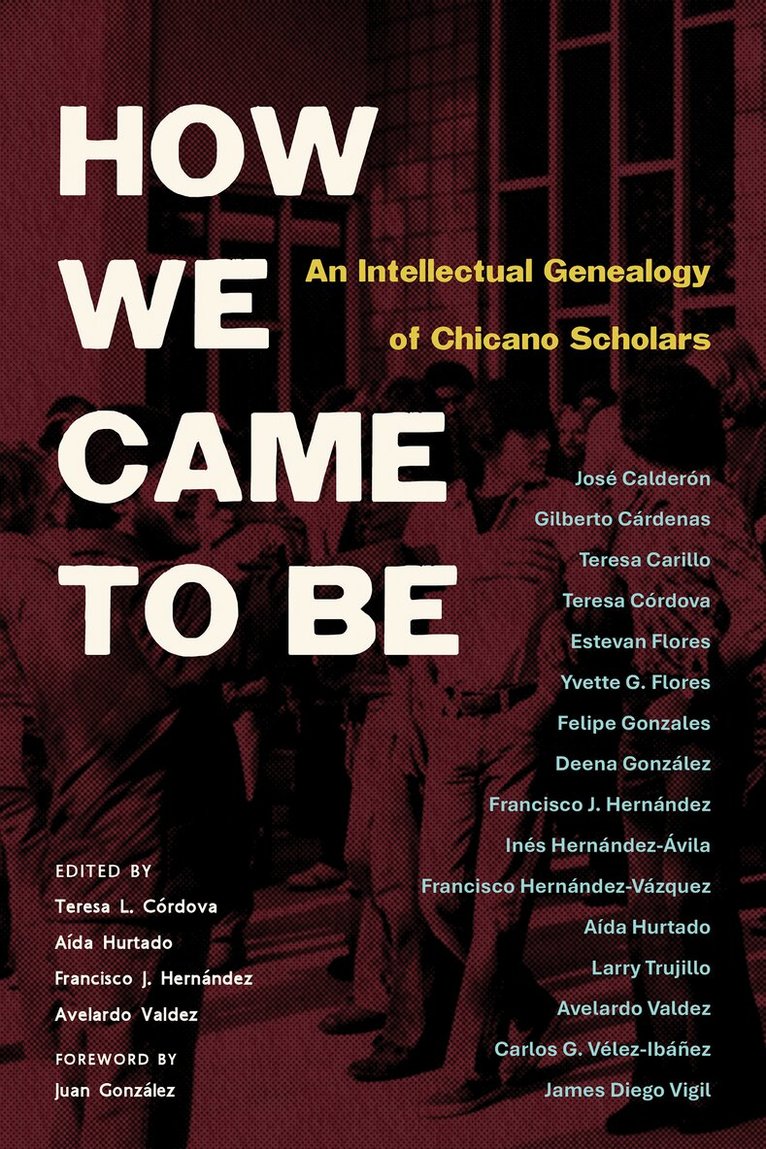
This work chronicles the lives and legacies of Chicana and Chicano scholars whose formative experiences in the Chicano Movement shaped the development of Chicano studies and transformed higher education. Originating from the Reuniones de Colegas Chicanas—gatherings of veteran scholars reflecting on their shared histories—the volume features sixteen essays organized into five thematic sections that explore the intersections of activism, scholarship, and institutional change.The contributors document how grassroots organizing evolved into academic inquiry, leading to the creation of departments, student support systems, and policy reforms that advanced equity and representation in universities. Essays address how community-engaged research influenced urban planning, health advocacy, and cultural production, while also highlighting Indigenous and transnational epistemologies that redefined theoretical frameworks in Chicano studies. The volume concludes with reflections on academic leadership and the breaking of barriers by Chicana scholars in higher education administration.Together, these essays offer a powerful intellectual history and a testament to a generation's enduring commitment to social justice. How We Came to Be is both a scholarly archive and a call to action, preserving the legacy of those who built Chicano studies and inspiring future generations to continue the work of transformation within and beyond the academy.ContributorsJosé CalderónGilberto CárdenasTeresa CarilloTeresa CórdovaEstevan FloresYvette G. FloresFelipe GonzalesDeena GonzalezFrancisco J. HernándezInés Hernández-ÁvilaFrancisco Hernández-VázquezAída HurtadoLarry TrujilloAvelardo ValdezCarlos G. Vélez-IbáñezJames Diego Vigil
1 560 kr
Kommande
This work chronicles the lives and legacies of Chicana and Chicano scholars whose formative experiences in the Chicano Movement shaped the development of Chicano studies and transformed higher education. Originating from the Reuniones de Colegas Chicanas—gatherings of veteran scholars reflecting on their shared histories—the volume features sixteen essays organized into five thematic sections that explore the intersections of activism, scholarship, and institutional change.The contributors document how grassroots organizing evolved into academic inquiry, leading to the creation of departments, student support systems, and policy reforms that advanced equity and representation in universities. Essays address how community-engaged research influenced urban planning, health advocacy, and cultural production, while also highlighting Indigenous and transnational epistemologies that redefined theoretical frameworks in Chicano studies. The volume concludes with reflections on academic leadership and the breaking of barriers by Chicana scholars in higher education administration.Together, these essays offer a powerful intellectual history and a testament to a generation's enduring commitment to social justice. How We Came to Be is both a scholarly archive and a call to action, preserving the legacy of those who built Chicano studies and inspiring future generations to continue the work of transformation within and beyond the academy.ContributorsJosé CalderónGilberto CárdenasTeresa CarilloTeresa CórdovaEstevan FloresYvette G. FloresFelipe GonzalesDeena GonzalezFrancisco J. HernándezInés Hernández-ÁvilaFrancisco Hernández-VázquezAída HurtadoLarry TrujilloAvelardo ValdezCarlos G. Vélez-IbáñezJames Diego Vigil
367 kr
Skickas inom 10-15 vardagar
Long considered a pervasive value of Latino cultures both south and north of the US border, machismo-a hypermasculinity that obliterates any other possible influences on men’s attitudes and behavior-is still used to define Latino men and boys in the larger social narrative. Yet a closer look reveals young, educated Latino men who are going beyond machismo to a deeper understanding of women’s experiences and a commitment to ending gender oppression. This new Latino manhood is the subject of Beyond Machismo.Applying and expanding the concept of intersectionality developed by Chicana feminists, AÍda Hurtado and Mrinal Sinha explain how the influences of race, class, ethnicity, sexuality, and gender shape Latinos’ views of manhood, masculinity, and gender issues in Latino communities and their acceptance or rejection of feminism. In particular, the authors show how encountering Chicana feminist writings in college, as well as witnessing the horrors of sexist oppression in the United States and Latin America, propels young Latino men to a feminist consciousness. By focusing on young, high-achieving Latinos, Beyond Machismo elucidates this social group’s internal diversity, thereby providing a more nuanced understanding of the processes by which Latino men can overcome structural obstacles, form coalitions across lines of difference, and contribute to movements for social justice.
1 127 kr
Skickas inom 10-15 vardagar
2020 Second Place, Best Nonfiction Multi Author, International Latino Book AwardsCollecting the perspectives of scholars who reflect on their own relationships to particular garments, analyze the politics of dress, and examine the role of consumerism and entrepreneurialism in the production of creating and selling a style, meXicana Fashions examines and searches for meaning in these visible, performative aspects of identity.Focusing primarily on Chicanas but also considering trends connected to other Latin American communities, the authors highlight specific constituencies that are defined by region (“Tejana style,” “L.A. style”), age group (“homie,” “chola”), and social class (marked by haute couture labels such as Carolina Herrera and Oscar de la Renta). The essays acknowledge the complex layers of these styles, which are not mutually exclusive but instead reflect a range of intersections in occupation, origin, personality, sexuality, and fads. Other elements include urban indigenous fashion shows, the shifting quinceaÑera market, “walking altars” on the Days of the Dead, plus-size clothing, huipiles in the workplace, and dressing in drag. Together, these chapters illuminate the full array of messages woven into a vibrant social fabric.
362 kr
Skickas inom 7-10 vardagar
2020 Second Place, Best Nonfiction Multi Author, International Latino Book AwardsCollecting the perspectives of scholars who reflect on their own relationships to particular garments, analyze the politics of dress, and examine the role of consumerism and entrepreneurialism in the production of creating and selling a style, meXicana Fashions examines and searches for meaning in these visible, performative aspects of identity.Focusing primarily on Chicanas but also considering trends connected to other Latin American communities, the authors highlight specific constituencies that are defined by region (“Tejana style,” “L.A. style”), age group (“homie,” “chola”), and social class (marked by haute couture labels such as Carolina Herrera and Oscar de la Renta). The essays acknowledge the complex layers of these styles, which are not mutually exclusive but instead reflect a range of intersections in occupation, origin, personality, sexuality, and fads. Other elements include urban indigenous fashion shows, the shifting quinceaÑera market, “walking altars” on the Days of the Dead, plus-size clothing, huipiles in the workplace, and dressing in drag. Together, these chapters illuminate the full array of messages woven into a vibrant social fabric.