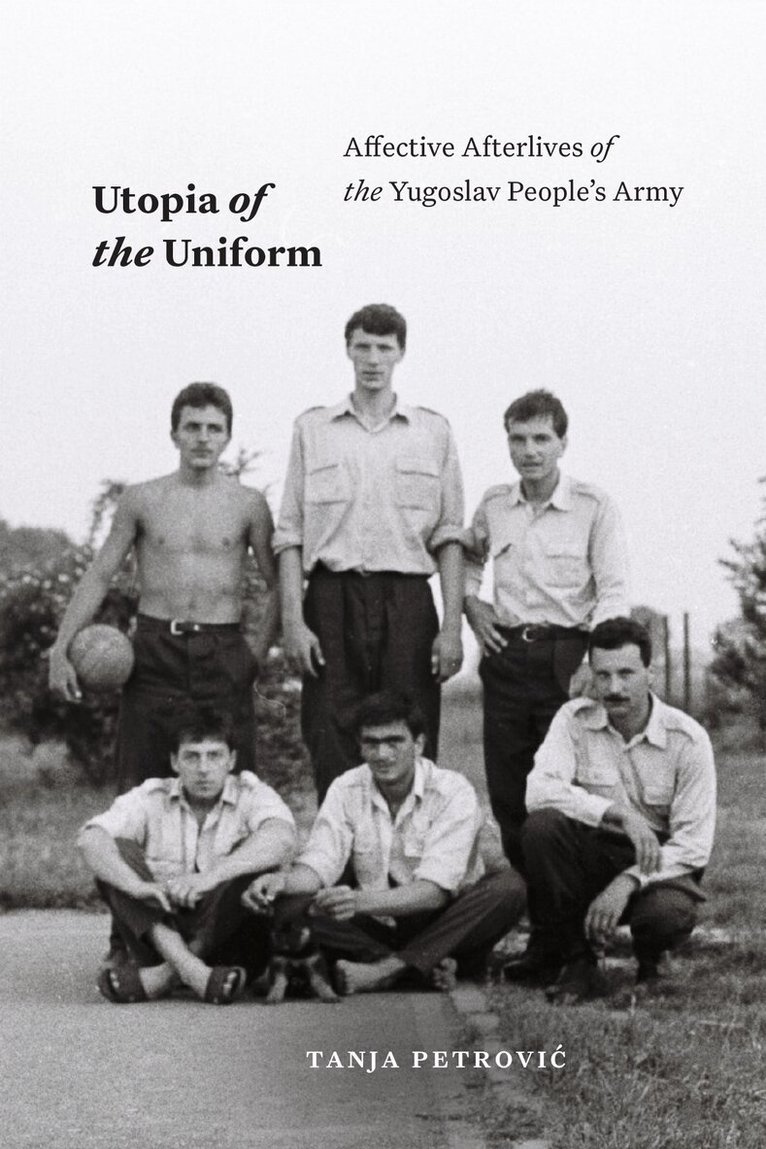
Häftad, Engelska, 2024
Utopia of the Uniform
Affective Afterlives of the Yugoslav People's Army
Del i serien Theory in Forms
297 kr
Beställningsvara. Skickas inom 7-10 vardagar. Fri frakt över 249 kr.
Beskrivning
Produktinformation
- Utgivningsdatum: 2024-03-15
- Mått: 152 x 229 x 14 mm
- Vikt: 408 g
- Format: Häftad
- Språk: Engelska
- Serie: Theory in Forms
- Antal sidor: 256
- Förlag: Duke University Press
- ISBN: 9781478025689
Utforska kategorier
Mer om författaren
Tanja Petrović is Head of the Institute of Culture and Memory Studies at the Research Center of the Slovenian Academy of Sciences and Arts. She is the author of numerous books, including A Long Way Home: Representations of the Western Balkans in Political and Media Discourses.
Recensioner i media
“In Utopia of the Uniform, Tanja Petrović offers a powerful and compelling narrative that provides a very much needed alternative reading of the end of socialist Yugoslavia. I particularly like the way the author mines the Yugoslav past for the possibilities of a utopian future. This book will shift the debate in a variety of fields.” - Kristen R. Ghodsee, author of (Everyday Utopia: What 2,000 Years of Wild Experiments Can Teach Us about the Good Life) “Tanja Petrović’s Utopia of the Uniform is a tender, provocative account of how men lived, thought, and felt in the Yugoslav armed forces. It is also about what happened to their friendships and solidarities when their country came apart at the seams. Petrović writes about masculinity from a place outside it. In so doing, she captures something that those who live it can’t see.” - Samuel Fury Childs Daly, author of (A History of the Republic of Biafra: Law, Crime, and the Nigerian Civil War) “Utopia of the Uniform stands out for its engaging language. The large number of first-hand testimonies and photographs transcend the hermeticism of academic literature, making it accessible to a wider readership interested in the former Yugoslavia.” - Astrea Nikolovska (Reviews in Anthropology) "The work is ethnographically rich and theoretically complex, arguing strongly that Yugoslavia was held together by such “affective infrastructures,” which made Yugoslavs see themselves as members of a collectivity. This study is an important corrective to the literature focusing on the wars that ended Yugoslavia and to the anthropology of the state. Recommended. Advanced undergraduates through faculty." - R. M. Hayden (Choice)
Betyg & recensioner
0 recensioner
Inga recensioner tillgängliga.