• Fri frakt över 249 kr
  • •
  • Snabba leveranser
  • •
  • Billiga böcker
Kundservice

Du är på sajten för privatpersoner.

Företag, bibliotek eller offentlig verksamhet?

Du handlar på classic.bokus.com, där alla dina funktioner finns intakta.
Till classic.bokus.com
Bokus logotyp. Gå till startsidan.
  • Erbjudanden
  • Nyheter
  • Student
  • Topplistor
  • Barn & ungdom
  • Bokus Play
  • E-böcker
  • Pocketböcker
  • Spel & pussel

10% rabatt på allt med kod NYSTART10 →

Sidfot

Mina sidor

    Hjälp

    • Kundservice
    • Vanliga frågor och svar
    • Frakt och leverans
    • Retur vid ångerrätt
    • Reklamera vara
    • Betalning
    • Köpvillkor
    • Allmänna villkor
    • Information om webbplatsens tillgänglighet

    Om Bokus

    • Om oss
    • Pressrum
    • För studenter
    • För företag
    • För bibliotek och offentlig verksamhet
    • För leverantörer
    • Hållbarhet

    Populärt

    • Aktuella erbjudanden
    • Presentkort
    • Studentlitteratur
    • Nya böcker
    • Topplistor
    • Signerade böcker
    • Engelska böcker

    Inspiration

    • Boktips
    • BookTok
    • Populära bokserier
    • Barnbokskaraktärer
    • Populära författare
    Logotyp för Bokus
    Följ oss på Facebook (extern länk)Följ oss på Instagram (extern länk)Följ oss på YouTube (extern länk)Följ oss på TikTok (extern länk)
    bokus @ CookiesAnpassa cookiesIntegritetspolicyKöpvillkor
    Till Citymail hemsida (extern länk)Till Budbee hemsida (extern länk)Till Postnord hemsida (extern länk)Till Schenker hemsida (extern länk)Till Early Bird hemsida (extern länk)Till Walleys hemsida (extern länk)
    1. Samhälle och politik
    2. Samhälle och kultur
    3. Sociala grupper och identitet
    4. Genusvetenskap

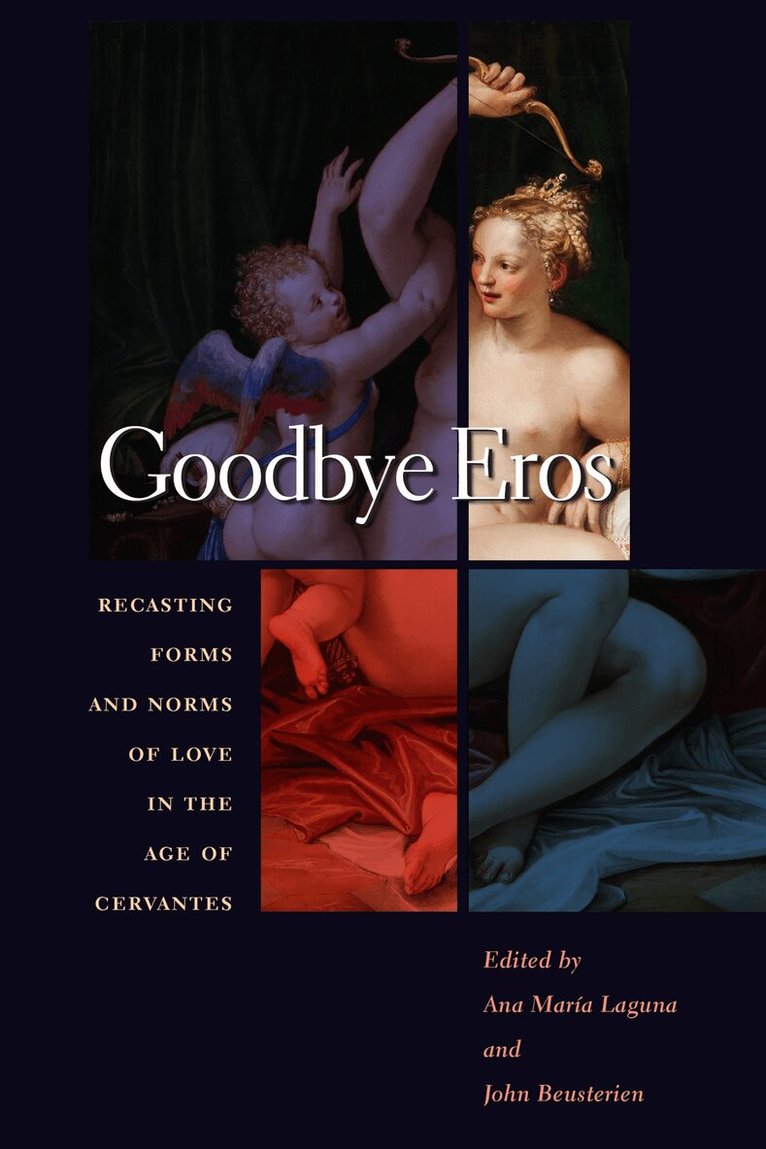
    Goodbye Eros

    Recasting Forms and Norms of Love in the Age of Cervantes

    AvAna Laguna,John Beusterien

    E-bok
    PDF, Engelska, 2020

    Del i serien Toronto Iberic

    1 029 kr

    Läs direkt i Bokus Reader – eller ladda ned till din enhet (PDF kräver ofta zoom och scroll på små skärmar).

    Beskrivning

    Traditional Petrarchan and Neoplatonic paradigms of love started to show clear signs of inadequacy and exhaustion in the sixteenth century. How did the Spanish Golden Age recast worn out discourses of love and make them compelling again? This volume explores how Spanish letters recognized that old love paradigms, especially the crisis of the subject, presented an extraordinary opportunity for revising traditional literary strictures. As a result, during Spain’s nascent modernity, literature took up the challenge to expand existing forms of desire and subjectivity.

    A range of scholars show how canonical and non-canonical Golden Age writers like Miguel de Cervantes, Diego Hurtado de Mendoza, Francisco de Quevedo, Luis de Góngora, Lope de Vega, and Francisco de la Torre y Sevil became equal agents of the sweeping ontological reconfiguration of the idea of eros that defined their culture. Such reconfiguration includes: the troubling displacement of "self" and "other" seen in sentimental genres like the pastoral or romance; the overlapping of emotions such as love and jealousy characteristic of the baroque lyric and dramatic production; and the conflation of axioms such as eros and eris prevalent in contemporaneous epic experiments.

    In uniting the findings of often surprising texts, the collection of essays in Goodbye Eros takes a pioneering look at how Golden Age moral, ideological, scientific, and literary discourses intersected to create fascinating re-elaborations of the trope of love.

    Produktinformation

    • Utgivningsdatum:2020-04-02
    • Språk:Engelska
    • Antal sidor:350
    • Filformat:PDF
    • Kopieringsskydd:LCP
    • ISBN:9781487519667
    • Förlag:University of Toronto Press
    • Serie:Toronto Iberic

    Utforska kategorier

    • Genusvetenskap inom Samhälle och politik

    Mer om författaren

    Ana Maria Laguna is an associate professor of Spanish at Rutgers University-Camden.John Beusterien is a professor of Spanish at Texas Tech University.

    Recensioner i media

    "In looking back on Cervantine cultural criticism, we find that there is an unspoken invitation to consider how our current generation of Cervantistas will be evaluated by scholars later in the twenty-first century. In the meantime, we can appreciate the creative and innovative approaches in Goodbye Eros, knowing that these erudite essays will surely inspire similarly provocative work in the future."- Sherry Velasco (Renaissance and Reformation, Vol. 43, No. 4) "The chapters gathered in Goodbye Eros: Recasting Forms and Norms of Love in the Age of Cervantes contribute a fresh approach to the critical dialogue as they highlight still contested issues pertaining to race, religion, politics, ethics, and sexuality, and further illustrate Cervantes’ universal and timeless relevance."- Kátia Sherman, Hillsdale College (Bulletin of Spanish Studies)

    Innehållsförteckning

    • Introduction: Eros in the Age of Cervantes Ana Maria Laguna, Rutgers University and John Beusterien, Texas Tech UniversityPart I. Amorous Optics: Reframing Perception, Gender Subjectivity, and Genre Convention1. Egocentricity versus Persuasion: Eros, Logos, and Pathos in Cervantes’s Marcela and Grisóstomo Episode Joan Cammarata, Manhattan College and Ana Maria Laguna, Rutgers University 2. The Deceived Gaze: Visual Fantasy, Art, and Feminine Adultery in Cervantes’s Reading of Ariosto Mercedes Alcalá Galán, University of Wisconsin-MadisonPart II. Reasoning the Unreasonable: Towards a Rationale of Love3. El Greco and Cervantes’s Euclidean Theologies Eric Clifford Graf, Francisco Marroquin University4. Love and the Laws of Literature: The Ethics and Poetics of Affect in Cervantes’s "The Little Gypsy Girl" Eli Cohen, Swarthmore College5. Eros and Ethos in the Political and Religious Logos of The Trials of Persiles and Sigismunda: The Anomic Character in Cervantes Jesús Maestro, University of OviedoPart III: Kissing between the Lines: Blurring Sexual and Racial Norms6. Sexy Beasts: Women and their Lapdogs in Baroque Satirical Verse Adrienne Martin, University of California, Santa Cruz7. Sexual Deviance and Morisco Marginality in Cervantes’s The Trials of Persiles and Sigismunda Christina Lee, Princeton University8. The Black Madonna Icon: Race, Rape, and the Virgin of Montserrat in The Confession with the Devil by Francisco de Torre y SevilJohn Beusterien, Texas Tech UniversityPart IV: Recasting Erotic and Heroic Molds9. For Love of the White Sea: The Curious Identity of Uludj Ali Diana de Armas Wilson, University of Denver10. Writing a Tragic Image: Eros and Eris in Lope de Vega’s Jerusalem Conquered Jason McCloskey, Bucknell University11. The Un-Romantic Approach to Don Quixote: Cervantine Love in the Spanish, Post-War AgeAna Maria Laguna, Rutgers UniversityNotes List of Contributors