• Fri frakt över 249 kr
  • •
  • Snabba leveranser
  • •
  • Billiga böcker
Kundservice

Du är på sajten för privatpersoner.

Företag, bibliotek eller offentlig verksamhet?

Du handlar på classic.bokus.com, där alla dina funktioner finns intakta.
Till classic.bokus.com
Bokus logotyp. Gå till startsidan.
  • Erbjudanden
  • Nyheter
  • Student
  • Topplistor
  • Barn & ungdom
  • Bokus Play
  • E-böcker
  • Pocketböcker
  • Spel & pussel

10% rabatt på allt med kod NYSTART10 →

Sidfot

Mina sidor

    Hjälp

    • Kundservice
    • Vanliga frågor och svar
    • Frakt och leverans
    • Retur vid ångerrätt
    • Reklamera vara
    • Betalning
    • Köpvillkor
    • Allmänna villkor
    • Information om webbplatsens tillgänglighet

    Om Bokus

    • Om oss
    • Pressrum
    • För studenter
    • För företag
    • För bibliotek och offentlig verksamhet
    • För leverantörer
    • Hållbarhet

    Populärt

    • Aktuella erbjudanden
    • Presentkort
    • Studentlitteratur
    • Nya böcker
    • Topplistor
    • Signerade böcker
    • Engelska böcker

    Inspiration

    • Boktips
    • BookTok
    • Populära bokserier
    • Barnbokskaraktärer
    • Populära författare
    Logotyp för Bokus
    Följ oss på Facebook (extern länk)Följ oss på Instagram (extern länk)Följ oss på YouTube (extern länk)Följ oss på TikTok (extern länk)
    bokus @ CookiesAnpassa cookiesIntegritetspolicyKöpvillkor
    Till Citymail hemsida (extern länk)Till Budbee hemsida (extern länk)Till Postnord hemsida (extern länk)Till Schenker hemsida (extern länk)Till Early Bird hemsida (extern länk)Till Walleys hemsida (extern länk)
    1. Naturvetenskap och teknik
    2. Matematik och naturvetenskap
    3. Matematik
    4. Tillämpad matematik

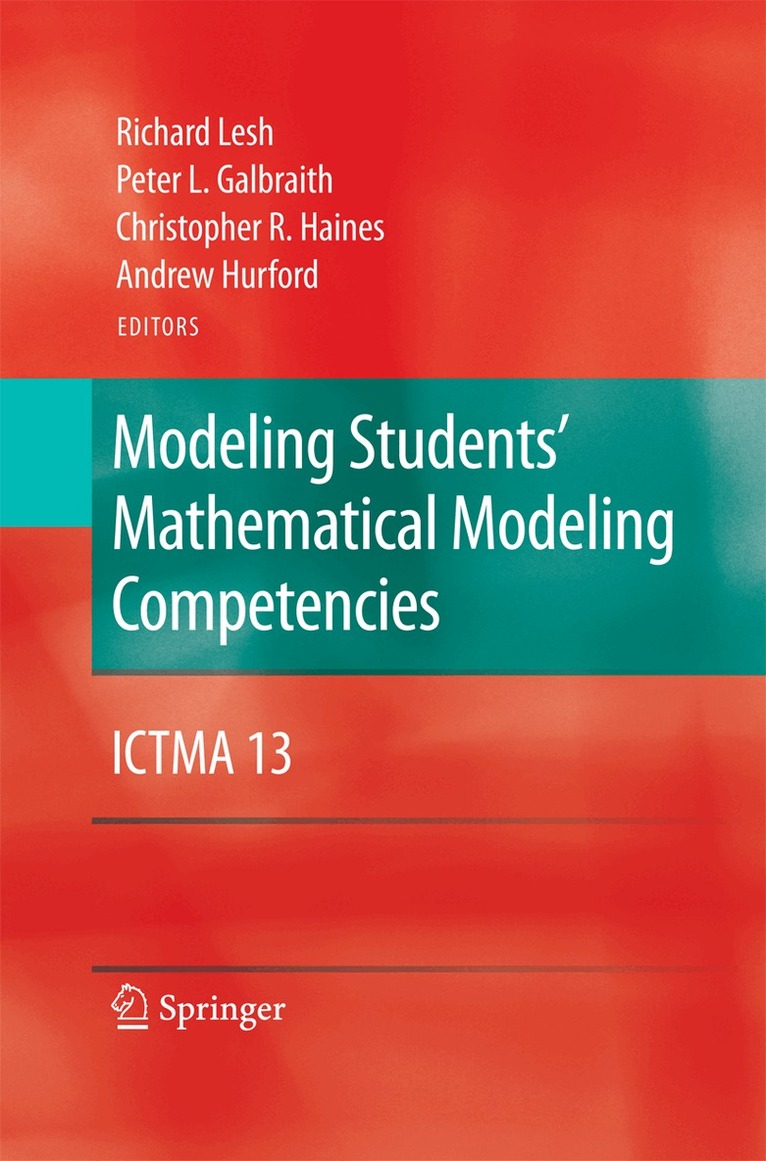
    Modeling Students' Mathematical Modeling Competencies

    ICTMA 13

    AvRichard Lesh,Peter L. Galbraith

    Häftad, Engelska, 2014

    1 625 kr

    Beställningsvara. Skickas inom 10-15 vardagar. Fri frakt över 249 kr.

    Beskrivning

    As we enter the 21st century, there is an urgent need for new approaches to mathematics education emphasizing its relevance in young learners’ futures. Modeling Students’ Mathematical Modeling Competencies explores the vital trend toward using real-world problems as a basis for teaching mathematics skills, competencies, and applications. Blending theoretical constructs and practical considerations, the book presents papers from the latest conference of the ICTMA, beginning with the basics (Why are models necessary? Where can we find them?) and moving through intricate concepts of how students perceive math, how instructors teach—and how both can become better learners. Dispatches as varied as classroom case studies, analyses of math in engineering work, and an in-depth review of modeling-based curricula in the Netherlands illustrate modeling activities on the job, methods of overcoming math resistance, and the movement toward replicable models and lifelong engagement.A sampling of topics covered:How students recognize the usefulness of mathematicsCreating the modeling-oriented classroomAssessing and evaluating students’ modeling capabilitiesThe relationship between modeling and problem-solvingInstructor methods for developing their own models of modelingNew technologies for modeling in the classroomModeling Students’ Mathematical Modeling Competencies offers welcome clarity and focus to the international research and professional community in mathematics, science, and engineering education, as well as those involved in the sciences of teaching and learning these subjects.

    Produktinformation

    • Utgivningsdatum:2014-09-02
    • Mått:155 x 235 x 36 mm
    • Vikt:996 g
    • Format:Häftad
    • Språk:Engelska
    • Antal sidor:650
    • Förlag:Springer-Verlag New York Inc.
    • ISBN:9781489983893

    Utforska kategorier

    • Tillämpad matematik inom Naturvetenskap och teknik
    • Naturvetenskap:allmänt inom Naturvetenskap och teknik

    Innehållsförteckning

    • The Nature of Models & Modeling.- Introduction: ICTMA and the Teaching of Modeling and Applications.- to Part I Modeling: What Is It? Why Do It?.- What Are Models?.- Modeling Theory for Math and Science Education.- Modeling a Crucial Aspect of Students’ Mathematical Modeling.- Modeling Perspectives in Math Education Research.- Where Are Models & Modelers Found?.- Modeling to Address Techno-Mathematical Literacies in Work.- Mathematical Modeling in Engineering Design Projects.- The Mathematical Expertise of Mechanical Engineers – The Case of Mechanism Design.- What Do Modeling Processes Look Like?.- Modeling and Quantitative Reasoning: The Summer Jobs Problem.- Tracing Students’ Modeling Processes in School.- What Creates The Need For Modeling.- Turning Ideas into Modeling Problems.- Remarks on a Modeling Cycle and Interpreting Behaviours.- Model Eliciting Environments as “Nurseries” for Modeling Probabilistic Situations.- Models as Tools, Especially for Making Sense of Problems.- In-Depth Use of Modeling in Engineering Coursework to Enhance Problem Solving.- Generative Activities: Making Sense of 1098 Functions.- How Do Models Develop?.- Modeling the Sensorial Perception in the Classroom.- Assessing a Modeling Process of a Linear Pattern Task.- Single Solution, Multiple Perspectives.- How is Modeling Different than Solving?.- Problem Solving Versus Modeling.- Investigating the Relationship Between the Problem and the Solver: Who Decides What Math Gets Used?.- Communication: The Essential Difference Between Mathematical Modeling and Problem Solving.- Analysis of Modeling Problem Solutions with Methods of Problem Solving.- Modeling in School Classrooms.- Modeling in K-16 Mathematics Classrooms – and Beyond.- How Can Students Recognize the Need for Modeling?.-Modeling with Complex Data in the Primary School.- Two Cases Studies of Fifth Grade Students Reasoning About Levers.- Don’t Disrespect Me: Affect in an Urban Math Class.- How Do Classroom Modling Communities Develop?.- Interdisciplinary Modeling Instruction: Helping Fifth Graders Learn About Levers.- Modeling Discourse in Secondary Science and Mathematics Classrooms.- A Middle Grade Teacher’s Guide to Model Eliciting Activities.- The Students’ Discussions in the Modeling Environment.- The Social Organization of a Middle School Mathematics Group Discussion.- Identifying Challenges within Transition Phases of Mathematical Modeling Activities at Year 9.- Realistic Mathematical Modeling and Problem Posing.- Modeling in Class and the Development of Beliefs about the Usefulness of Mathematics.- How Do Teachers Develop Models of Modeling?.- Insights into Teachers’ Unconscious Behaviour in Modeling Contexts.- Future Teachers’ Professional Knowledge on Modeling.- Theory Meets Practice: Working Pragmatically Within Different Cultures and Traditions.- Secondary Teachers Learn and Refine Their Knowledge During Modeling Activities in a Learning Community Environment.- An Investigation of Teachers’ Shared Interpretations of Their Roles in Supporting and Enhancing Group Functioning.- Mathematical Modeling: Implications for Teaching.- A Professional Development Course with an Introduction of Models and Modeling in Science.- Modeling as Isomorphism: The Case of Teacher Education.- Mathematical Modeling and the Teachers’ Tensions.- A Case Study of Two Teachers: Teacher Questions and Student Explanations.- Pre-service Teachers’ Perceptions of Model Eliciting Activities.- How Do New Technologies Influence Modeling In School?.- Modeling Practices with The Geometer’sSketchpad.- A Principal Components Model of Simcalc Mathworlds.- Modeling Random Binomial Rabbit Hops.- Investigating Mathematical Search Behavior Using Network Analysis.- Mathematical Modeling and Virtual Environments.- What is The History of Modeling in Schools?.- On the Use of Realistic Fermi Problems in Introducing Mathematical Modelling in Upper Secondary Mathematics.- The Dutch Maths Curriculum: 25 Years of Modelling.