• Fri frakt över 249 kr
  • •
  • Snabba leveranser
  • •
  • Billiga böcker
Kundservice

Du är på sajten för privatpersoner.

Företag, bibliotek eller offentlig verksamhet?

Du handlar på classic.bokus.com, där alla dina funktioner finns intakta.
Till classic.bokus.com
Bokus logotyp. Gå till startsidan.
  • Erbjudanden
  • Student
  • Topplistor
  • Barn & ungdom
  • Bokus Play
  • Bokus Play
  • E-böcker
  • Ljudböcker
  • Pocketböcker
  • Spel & pussel

10% rabatt på allt med kod NYSTART10 →

Sidfot

Mina sidor

    Hjälp

    • Kundservice
    • Vanliga frågor och svar
    • Frakt och leverans
    • Retur vid ångerrätt
    • Reklamera vara
    • Betalning
    • Köpvillkor
    • Allmänna villkor
    • Information om webbplatsens tillgänglighet

    Om Bokus

    • Om oss
    • Pressrum
    • För studenter
    • För företag
    • För bibliotek och offentlig verksamhet
    • För leverantörer
    • Hållbarhet

    Populärt

    • Aktuella erbjudanden
    • Presentkort
    • Studentlitteratur
    • Nya böcker
    • Topplistor
    • Signerade böcker
    • Engelska böcker

    Inspiration

    • Boktips
    • BookTok
    • Populära bokserier
    • Barnbokskaraktärer
    • Populära författare
    Logotyp för Bokus
    Följ oss på Facebook (extern länk)Följ oss på Instagram (extern länk)Följ oss på YouTube (extern länk)Följ oss på TikTok (extern länk)
    bokus @ CookiesAnpassa cookiesIntegritetspolicyKöpvillkor
    Till Citymail hemsida (extern länk)Till Budbee hemsida (extern länk)Till Postnord hemsida (extern länk)Till Schenker hemsida (extern länk)Till Early Bird hemsida (extern länk)Till Walleys hemsida (extern länk)
    1. Psykologi och pedagogik
    2. Pedagogik
    3. Skolväsen och utbildningssystem
    4. Examination och betygsättning

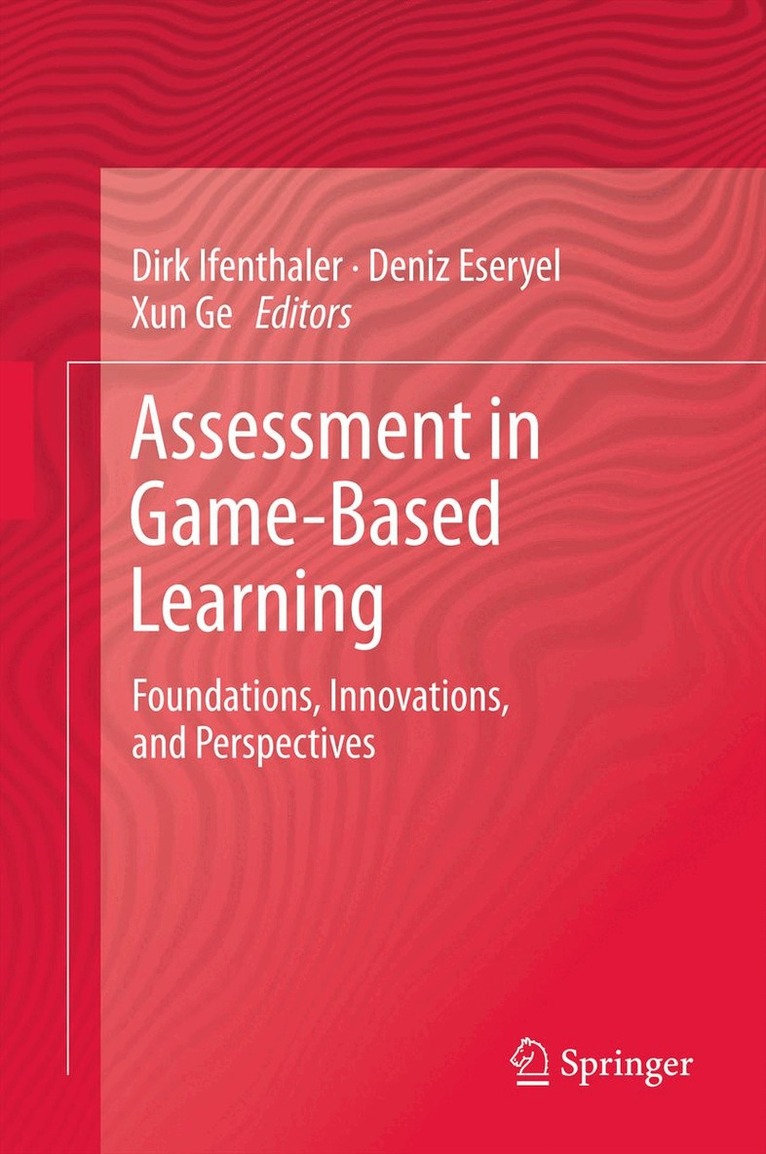
    Assessment in Game-Based Learning

    Foundations, Innovations, and Perspectives

    AvDirk Ifenthaler,Deniz Eseryel

    Häftad, Engelska, 2014

    1 054 kr

    Beställningsvara. Skickas inom 10-15 vardagar. Fri frakt över 249 kr.

    Beskrivning

    The capabilities and possibilities of emerging game-based learning technologies bring about a new perspective of learning and instruction. This, in turn, necessitates alternative ways to assess the kinds of learning that is taking place in the virtual worlds or informal settings. accordingly, aligning learning and assessment is the core for creating a favorable and effective learning environment. The edited volume will cover the current state of research, methodology, assessment, and technology of game-based learning. There will be contributions from international distinguished researchers which will present innovative work in the areas of educational psychology, educational diagnostics, educational technology, and learning sciences. The edited volume will be divided into four major parts.

    Produktinformation

    • Utgivningsdatum:2014-07-17
    • Mått:155 x 235 x 27 mm
    • Vikt:739 g
    • Format:Häftad
    • Språk:Engelska
    • Antal sidor:464
    • Förlag:Springer-Verlag New York Inc.
    • ISBN:9781489996015

    Utforska kategorier

    • Examination och betygsättning inom Psykologi och pedagogik
    • Material och digital teknik i undervisningen inom Psykologi och pedagogik

    Mer om författaren

    Dirk Ifenthaler’s research interests focus on the learning-dependent progression of mental models, complex problem solving, decision making, situational awareness, and emotions. He developed automated and computer-based methodologies for the assessment and analysis of graphical and natural language representations (SMD Technology, HIMATT, AKOVIA). Additionally, he developed components of course management software and an educational simulation games (DIVOSA, SEsim). He is also interested in the development of educational software and learning management systems (LMS) as well as technology integration into the classroom. Dr. Ifenthaler has published multiple books and book chapters as well as numerous articles in leading journals of the field. Dr. Ifenthaler is the current Fullbright Scholar in Residence at the Jeannine Rainboldt College of Education, University of Oklahoma.Deniz Eseryel is an Assistant Professor in the Instructional Psychology & Technology Program at the University of Oklahoma. Her research focuses on issues related to learning, problem-solving, and expertise development in complex, ill-structured knowledge domains such as STEM. She is concerned with developing and evaluating new instructional approaches for advanced computer-based learning environments to facilitate development of complex learning and problem-solving outcomes.Xun Ge is an Associate Professor with the Program of Instructional Psychology and Technology, Department of Educational Psychology, at the University of Oklahoma. She holds a Ph.D. in Instructional Systems from the Pennsylvania State University. Dr. Ge’s primary research interest involves scaffolding student complex and ill-structured problem solving and self-regulated learning through designing and developing instructional scaffolds, learning technologies, and open learning environments. Dr. Ge has published multiple book chapters and numerous articles in leadingjournals of the field, and she is recognized for the two awards – 2003 Young Scholar by Educational Technology Research & Development and 2004 Outstanding Journal Article by Association for Educational Communications and Technology.

    Recensioner i media

    From the reviews: "When applying video game technology to an educational process, one must ask how we know it is effective. Addressing that question is what this book is about. The book is an edited collection of 21 chapters divided into three parts ... . Three outstanding strengths of the book lead me to highly recommend it. ... This book would be of greatest interest to educators, academics, and researchers in game-based learning. ... it will also provide valuable perspectives for video game designers." (J. M. Artz, ACM Computing Reviews, October, 2012)

    Innehållsförteckning

    • -Foundations of game-based assessment. - Are all games the same? –The role of construct definintion in the creation of formative assessments in game-based learning. –Games, learning and assessment. –Three things game designers need to know about assessment. –Technological and methodological innovations for assessing game-based learning. –Patterns of game playing behaviors as indicators of mastery. – Taking activity-goal alignment into open-ended environments: Assessment and automation in game-based learning. –Infomration trails: In-process assessment of game-based learning. – Timed report measures learning. –Driving assessment of students’explanations in game dialogue. –Assessing learning games for school content: A TPACK-PCARD framework and methodology. –Implementing game-based learning:The MAPLET framework as a guide to learner-centered design and assessment. – Innovative assessment technologies in educational games. –Realizing assessment in game-based learning. –Interactivity design and assessment framework for educational games to promote motivation and complex problem-solving skills. – Measurement principles for gaming. – Using institutional data to evaluate game-based instructional designs. – Examing students’ cultural identity and player styles through avatar drawings in a game-based classroom. – Measurement and analysis of learners’ motivation in game-based e-learning. – Assessment of students’ emotions in game-based learning. –Designing for participation in educational video games. – Computer games as preparation for future learning.