• Fri frakt över 249 kr
  • •
  • Snabba leveranser
  • •
  • Billiga böcker
Kundservice

Du är på sajten för privatpersoner.

Företag, bibliotek eller offentlig verksamhet?

Du handlar på classic.bokus.com, där alla dina funktioner finns intakta.
Till classic.bokus.com
Bokus logotyp. Gå till startsidan.
  • Erbjudanden
  • Nyheter
  • Student
  • Topplistor
  • Barn & ungdom
  • Bokus Play
  • E-böcker
  • Pocketböcker
  • Spel & pussel

Må bättre, för mindre! Upp till 50% rabatt på hälsoböcker

Sidfot

Mina sidor

    Hjälp

    • Kundservice
    • Vanliga frågor och svar
    • Frakt och leverans
    • Retur vid ångerrätt
    • Reklamera vara
    • Betalning
    • Köpvillkor
    • Allmänna villkor
    • Information om webbplatsens tillgänglighet

    Om Bokus

    • Om oss
    • Pressrum
    • För studenter
    • För företag
    • För bibliotek och offentlig verksamhet
    • För leverantörer
    • Hållbarhet

    Populärt

    • Aktuella erbjudanden
    • Presentkort
    • Studentlitteratur
    • Nya böcker
    • Topplistor
    • Signerade böcker
    • Engelska böcker

    Inspiration

    • Boktips
    • BookTok
    • Populära bokserier
    • Barnbokskaraktärer
    • Populära författare
    Logotyp för Bokus
    Följ oss på Facebook (extern länk)Följ oss på Instagram (extern länk)Följ oss på YouTube (extern länk)Följ oss på TikTok (extern länk)
    bokus @ CookiesAnpassa cookiesIntegritetspolicyKöpvillkor
    Till Citymail hemsida (extern länk)Till Budbee hemsida (extern länk)Till Postnord hemsida (extern länk)Till Schenker hemsida (extern länk)Till Early Bird hemsida (extern länk)Till Walleys hemsida (extern länk)
    1. Medicin
    2. Andra medicinska specialiteter
    3. Neurologi och klinisk neurofysiologi
    4. Alzheimer, demens

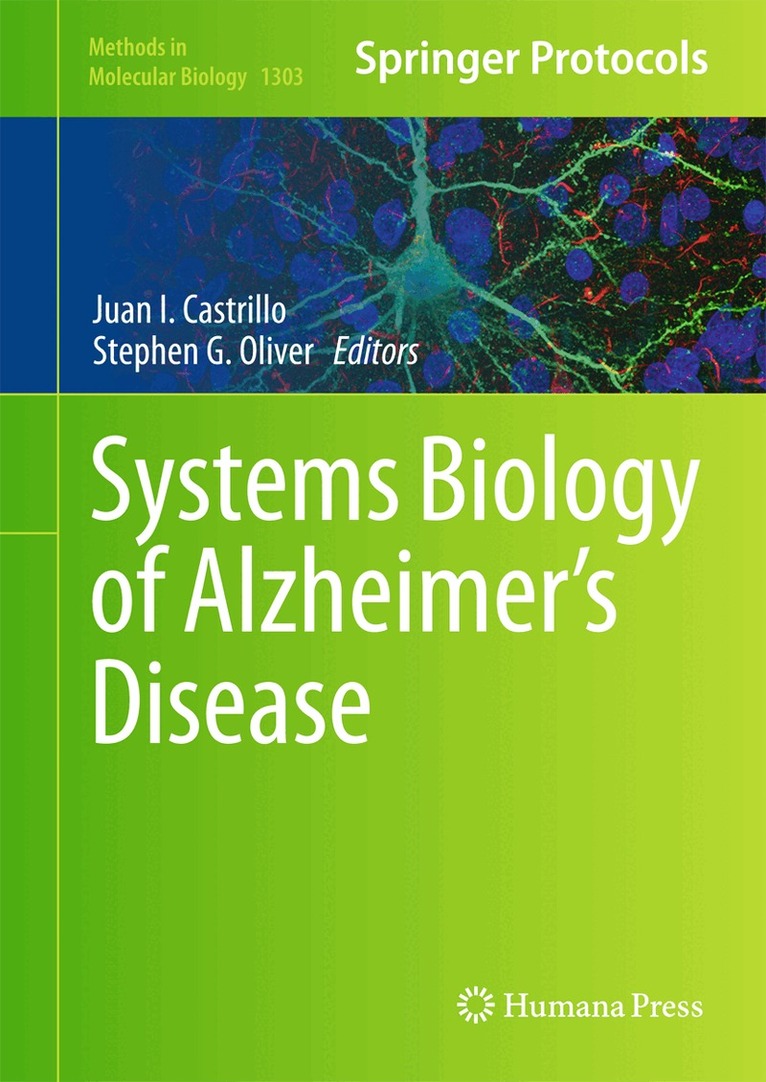
    Systems Biology of Alzheimer's Disease

    AvJuan I. Castrillo,Stephen G. Oliver

    Inbunden, Engelska, 2015

    Del i serien Methods in Molecular Biology

    2 381 kr

    Beställningsvara. Skickas inom 10-15 vardagar. Fri frakt över 249 kr.

    Beskrivning

    Alzheimer’s disease (AD) and many other neurodegenerative disorders are multifactorial in nature, involving a combination of genomic, epigenomic, network dynamic and environmental factors. A proper investigation requires new integrative Systems Biology approaches, at both the experimental and computational level. The interplay of disease mechanisms and homeostatic networks will underlie the time of onset and rate of progression of the disease.This book addresses such an integrated approach to AD. It aims to present Systems Biology, including both experimental and computational approaches, as a new strategy for the study of AD and other multifactorial diseases, with the hope that the results will translate into more effective diagnosis and treatment, as well as improved public health policies.Written for the highly successful Methods in Molecular Biology series, practical and cutting-edge, Systems Biology of Alzheimer’s Disease is intended for post-graduate students, post-doctoral researchers and experts in different fields with an interest in comprehensive Systems Biology strategies applicable to AD and other complex multifactorial diseases (including other neurodegenerative diseases and cancers). This book aims to complement other excellent volumes and monographs on AD that cover fundamental, physiological or medical aspects of the disease.

    Produktinformation

    • Utgivningsdatum:2015-08-05
    • Mått:178 x 254 x 35 mm
    • Vikt:1 404 g
    • Format:Inbunden
    • Språk:Engelska
    • Serie:Methods in Molecular Biology
    • Antal sidor:563
    • Upplaga:15001
    • Förlag:Humana Press Inc.
    • ISBN:9781493926268

    Utforska kategorier

    • Alzheimer, demens inom Medicin
    • Biologi inom Naturvetenskap och teknik

    Mer om författaren

    Stephen G. OliverDepartment of Biochemistry & Cambridge Systems Biology CentreUniversity of CambridgeCambridge UKsteve.oliver@bioc.cam.ac.uk Juan I. CastrilloDepartment of Biochemistry & Cambridge Systems Biology CentreUniversity of CambridgeCambridge UK Genetadi Biotech S.L. PraqueTecnologico de BizkaiaDerio, Bizkaia, Spainjicd28@yahoo.co.uk   jic28@genetadi.com

    Recensioner i media

    "The book represents a very useful introduction to Systems Biology as the approach necessary to obtain a global view of the dysregulation of pathways involved in AD. In the need for standardization of techniques, the methods described in this book provide a step forward in the definition of common guidelines leading to the reproducible and dependable results necessary for a better understanding of the pathophysiology of AD." (Dr. Alessandro Villa, Journal of Alzheimer's Disease, Vol. 50, 2016)

    Innehållsförteckning

    • Alzheimer’s as a Systems-Level Disease Involving the Interplay of Multiple Cellular Networks.- Application of Systems Theory in Longitudinal Studies on the Origin and Progression of Alzheimer’s Disease.- The APP Proteolytic System and Its Interactions with Dynamic Networks in Alzheimer’s Disease.- Effects of Mild and Severe Oxidative Stress on BACE1 Expression and APP Amyloidogenic Processing.- Advanced Assay Monitoring APP-Carboxyl-Terminal Fragments as Markers of APP Processing in Alzheimer Disease Mouse Models.- Advanced Optical Super-Resolution Method and Techniques for the Study of β-Amyloid Aggregation In Vitro and In Vivo.- Protocols for Monitoring the Development of Tau Pathology in Alzheimer’s Disease.- LC3-II Tagging and Western Blotting for Monitoring Autophagic Activity in Mammalian Cells.- Advanced Mitochondrial Respiration Assay for Evaluation of Mitochondrial Dysfunction in Alzheimer’s Disease.- Analysis of Microglial Proliferation in Alzheimer’s Disease.- Yeast as aModel for Alzheimer’s Disease: Latest Studies and Advanced Strategies.- Yeast as a Model for Studies on Aβ Aggregation Toxicity in Alzheimer’s Disease, Autophagic Responses, and Drug Screening.- Drosophila melanogaster as a Model for Studies on the Early Stages of Alzheimer’s Disease.- Chronic Mild Stress Assay Leading to Early Onset and Propagation of Alzheimer’s Disease Phenotype in Mouse Models.- Gene Expression Studies on Human Trisomy 21 iPSCs and Neurons: Towards Mechanisms Underlying Down’s Syndrome and Early Alzheimer’s Disease-Like Pathologies.- Cortical Differentiation of Human Pluripotent Cells for In Vitro Modeling of Alzheimer’s Disease.- Next Generation Sequencing in Alzheimer’s Disease.- Pooled-DNA Sequencing for Elucidating New Genomic Risk Factors, Rare Variants Underlying Alzheimer’s Disease.- New Genome-Wide Methods for Elucidation of Candidate Copy Number Variations (CNVs) Contributing to Alzheimer’s Disease Heritability.- RNA-Sequencing to Elucidate Early Patterns of Dysregulation Underlying the Onset of Alzheimer’s Disease.- Systems Biology Approaches to the Study of Biological Networks Underlying Alzheimer’s Disease: Role of miRNAs.- The Emerging Role of Metalloproteomics in Alzheimer’s Disease Research.- Redox Proteomics in Human Biofluids: Sample Preparation, Separation and Immunochemical Tagging for Analysis of Protein Oxidation.- Advanced Shotgun Lipidomics for Characterization of Altered Lipid Patterns in Neurodegenerative Diseases and Brain Injury.- AlzPathway, an Updated Map of Curated Signaling Pathways: Towards Deciphering Alzheimer’s Disease Pathogenesis.- A Computational Network Biology Approach to Uncover Novel Genes Related to Alzheimer’s Disease.- Network Approaches to the Understanding of Alzheimer’s Disease: From Model Organisms to Humans.- Characterization of Genetic Networks Associated with Alzheimer's Disease.- Network-Based Analysis for Uncovering Mechanisms Underlying Alzheimer’s Disease.- The SDREM Method for Reconstructing Signaling and Regulatory Response Networks: Applications for Studying Disease Progression.- Advanced Neuroimaging Methods Towards Characterization of Early Stages of Alzheimer’s Disease.- Plasma Proteomics Biomarkers in Alzheimer's Disease: Latest Advances and Challenges.- A Practical Guide For Exploring Opportunities of Repurposing Drugs for CNS Diseases in Systems Biology.