• Fri frakt över 249 kr
  • •
  • Snabba leveranser
  • •
  • Billiga böcker
Kundservice

Du är på sajten för privatpersoner.

Företag, bibliotek eller offentlig verksamhet?

Du handlar på classic.bokus.com, där alla dina funktioner finns intakta.
Till classic.bokus.com
Bokus logotyp. Gå till startsidan.
  • Erbjudanden
  • Nyheter
  • Student
  • Topplistor
  • Barn & ungdom
  • Bokus Play
  • E-böcker
  • Pocketböcker
  • Spel & pussel

10% rabatt på allt med kod NYSTART10 →

Sidfot

Mina sidor

    Hjälp

    • Kundservice
    • Vanliga frågor och svar
    • Frakt och leverans
    • Retur vid ångerrätt
    • Reklamera vara
    • Betalning
    • Köpvillkor
    • Allmänna villkor
    • Information om webbplatsens tillgänglighet

    Om Bokus

    • Om oss
    • Pressrum
    • För studenter
    • För företag
    • För bibliotek och offentlig verksamhet
    • För leverantörer
    • Hållbarhet

    Populärt

    • Aktuella erbjudanden
    • Presentkort
    • Studentlitteratur
    • Nya böcker
    • Topplistor
    • Signerade böcker
    • Engelska böcker

    Inspiration

    • Boktips
    • BookTok
    • Populära bokserier
    • Barnbokskaraktärer
    • Populära författare
    Logotyp för Bokus
    Följ oss på Facebook (extern länk)Följ oss på Instagram (extern länk)Följ oss på YouTube (extern länk)Följ oss på TikTok (extern länk)
    bokus @ CookiesAnpassa cookiesIntegritetspolicyKöpvillkor
    Till Citymail hemsida (extern länk)Till Budbee hemsida (extern länk)Till Postnord hemsida (extern länk)Till Schenker hemsida (extern länk)Till Early Bird hemsida (extern länk)Till Walleys hemsida (extern länk)
    1. Historia och arkeologi
    2. Historia
    3. Historia: särskilda händelser och ämnen
    4. Socialhistoria och kulturhistoria

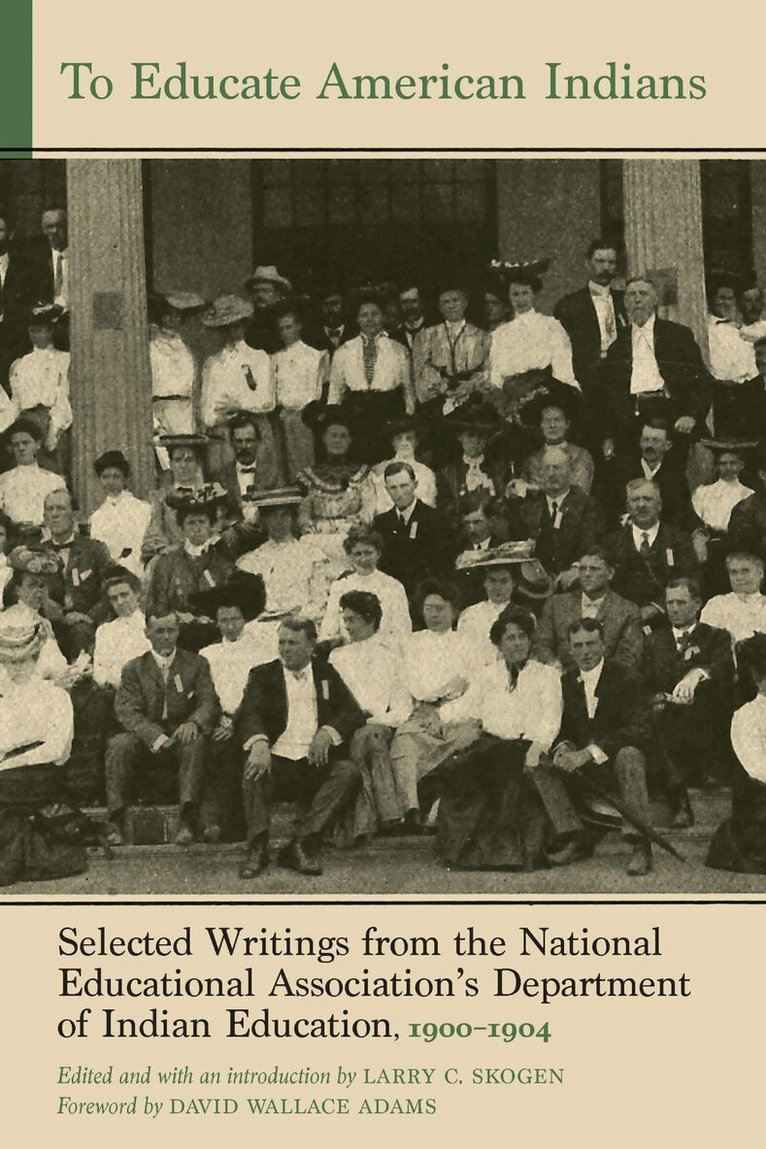
    To Educate American Indians

    Selected Writings from the National Educational Association's Department of Indian Education, 1900–1904

    AvLarry C. Skogen

    Inbunden, Engelska, 2024

    Del i serien Indigenous Education

    866 kr

    Beställningsvara. Skickas inom 10-15 vardagar. Fri frakt över 249 kr.

    Beskrivning

    To Educate American Indians presents the most complete versions of papers presented at the National Educational Association’s Department of Indian Education meetings during a time when the debate about how best to “civilize” Indigenous populations dominated discussions. During this time two philosophies drove the conversation. The first, an Enlightenment era–influenced universalism, held that through an educational alchemy American Indians would become productive, Christianized Americans, distinguishable from their white neighbors only by the color of their skin. Directly confronting the assimilationists’ universalism were the progressive educators who, strongly influenced by the era’s scientific racism, held the notion that American Indians could never become fully assimilated. Despite these differing views, a frightening ethnocentrism and an honor-bound dedication to “gifting” civilization to Native students dominated the writings of educators from the NEA’s Department of Indian Education.For a decade educators gathered at annual meetings and presented papers on how best to educate Native students. Though the NEA Proceedings published these papers, strict guidelines often meant they were heavily edited before publication. In this volume Larry C. Skogen presents many of these unedited papers and gives them historical context for the years 1900 to 1904.

    Produktinformation

    • Utgivningsdatum:2024-02-01
    • Mått:152 x 229 x undefined mm
    • Format:Inbunden
    • Språk:Engelska
    • Serie:Indigenous Education
    • Antal sidor:432
    • Förlag:University of Nebraska Press
    • Medarbetare:DavidWallace Adams
    • ISBN:9781496236760

    Utforska kategorier

    • Socialhistoria och kulturhistoria inom Historia och arkeologi
    • Pedagogik: historia inom Psykologi och pedagogik
    • Etnicitet inom Samhälle och politik

    Mer om författaren

    Larry C. Skogen is president emeritus of Bismarck State College, an independent historian, and a retired member of the U.S. Air Force. He is the author of Indian Depredation Claims, 1796–1920. David Wallace Adams (1941–2023) was a professor emeritus of education at Cleveland State University and the author of Education for Extinction: American Indians and the Boarding School Experience, 1875–1928.

    Recensioner i media

    “The National Education Association is a voice for education professionals and dedicated to preparing students for success in a diverse and interdependent world. That doesn’t mean, however, that the NEA hasn’t made mistakes and missteps along the way. With this important work, Larry Skogen provides a window into a time when the federal government forced a curriculum upon Native American students that subjugated them into a marginalized role in our country. The papers of the NEA Department of Indian Education (1900–1904) reveal the association’s role in advancing this harm. This critical study is a reality check for all Americans to learn our true history so that we better understand the mistakes of our past, can be a part of repairing harm, and can be agents of change to make a better future for all of our students and communities.”-Becky Pringle, president of the National Education Association “As our nation struggles with the realities of the Indian boarding school experience, it is important that we understand the motives and educational philosophies of those who administered and worked at those schools. In this groundbreaking work, Larry Skogen provides us with the story of the Indian service educators when they were part of the National Educational Association. Through these selected papers, we get a firsthand account of their efforts to assimilate Native students forcibly into white society. One cannot read these papers without feeling a sense of shame at the educators’ attitudes toward their own Native students. But it is important history that we need to acknowledge.”-Byron L. Dorgan, former U.S. Senator and chairman of the U.S. Senate Committee on Indian Affairs, author of The Girl in the Photograph “This is important work to enhance the body of knowledge on behalf of Indian Country and our future generations.”-Leander “Russ” McDonald (Dakota/Arikara), president of United Tribes Technical College in Bismarck, North Dakota “Where historians have used the tools of social history to examine the lives of employees in the Indian schools, Skogen’s work uses an intellectual lens to demonstrate how these workers drove important changes in curriculum and policy. This detailed and nuanced work helps to untangle the genocidal roots of boarding school systems and to see more clearly the challenges that Native people faced in moving their communities and cultures through the difficult years of the early twentieth century.”-Kevin Whalen, author of Native Students at Work: American Indian Labor and Sherman Institute’s Outing Program 1900–1945 “These NEA Indian Department presentations, which Larry Skogen does a masterful job of editing, provide an important window into how many people in the United States thought about American Indians and American Indian education in the beginning of the twentieth century. Skogen has done a remarkable job providing the reader with background information, both in his introduction to each document and in the extensive notes and references he provides.”-Jon A. Reyhner, author of American Indian Education: A History

    Innehållsförteckning

    • List of Illustrations Foreword, by David Wallace AdamsAcknowledgmentsIntroductionNote on Editorial Style, Citations, and NamesList of Abbreviations Part 1. Charleston, South Carolina, July 7–13, 19001. What Is the Relation of the Indian of the Present Decade to the Indian of the Future? H. B. Frissell, Principal, Hampton Normal and Agricultural Institute, Hampton, Virginia2. The Indian ProblemH. B. Frissell, Principal, Hampton Normal and Agricultural Institute, Hampton, Virginia3. The Proper Relation between Literary and Industrial Education in Indian SchoolsA. J. Standing, Assistant Superintendent, Carlisle Indian Industrial School, Carlisle, Pennsylvania4. The Training of Teachers for Indian SchoolsCharles Bartlett Dyke, Director of the Normal Department, Hampton Normal and Agricultural Institute, Hampton, Virginia5. Teaching Trades to IndiansFrank K. Rogers, Director, Armstrong-Slater Memorial Trade School, Hampton Normal and Agricultural Institute, Hampton, Virginia6. The Training of the Indian Girl as the Uplifter of the HomeJosephine E. Richards, Head of the Indian Department, Hampton Normal and Agricultural Institute, Hampton, Virginia7. Practical Methods of Indian EducationJohn Seger, Superintendent, Seger Colony School, Colony, OklahomaPart 2. Detroit, Michigan, July 8–12, 19018. President’s Address: Learning by DoingH. B. Frissell, Principal, Hampton Normal and Agricultural Institute, Hampton, Virginia9. Civilization and Higher EducationWilliam T. Harris, U.S. Commissioner of Education, Washington DC10. The Reservation Day School Should Be the Prime Factor in Indian EducationC. C. Covey, Teacher, Pine Ridge Indian School, Pine Ridge, South Dakota11. The Unification of Industrial and Academic Features of the Indian SchoolO. H. Bakeless, Carlisle Indian Industrial School, Carlisle, Pennsylvania12. What Shall Be Taught in an Indian School? Calvin M. Woodward, Director, Manual Training School of Washington University, St. Louis, Missouri13. An All-Around Mechanical Training for IndiansFrank K. Rogers, Director, Armstrong-Slater Memorial Trade School, Hampton Normal and Agricultural Institute, Hampton, Virginia14. Practical Methods in Indian EducationJoseph W. Evans, Teacher, Chilocco Indian School, Chilocco, Oklahoma15. Character Building among Indian ChildrenCora M. Folsom, Teacher and Indian Corresponding Secretary, Hampton Normal and Agricultural Institute, Hampton, Virginia16. The Day School: The Gradual Uplifter of the TribeMacaria Murphy, Teacher, Odanah Day School, Odanah, Wisconsin17. The Necessity for a Large Agricultural School in the Indian ServiceC. W. Goodman, Superintendent, Chilocco Indian School, Chilocco, OklahomaPart 3. Minneapolis, Minnesota, July 7–11, 190218. President’s AddressS. M. McCowan, Superintendent, Chilocco Indian School, Chilocco, Oklahoma19. The Value of an Agricultural School in the Indian ServiceS. M. McCowan, Superintendent, Chilocco Indian School, Chilocco, Oklahoma20. The Value of the Outing System for GirlsLaura Jackson, Girls’ Manager, Carlisle Indian Industrial School, Carlisle, Pennsylvania21. What Is Our Aim? E. A. Allen, Assistant Superintendent, Carlisle Indian Industrial School, Carlisle, Pennsylvania22. Needed Changes in Indian SchoolsA. O. Wright, Supervisor of Indian Schools, Washington DC23. The Value of Day SchoolsJames J. Duncan, Day School Inspector, Pine Ridge, South Dakota24. Newspapers in Indian SchoolsW. T. Harris, U.S. Commissioner of Education, Washington DCPart 4. Boston, Massachusetts, July 6–10, 190325. President’s Address: Our Work, Its Progress and NeedsH. B. Peairs, Superintendent, Haskell Institute, Lawrence, Kansas26. To What Degree Has the Present System of Indian Schools Been Successful in Qualifying for Citizenship? H. B. Frissell, Principal, Hampton Normal and Agricultural Institute, Hampton, Virginia27. An Alaskan Start toward CitizenshipSheldon Jackson, General Agent of Education in Alaska, Washington DC28. The White Man’s Burden versus Indigenous Development for the Lower RacesG. Stanley Hall, President, Clark University, Worcester, Massachusetts29. Heart Culture in Indian EducationCharles F. Meserve, President, Shaw University, Raleigh, North Carolina30. Tenure in the Civil ServiceJohn T. Doyle, Secretary of the U.S. Civil Service Commission, Washington DCPart 5. St. Louis, Missouri, June 27–July 1, 190431. Efficiency in the Indian ServiceJohn T. Doyle, Secretary of the U.S. Civil Service Commission, Washington DC32. Indian Music and Indian EducationNatalie Curtis, New York, New York33. What’s in a Name? Emily S. Cook, Office of Indian Affairs, Washington DC34. Indian NamesAlice C. Fletcher, Ex-President of the Anthropological Society, Washington DC ConclusionNotesBibliographyIndex