• Fri frakt över 249 kr
  • •
  • Snabba leveranser
  • •
  • Billiga böcker
Kundservice

Du är på sajten för privatpersoner.

Företag, bibliotek eller offentlig verksamhet?

Du handlar på classic.bokus.com, där alla dina funktioner finns intakta.
Till classic.bokus.com
Bokus logotyp. Gå till startsidan.
  • Erbjudanden
  • Nyheter
  • Student
  • Topplistor
  • Barn & ungdom
  • Bokus Play
  • E-böcker
  • Pocketböcker
  • Spel & pussel

10% rabatt på allt med kod: NYSTART10 →

Sidfot

Mina sidor

    Hjälp

    • Kundservice
    • Vanliga frågor och svar
    • Frakt och leverans
    • Retur vid ångerrätt
    • Reklamera vara
    • Betalning
    • Köpvillkor
    • Allmänna villkor
    • Information om webbplatsens tillgänglighet

    Om Bokus

    • Om oss
    • Pressrum
    • För studenter
    • För företag
    • För bibliotek och offentlig verksamhet
    • För leverantörer
    • Hållbarhet

    Populärt

    • Aktuella erbjudanden
    • Presentkort
    • Studentlitteratur
    • Nya böcker
    • Topplistor
    • Signerade böcker
    • Engelska böcker

    Inspiration

    • Boktips
    • BookTok
    • Populära bokserier
    • Barnbokskaraktärer
    • Populära författare
    Logotyp för Bokus
    Följ oss på Facebook (extern länk)Följ oss på Instagram (extern länk)Följ oss på YouTube (extern länk)Följ oss på TikTok (extern länk)
    bokus @ CookiesAnpassa cookiesIntegritetspolicyKöpvillkor
    Till Citymail hemsida (extern länk)Till Budbee hemsida (extern länk)Till Postnord hemsida (extern länk)Till Schenker hemsida (extern länk)Till Early Bird hemsida (extern länk)Till Walleys hemsida (extern länk)
    1. Historia och arkeologi
    2. Historia
    3. Historia: särskilda händelser och ämnen
    4. Socialhistoria och kulturhistoria

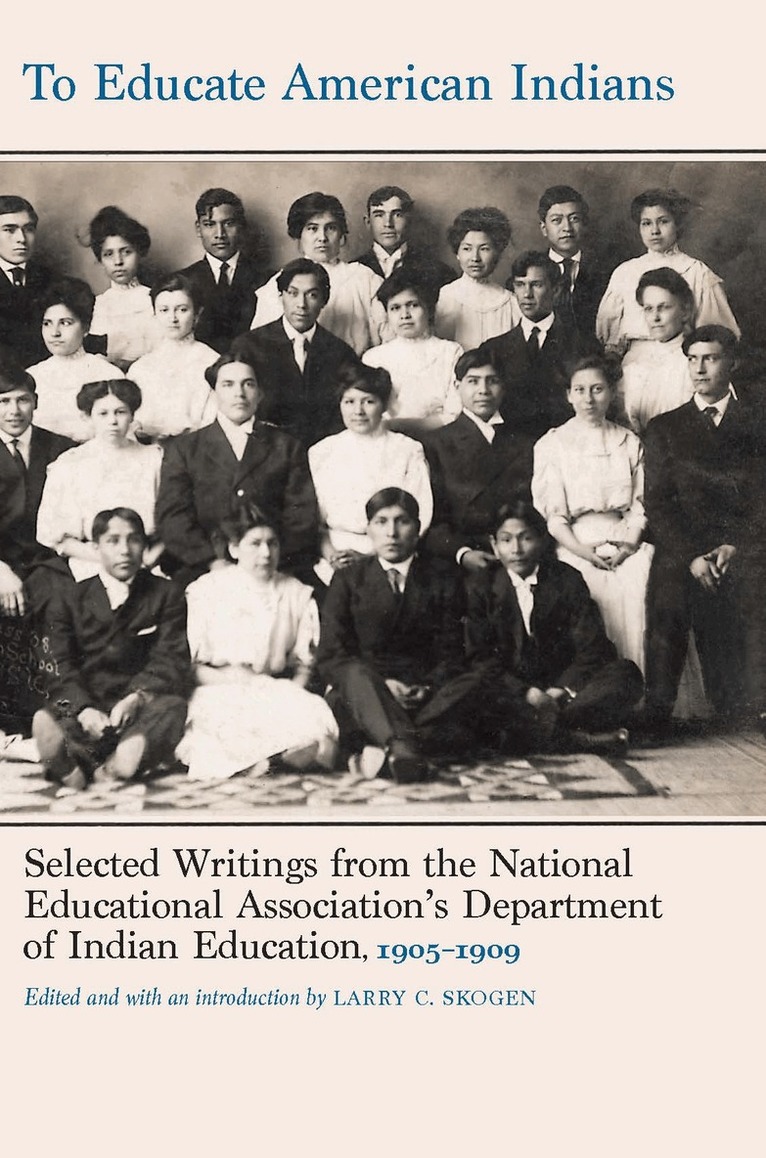
    To Educate American Indians

    Selected Writings from the National Educational Association's Department of Indian Education, 1905–1909

    AvLarry C. Skogen,Larry C. Skogen

    Inbunden, Engelska, 2025

    Del i serien Indigenous Education

    866 kr

    Beställningsvara. Skickas inom 10-15 vardagar. Fri frakt över 249 kr.

    Beskrivning

    From 1900 to 1909, Indian school educators gathered at annual meetings of the National Educational Association’s Department of Indian Education. The papers they delivered were later published in the Journal of Proceedings and Addresses of the National Educational Association, but strict guidelines often meant they were heavily edited before publication. In this second volume of Department of Indian Education papers, Larry C. Skogen presents selected complete papers from the years 1905 to 1909 and provides historical context.During this period educators promoted the belief that Natives could never be fully integrated into white society and argued instead for vocational and practical education near or on reservations, a clear break from earlier years, when prominent Indian school administrators advocated education far removed from Native communities. Indian school educators at these annual meetings also shared their methods with other educational thinkers and practitioners, who were seeking alternative pedagogies as new immigrants arrived in U.S. cities and challenges arose from new island territories. These selected writings reveal how the NEA influenced Indian school educators and how those educators, in turn, affected mainstream educational thinking.

    Produktinformation

    • Utgivningsdatum:2025-11-01
    • Mått:152 x 229 x undefined mm
    • Format:Inbunden
    • Språk:Engelska
    • Serie:Indigenous Education
    • Antal sidor:378
    • Förlag:University of Nebraska Press
    • ISBN:9781496240453

    Utforska kategorier

    • Socialhistoria och kulturhistoria inom Historia och arkeologi
    • Pedagogik: historia inom Psykologi och pedagogik
    • Etnicitet inom Samhälle och politik

    Mer om författaren

    Larry C. Skogen is president emeritus of Bismarck State College, an independent historian, and a retired member of the U.S. Air Force. He is the editor of To Educate American Indians: Selected Writings from the National Educational Association’s Department of Indian Education, 1900–1904 and the author of Indian Depredation Claims, 1796–1920.

    Recensioner i media

    “Larry Skogen’s important and seminal work is a timely adjunct to the Federal Indian Boarding School Initiative, which seeks to expand our nation’s understanding and documentation of the federal Indian boarding schools. This collection of papers presented by Indian school employees at the annual meetings of the National Educational Association and Skogen’s commentary with them provide another lens through which to see the motives of educators in the national effort to solve the ‘Indian problem.’ With this book we are drawn toward a better understanding of the challenges faced by the Native students subjected to the federally mandated curriculum designed to make these First Americans into white-defined American citizens.”—Cynthia Lindquist (Spirit Lake Dakota), president emerita of Cankdeska Cikana Community College in Fort Totten, North Dakota “Since the launching of the Federal Indian Boarding School Initiative in June 2021, our nation has learned much about the establishment of Indian schools, the conditions children experienced at those institutions, and the intergenerational consequences of the trauma suffered. These papers from the National Educational Association’s Department of Indian Education and Larry Skogen’s commentary with them provide clear evidence that along with the consequences of trauma, we must also acknowledge the intergenerational impacts of an educational curriculum designed to relegate Native students to the bottom rungs of society. Being denied a true academic education and prepared solely as laborers in white society has also negatively affected Native peoples and nations for generations. This is an important contribution to understanding the relationship between our Native nations and the federal government.”—Ruth Anna Buffalo (Mandan Hidatsa Arikara Nation, Chiricahua Band of Apache descent), president of the National Native American Boarding School Healing Coalition “I was left with a greater realization of the influence the Department of Indian Education, under the leadership of Superintendent of Indian Schools Estelle Reel, had on national educational policy of marginalized students during its short ten-year association with the National Educational Association. Not only does Larry Skogen make available the NEA articles, but he also locates contemporary publications or versions edited by Superintendent Reel to demonstrate how Reel controlled the message of educational theory in Indian schools, Skogen’s extensive footnoting and addition of background documentation illuminates the characters and their philosophies.”—David H. DeJong, author of Paternalism to Partnership: The Administration of Indian Affairs, 1786–2021 “This volume investigates a short, but critical period, when efforts to Americanize ‘Indians’ were brought into alignment with the challenges of educating a massive, new, urban immigrant population, to render the latter fit to join the industrial work force. It engages with the ideas of social Darwinism that were current, and their impact on curricula. Previous scholars have touched on this topic, but the National Education Association has never before been the main focus of study. Carefully selected primary sources make up the bulk of this work. The different parts are linked by a clear and convincing argument that is progressively developed. The fact that these documents are assembled here will provide ready access to thinking and discussion about Indian education during these years, which will be a boom to all those grappling with primary source collections.”—Jacqueline Fear-Seagal, coeditor of Carlisle Indian Industrial School: Indigenous Histories, Memories, and Reclamations

    Innehållsförteckning

    • List of IllustrationsAcknowledgmentsIntroductionList of AbbreviationsPart 1. Asbury Park and Ocean Grove, New Jersey, July 3–7, 19051. Greeting to Indian School EducatorsHonorable John J. Fitzgerald, Member of the Committee on Indian Affairs, U. S.House of Representatives2. Greeting to Indian School EducatorsMary R. Campbell, Graduate Student in Philosophy, Johns Hopkins University, Baltimore, Maryland3. Greeting to Indian School EducatorsEstelle Reel, Superintendent of Indian Schools, Washington DC4. Music of the American IndianNatalie Curtis, New York City5. Teaching Indian Pupils to Speak EnglishReuben Perry, Superintendent, Navajo Indian School, Fort Defiance, Arizona6. Indian CharacteristicsMary C. Judd, Minneapolis, Minnesota7. The Advisability of Conducting Normal Schools to Train Teachers for the Specific Purpose of Instructing Indian ChildrenJohn D. Benedict, Superintendent of Schools in Indian Territory8. The Necessity for More and Better-Equipped Day SchoolsJames J. Duncan, Day School Inspector, Pine Ridge Agency, South DakotaPart 2. Los Angeles, California, July 8-12, 19079. Indians and Their EducationFrancis E. Leupp, Commissioner of Indian Affairs, Washington DC10. Response to Greetings from Local DignitariesFrancis E. Leupp, Commissioner of Indian Affairs, Washington DC11. Essential Features in the Education of the Child RaceGeorge P. Phenix, Superintendent of the Academic and Normal Departments, Hampton Normal and Agricultural Institute, Hampton, Virginia12. Native Indian ArtAngel De Cora, Instructor in Native Indian Art, Carlisle Indian Industrial School, Carlisle, Pennsylvania13. Roundtable ConferenceChairman-Francis E. Leupp, Commissioner of Indian Affairs, Washington DC (Question and Answer Portion)14. AddressElmer Ellsworth Brown, U. S. Commissioner of Education, Washington DC15. Manual Training in the Indian SchoolsMoses Friedman, Assistant Superintendent, Haskell Indian Institute, Lawrence, KansasPart 3. Cleveland, Ohio, June 29-July 3, 190816. Utilization of Experience in Home EnvironmentElla Flagg Young, Principal, Chicago Normal School, Chicago, Illinois17. Progress the Indian is Making Toward Citizenship and Self-SupportJohn H. Seger, Farm Manager, Seger Indian School, Colony, Oklahoma18. How Far Are the Principles of Education Along Indigenous Lines Applicable to American Indians?G. Stanley Hall, President, Clark University, Worchester, Massachusetts19. Commencement Exercise: An Oration Entitled “My People”Elisabeth Penny (Nez PercÉ), Class of 1908, Carlisle Indian Industrial School, Carlisle, PennsylvaniaPart 4. Denver, Colorado, July 3-9, 190920. President’s Address: A ResumÉ of Indian WorkCharles E. Burton, Superintendent, Grand Junction Indian School, Colorado21. The Prevention of Tuberculosis in the Indian SchoolsJoseph A. Murphy, Medical Supervisor, U. S. Indian Service, Washington DC22. Demonstration Lesson-Wheat and Bread MakingHaskell Indian School Teachers and Students, Lawrence, Kansas23. Our Educational Duties to the IndianJames H. Baker, President, University of Colorado, Boulder, Colorado24. Essential Features in the Education of the Child RacesCharles Bartlett Dyke, Headmaster, State Preparatory School, Boulder, Colorado25. The Teacher’s Responsibility to the Indian ChildSylvanus L. Heeter, Superintendent of Schools, St. Paul, Minnesota26. Character-Building-The Foundation of EducationJohn H. Phillips, Superintendent of Schools, Birmingham, Alabama27. What Education Has Done for the IndianHervey B. Peairs, Superintendent, Haskell Indian Institute, Lawrence, Kansas28. Moral Training-DiscussionGeorge W. Cross, Principal, Tohatchi Indian School, Tohatchi, New Mexico29. The Preservation of Aboriginal ArtsArthur J. Fynn, Principal, Longfellow School, Denver, Colorado30. Elementary Industrial Training in the Day SchoolS. Toledo Sherry, Day School Inspector, Standing Rock Agency, Fort Yates, North DakotaConclusionBibliographyIndex