• Fri frakt över 249 kr
  • •
  • Snabba leveranser
  • •
  • Billiga böcker
Kundservice

Du är på sajten för privatpersoner.

Företag, bibliotek eller offentlig verksamhet?

Du handlar på classic.bokus.com, där alla dina funktioner finns intakta.
Till classic.bokus.com
Bokus logotyp. Gå till startsidan.
  • Erbjudanden
  • Nyheter
  • Student
  • Topplistor
  • Barn & ungdom
  • Bokus Play
  • E-böcker
  • Pocketböcker
  • Spel & pussel

Må bättre, för mindre! Upp till 50% rabatt på hälsoböcker

Sidfot

Mina sidor

    Hjälp

    • Kundservice
    • Vanliga frågor och svar
    • Frakt och leverans
    • Retur vid ångerrätt
    • Reklamera vara
    • Betalning
    • Köpvillkor
    • Allmänna villkor
    • Information om webbplatsens tillgänglighet

    Om Bokus

    • Om oss
    • Pressrum
    • För studenter
    • För företag
    • För bibliotek och offentlig verksamhet
    • För leverantörer
    • Hållbarhet

    Populärt

    • Aktuella erbjudanden
    • Presentkort
    • Studentlitteratur
    • Nya böcker
    • Topplistor
    • Signerade böcker
    • Engelska böcker

    Inspiration

    • Boktips
    • BookTok
    • Populära bokserier
    • Barnbokskaraktärer
    • Populära författare
    Logotyp för Bokus
    Följ oss på Facebook (extern länk)Följ oss på Instagram (extern länk)Följ oss på YouTube (extern länk)Följ oss på TikTok (extern länk)
    bokus @ CookiesAnpassa cookiesIntegritetspolicyKöpvillkor
    Till Citymail hemsida (extern länk)Till Budbee hemsida (extern länk)Till Postnord hemsida (extern länk)Till Schenker hemsida (extern länk)Till Early Bird hemsida (extern länk)Till Walleys hemsida (extern länk)
    1. Historia och arkeologi
    2. Historia
    3. Europas historia

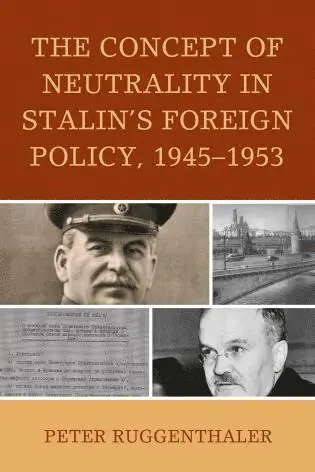
    Concept of Neutrality in Stalin's Foreign Policy, 1945–1953

    AvPeter Ruggenthaler

    Häftad, Engelska, 2017

    Del i serien Harvard Cold War Studies Book Series

    864 kr

    Beställningsvara. Skickas inom 10-15 vardagar. Fri frakt över 249 kr.

    Beskrivning

    Drawing on recently declassified Soviet archival sources, this book sheds new light on how the division of Europe came about in the aftermath of World War II. The book contravenes the notion that a neutral zone of states, including Germany, could have been set up between East and West. The Soviet Union under Joseph Stalin was determined to preserve control over its own sphere of German territory. By tracing Stalin's attitude toward neutrality in international politics, the book provides important insights into the origins of the Cold War.

    Produktinformation

    • Utgivningsdatum:2017-04-14
    • Mått:153 x 233 x 26 mm
    • Vikt:685 g
    • Format:Häftad
    • Språk:Engelska
    • Serie:Harvard Cold War Studies Book Series
    • Antal sidor:442
    • Förlag:Bloomsbury Publishing Plc
    • ISBN:9781498517454

    Utforska kategorier

    • Europas historia inom Historia och arkeologi
    • Marxism och kommunism inom Samhälle och politik
    • Internationella relationer inom Samhälle och politik

    Mer om författaren

    Peter Ruggenthaler is senior research fellow at the Ludwig Boltzmann Institute for Research on War´s Consequences and lecturer at the University of Graz.

    Recensioner i media

    Ruggenthaler has produced what is nothing less than one of the most important studies to date of Stalin’s post-war foreign policy. There is little doubt that it brings us several leaps forward in our understanding of this troubled period. It should be essential reading for historians and area specialists, as well as students of foreign policy analysis.

    Innehållsförteckning

    • Introduction: Soviet European Policy in World War IIChapter 1: Soviet Central and Northern European policy: 1945 to the Foundation of NATO in 1949The Soviet Union and the German Question 1945 to 1949Austria in the Context of Soviet European Policy (1945 to 1949)The Soviet Union and Scandinavia 1945-1949Chapter 2: Neutrality and the Consolidation of the Eastern Bloc—The Perpetuation of a Divided Europe: Stalin’s European Policy 1949 to 1952-1953The Foundation of COMECON: Soviet Aims and StrategiesSoviet Reactions to the Foundation of NATO Soviet German Policy 1949 to 1951Neutrality for a Unified Germany?The Soviet Union’s Austrian Policy Between 1949 and 1952-1953—Austria as a Factor in the Consolidation of the Eastern BlocThe USSR and ScandinaviaChapter 3: Neutrality and Soviet Foreign Policy