• Fri frakt över 249 kr
  • •
  • Snabba leveranser
  • •
  • Billiga böcker
Kundservice

Du är på sajten för privatpersoner.

Företag, bibliotek eller offentlig verksamhet?

Du handlar på classic.bokus.com, där alla dina funktioner finns intakta.
Till classic.bokus.com
Bokus logotyp. Gå till startsidan.
  • Erbjudanden
  • Nyheter
  • Student
  • Topplistor
  • Barn & ungdom
  • Bokus Play
  • E-böcker
  • Pocketböcker
  • Spel & pussel

10% rabatt på allt med kod: NYSTART10 →

Sidfot

Mina sidor

    Hjälp

    • Kundservice
    • Vanliga frågor och svar
    • Frakt och leverans
    • Retur vid ångerrätt
    • Reklamera vara
    • Betalning
    • Köpvillkor
    • Allmänna villkor
    • Information om webbplatsens tillgänglighet

    Om Bokus

    • Om oss
    • Pressrum
    • För studenter
    • För företag
    • För bibliotek och offentlig verksamhet
    • För leverantörer
    • Hållbarhet

    Populärt

    • Aktuella erbjudanden
    • Presentkort
    • Studentlitteratur
    • Nya böcker
    • Topplistor
    • Signerade böcker
    • Engelska böcker

    Inspiration

    • Boktips
    • BookTok
    • Populära bokserier
    • Barnbokskaraktärer
    • Populära författare
    Logotyp för Bokus
    Följ oss på Facebook (extern länk)Följ oss på Instagram (extern länk)Följ oss på YouTube (extern länk)Följ oss på TikTok (extern länk)
    bokus @ CookiesAnpassa cookiesIntegritetspolicyKöpvillkor
    Till Citymail hemsida (extern länk)Till Budbee hemsida (extern länk)Till Postnord hemsida (extern länk)Till Schenker hemsida (extern länk)Till Early Bird hemsida (extern länk)Till Walleys hemsida (extern länk)
    1. Psykologi och pedagogik
    2. Pedagogik
    3. Skolväsen och utbildningssystem
    4. Examination och betygsättning

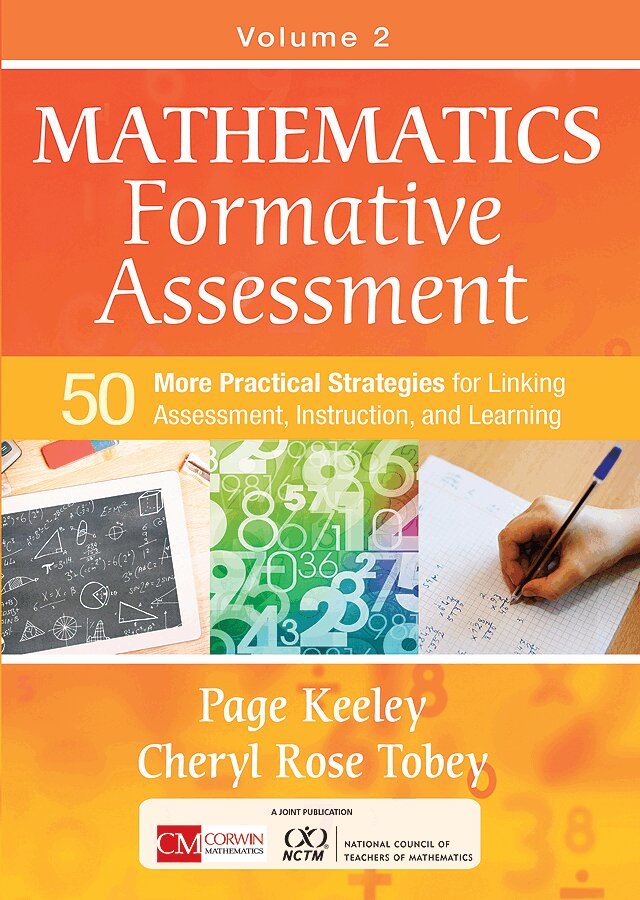
    Mathematics Formative Assessment, Volume 2

    50 More Practical Strategies for Linking Assessment, Instruction, and Learning

    AvPage D. Keeley,Cheryl Rose Tobey

    Häftad, Engelska, 2017

    Del i serien Corwin Mathematics Series

    587 kr

    Beställningsvara. Skickas inom 3-6 vardagar. Fri frakt över 249 kr.

    Beskrivning

    Everything you need to promote mathematical thinking and learning! Good math teachers have a robust repertoire of strategies to move students’ learning forward. This new volume from award-winning author Page Keeley and mathematics expert Cheryl Rose Tobey helps you improve student outcomes with 50 all-new formative assessment classroom techniques (FACTS) that are embedded throughout a cycle of instruction. Descriptions of how the FACTs promote learning and inform teaching, including illustrative examples, support the inextricable link between instruction and learning. Useful across disciplines, Keeley and Tobey’s purposeful assessment techniques help K-12 math teachers: Promote conceptual understanding Link techniques to core ideas and practices Modify instruction for diverse learnersSeamlessly embed formative assessment throughout the stages of instructionFocus on learning targets and feedbackInstead of a one-size fits all approach, you can build a bridge between your students’ initial ideas and correct mathematical thinking with this one-of-a-kind resource!

    Produktinformation

    • Utgivningsdatum:2017-04-26
    • Mått:177 x 254 x 15 mm
    • Vikt:490 g
    • Format:Häftad
    • Språk:Engelska
    • Serie:Corwin Mathematics Series
    • Antal sidor:256
    • Förlag:SAGE Publications Inc
    • ISBN:9781506311395

    Utforska kategorier

    • Examination och betygsättning inom Psykologi och pedagogik
    • Undervisning i specifika ämnen inom Psykologi och pedagogik

    Mer om författaren

    Page is a prolific author of over twenty national best-selling and award-winning books, including twelve books in the Uncovering Student Ideas in Science series, four books in the first edition Curriculum Topic Study series, and four books in the Science and Mathematics Formative Assessment- Practical Strategies for Linking Assessment, Instruction, and Learning series. Several of her books have received prestigious awards in educational publishing.  She has authored numerous journal articles and contributed to several book chapters. She is a frequent invited speaker at regional, national, and international conferences on the topic of formative assessment in science, understanding students’ (and teachers’) thinking, and teaching for conceptual understanding.Prior to leaving the classroom to work at the Maine Mathematics and Science Alliance in 1996, Page taught middle and high school science for 15 years. At that time she was an active teacher leader at the state and national level, serving two terms as President of the Maine Science Teachers Association and NSTA District II Director 1995-1998 and NSTA Executive Board member (prior to the Board and Council restructuring in 1997). She received the Presidential Award for Excellence in Secondary Science Teaching in 1992 and the Milken National Distinguished Educator Award in 1993.Since leaving the classroom in 1996, her work in leadership and professional development has been nationally recognized.  In 2008 she was elected the 63rd President of the National Science Teachers Association (NSTA), the world′s largest organization of K-12, university, and informal science educators. In 2009 she received the National Staff Development Council’s (now Learning Forward) . In 2013 she received the Outstanding Leadership in Science Education award from the National Science Education Leadership Association (NSELA) and in 2018, The Distinguished Service to Science Education Award from NSTA.  She has served as an adjunct instructor at the University of Maine, was a Cohort 1 Fellow in the National Academy for Science and Mathematics Education Leadership, was a science literacy leader for the AAAS/Project 2061 Professional Development Program, and served on several national advisory boards. She has a strong interest in global science education and has led science/STEM education delegations to South Africa (2009), China (2010), India (2012), Cuba (2014), Iceland (2017), Panama (2018), and Costa Rica (2019).Prior to entering the teaching profession, Page was a research assistant for immunogeneticist, Dr. Leonard Shultz, at the Jackson Laboratory of Mammalian Genetics in Bar Harbor, Maine. She received her B.S. in Life Sciences/pre-veterinary studies from the University of New Hampshire and her Masters degree in Science Education from the University of Maine. In her spare time she enjoys travel, reading, photography, fiber art, and dabbles in modernist cooking and culinary art. A Maine resident for almost 40 years, Page and her husband currently reside in Fort Myers, FL and Wickford, RI. Page can be contacted at pagekeeley@gmail.com or through her web site at www.uncoveringstudentideas.orgCheryl Rose Tobey is a senior mathematics associate at Education Development Center (EDC) in Massachusetts. She is the project director for Formative Assessment in the Mathematics Classroom: Engaging Teachers and Students (FACETS) and a mathematics specialist for Differentiated Professional Development: Building Mathematics Knowledge for Teaching Struggling Students (DPD); both projects are funded by the National Science Foundation (NSF). She also serves as a director of development for an Institute for Educational Science (IES) project, Eliciting Mathematics Misconceptions (EM2). Her work is primarily in the areas of formative assessment and professional development.Prior to joining EDC, Tobey was the senior program director for mathematics at the Maine Mathematics and Science Alliance (MMSA), where she served as the co–principal investigator of the mathematics section of the NSF-funded Curriculum Topic Study, and principal investigator and project director of two Title IIa state Mathematics and Science Partnership projects. Prior to working on these projects, Tobey was the co–principal investigator and project director for MMSA’s NSF-funded Local Systemic Change Initiative, Broadening Educational Access to Mathematics in Maine (BEAMM), and she was a fellow in Cohort 4 of the National Academy for Science and Mathematics Education Leadership. She is the coauthor of six published Corwin books, including seven books in the Uncovering Student Thinking series (2007, 2009, 2011, 2013, 2014), two Mathematics Curriculum Topic Study resources (2006, 2012), and Mathematics Formative Assessment: 75 Practical Strategies for Linking Assessment, Instruction and Learning (2011). Before joining MMSA in 2001 to begin working with teachers, Tobey was a high school and middle school mathematics educator for ten years. She received her BS in secondary mathematics education from the University of Maine at Farmington and her MEd from City University in Seattle. She currently lives in Maine with her husband and blended family of five children.

    Innehållsförteckning

    • PrefaceAcknowledgmentsAbout the AuthorsChapter 1: An Introduction to 50 More Formative Assessment Classroom Techniques (FACTs)Classroom Snapshot of Formative Assessment in PracticeWhy 50 More FACTs?Elicitation FACTsSupporting Productive Mathematics DiscourseNext StepsChapter 2: Formative Assessment and StandardsFACTs and Key Ideas in MathematicsFACTs and Mathematics PracticesChapter 3: Get the FACTs! Formative Assessment Classroom Techniques1. Comment Coding2. Concept Mix-Up Probes3. Confidence Level Assessment (CLA)4. Conjecture Cards5. Cover-Up6. Enhanced Multiple Choice7. Error Analysis8. Extended Sticky Bars9. Eye Contact Partners10. Feedback Check-Ins11. Feedback Focused Group Discourse12. Feedback Sandwich13. Find Someone Who14. Fingers Under Chin15. Flip the Question16. Four Corners Jigsaw17. Gallery Walk18. Group Frayer Model19. Group Talk Feedback20. Homework Card Sort21. I Think–I Rethink22. Interactive Whole-Class Card Sorting23. Learning Intentions24. Learning Intentions Reflection25. Let’s Keep Thinking26. Lines of Agreement27. Most and Least Sure About28. Now Ask Me a Question29. Partner Strategy Rounds30. Plus–Delta31. PMI (Plus–Minus–Interesting)32. Questioning Cue Cards33. Ranking Tasks34. RAQ (Revise, Add, Question) Feedback35. Reflect Aloud36. Reflect Then Self-Assess37. “Rules That Expire” Probes38. Seeing Structure39. Slide Sort40. Sort Envelopes41. Structures for Taking Action42. Success Indicators43. Success Indicator Problem Generating44. Take Stock45. Talk Moves46. Thermometer Feedback47. Traffic Light Sliders48. VDR (Vote, Discuss, Revote)49. What Stuck With You Today?50. X Marks the SpotAppendix: Annotated Resources for Mathematics Formative AssessmentReferencesIndex