• Fri frakt över 249 kr
  • •
  • Snabba leveranser
  • •
  • Billiga böcker
Kundservice

Du är på sajten för privatpersoner.

Företag, bibliotek eller offentlig verksamhet?

Du handlar på classic.bokus.com, där alla dina funktioner finns intakta.
Till classic.bokus.com
Bokus logotyp. Gå till startsidan.
  • Erbjudanden
  • Student
  • Topplistor
  • Barn & ungdom
  • Bokus Play
  • E-böcker
  • Ljudböcker
  • Pocketböcker
  • Spel och pussel

5% studentrabatt – använd koden KURSBOK27 →

Sidfot

Mina sidor

    Hjälp

    • Kundservice
    • Vanliga frågor och svar
    • Frakt och leverans
    • Retur vid ångerrätt
    • Reklamera vara
    • Betalning
    • Köpvillkor
    • Allmänna villkor
    • Information om webbplatsens tillgänglighet

    Om Bokus

    • Om oss
    • Pressrum
    • För studenter
    • För företag
    • För bibliotek och offentlig verksamhet
    • För leverantörer
    • Hållbarhet

    Populärt

    • Aktuella erbjudanden
    • Presentkort
    • Studentlitteratur
    • Nya böcker
    • Topplistor
    • Signerade böcker
    • Engelska böcker

    Inspiration

    • Boktips
    • BookTok
    • Barnbokskaraktärer
    • Populära författare
    Logotyp för Bokus
    Följ oss på Facebook (extern länk)Följ oss på Instagram (extern länk)Följ oss på YouTube (extern länk)Följ oss på TikTok (extern länk)
    bokus @ CookiesAnpassa cookiesIntegritetspolicyKöpvillkor
    Till Citymail hemsida (extern länk)Till Budbee hemsida (extern länk)Till Postnord hemsida (extern länk)Till Schenker hemsida (extern länk)Till Early Bird hemsida (extern länk)Till Walleys hemsida (extern länk)
    1. Ekonomi och Ledarskap
    2. Nationalekonomi
    3. Ekonomisk politik

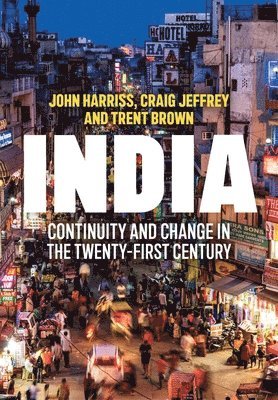
    India

    Continuity and Change in the Twenty-First Century

    AvJohn Harriss,Craig Jeffrey

    Häftad, Engelska, 2020

    280 kr

    Beställningsvara. Skickas inom 5-8 vardagar. Fri frakt över 249 kr.

    Fler format och utgåvor

    Inbunden

    765 kr

    Beskrivning

    India has been catapulted to the centre of world attention. Its rapidly growing economy, new geo-political confidence, and global cultural influence have ensured that people across the world recognise India as one of the main sites of social dynamism in the early twenty-first century.   In this book, research leaders John Harriss, Craig Jeffrey and Trent Brown explore in depth the economic, social, and political changes occurring in India today, and their implications for the people of India and the world. Each of the book’s fourteen chapters seeks to answer a key question: Is India’s democracy under threat? Can India’s Growth be sustained? How are youth changing India? Drawing on a wealth of scholarly and popular material as well as their own experience researching the country during this period of major transformation, the authors draw the reader into key debates about economic growth, poverty, environmental justice, the character of Indian democracy, rights and social movements, gender, caste, education, and foreign policy. India, they conclude, has undergone some extraordinary and positive changes since the early 1990s but deeply worrying threats remain: increasing authoritarianism, growing inequality, entrenched poverty, and environmental vulnerability. How India responds to these crucial challenges will shape the world’s largest democracy for years to come.

    Produktinformation

    • Utgivningsdatum:2020-09-25
    • Mått:170 x 244 x 33 mm
    • Vikt:726 g
    • Format:Häftad
    • Språk:Engelska
    • Antal sidor:400
    • Förlag:Polity Press
    • ISBN:9781509539710

    Utforska kategorier

    • Ekonomisk politik inom Ekonomi och Ledarskap
    • Geografi inom Naturvetenskap och teknik
    • Politik och statsskick inom Samhälle och politik

    Mer om författaren

    John Harris is Professor Emeritus of International Studies at Simon Fraser University.Craig Jeffrey is Director of the Australia India Institute and Professor of Geography at the University of Melbourne.Trent Brown is DECRA Research Fellow in the School of Geography at the University of Melbourne.

    Recensioner i media

    �As a book that covers a tremendous range of issues and refuses to fall for easy explanatory traps, India: Continuity and Change in the 21st Century offers an original, unique and comprehensive coverage of the economy, society and politics in 21st century India.�Philippa Williams, Queen Mary University of London �This book asks some of the most compelling questions about politics, society and the economy in contemporary India, and offers answers with historical depth, a comprehensive engagement with the latest scholarship on the subject, and nuanced analysis. An indispensable guide to understanding the multiple complexities of India today.�  Niraja Gopal Jayal, Jawaharlal Nehru University �A crisply written account of key issues in the study of contemporary India. It will be an invaluable resource for scholars and students alike.�  Rob Jenkins, City University of New York

    Innehållsförteckning

    • About the Authors Preface and Acknowledgements1 Making Sense of Twenty-First-Century India1.1 Introduction1.2 Past and Present1.3 The Impact of Colonialism in India1.4 The Invention of Modern India1.5 The Reinvention of IndiaPart One: Economy and Environment2 When and Why Has India’s Economic Growth Accelerated?2.1 Introduction: Thinking About Economic Growth2.2 India’s History of Economic Growth2.3 Economic Growth 1950–1992: A Story of Failure?2.4 India’s ‘Economic Reforms’ and Growth in 1993–20012.5 ‘Superfast’ Growth, Slowdown and Questionable Recovery: 2002–20152.6 Conclusion3 How ‘Inclusive’ is India’s Economic Growth?3.1 Introduction: Economic Growth and ‘Development’3.2 Constructions and Measurements of Poverty3.3 Poverty Trends in India3.4 Durable Inequalities in Indian Society, Mobility and the Missing Middle Class3.5 Conclusion4 Why Isn’t India Doing Better at Realizing ‘Inclusive Growth’?4.1 Introduction: The Pattern of India’s Economic Growth4.2 Has the Growth Process Ignored Indian Agriculture?4.3 ‘Jobless Growth’, ‘Excluded Labour’ and ‘Make in India’4.4 Conclusion: Binding Economic and Social Constraints5 Can India’s Economic Growth Be Reconciled with Sustainability and Environmental Justice?5.1 Introduction: The Costs of Environmental Degradation5.2 The Environment and Development Debate: Must Growth Come First?5.3 Environmental Conflicts: Capital, State, Civil Society and People5.4 Environmental Policy and the Practice of Regulation5.5 ConclusionPart Two: Politics6 Has India Become the Hindu Rashtra?6.1 Introduction: ‘God Man’ to Government6.2 The RSS, the BJP and the Struggle for Hindutva6.3 Temples, Gods and Gurus: Banal Hinduism, Banal Hindutva6.4 Banal Hindutva, Communal Violence and the State6.5 Hindutva Rising6.6 Authoritarian Populism and the Indian Case6.7 Conclusion7 Is India’s Democracy at Risk?7.1 Introduction7.2 India as a Formal Democracy7.3 India as Substantive Democracy 1947–20147.4 Substantive Democratization Since 20147.5 Conclusions8 Why Hasn’t Democracy Made Indian Governments More Responsive?8.1 Introduction: Economic and Social Rights and the Indian Constitution8.2 The ‘New Rights Agenda’8.3 From Rights Legislation to Implementation8.4 Social Rights under the First Modi Government8.5 How Government Works8.6 Conclusions9 Is There a Countermovement against Neoliberalism in India?9.1 Introduction: Polanyi’s Idea of the ‘Double Movement’ and India Today9.2 Towards Social Movement Unionism?9.3 Rural Struggles: Agrarian Crisis, and the ‘New’ Land Question9.4 Middle-Class Activism9.5 ConclusionsPart Three: Society10 Is India Witnessing a Social Revolution?10.1 Introduction10.2 What is the Social Revolution?10.3 Cultural Renaissance10.4 Growing Prominence of Civil Society10.5 Constraints on India’s Social Revolution10.6 Conclusion11 Does Caste Still Matter in India?11.1 Introduction11.2 Caste in Mid-Twentieth-Century India11.3 The Decline of Caste Hierarchies11.4 Caste, Identity and Politics11.5 Caste as Habitus: Hierarchy Revisited11.6 Conclusions12 Why Does Gender Inequality Persist in India?12.1 Introduction12.2 Gender Relations and the Family12.3 Gender Inequality in Education and the Workplace12.4 Politicizing Gender Inequality12.5 Conclusion13 Can Youth Transform India?13.1 Introduction: Ideas about ‘Youth’13.2 School Education13.3 Higher Education13.4 Unemployment13.5 The Politics of Youth Unemployment13.6 ConclusionsAfterword14 Afterword: Is India Now a ‘Leading Power’?14.1 Introduction: India’s Transformations and the International Arena14.2 Coming in from the Margins: India in the World in the Late Twentieth Century14.3 After the Cold War: An ‘Emerging and Responsible Power’?14.4 Conclusion: Still an Aspirant as a ‘Leading Power’GlossaryReferencesIndex