• Fri frakt över 249 kr
  • •
  • Snabba leveranser
  • •
  • Billiga böcker
Kundservice

Du är på sajten för privatpersoner.

Företag, bibliotek eller offentlig verksamhet?

Du handlar på classic.bokus.com, där alla dina funktioner finns intakta.
Till classic.bokus.com
Bokus logotyp. Gå till startsidan.
  • Erbjudanden
  • Student
  • Topplistor
  • Barn & ungdom
  • Bokus Play
  • E-böcker
  • Ljudböcker
  • Pocketböcker
  • Spel och pussel

5% studentrabatt – använd koden KURSBOK27 →

Sidfot

Mina sidor

    Hjälp

    • Kundservice
    • Vanliga frågor och svar
    • Frakt och leverans
    • Retur vid ångerrätt
    • Reklamera vara
    • Betalning
    • Köpvillkor
    • Allmänna villkor
    • Information om webbplatsens tillgänglighet

    Om Bokus

    • Om oss
    • Pressrum
    • För studenter
    • För företag
    • För bibliotek och offentlig verksamhet
    • För leverantörer
    • Hållbarhet

    Populärt

    • Aktuella erbjudanden
    • Presentkort
    • Studentlitteratur
    • Nya böcker
    • Topplistor
    • Signerade böcker
    • Engelska böcker

    Inspiration

    • Boktips
    • BookTok
    • Barnbokskaraktärer
    • Populära författare
    Logotyp för Bokus
    Följ oss på Facebook (extern länk)Följ oss på Instagram (extern länk)Följ oss på YouTube (extern länk)Följ oss på TikTok (extern länk)
    bokus @ CookiesAnpassa cookiesIntegritetspolicyKöpvillkor
    Till Citymail hemsida (extern länk)Till Budbee hemsida (extern länk)Till Postnord hemsida (extern länk)Till Schenker hemsida (extern länk)Till Early Bird hemsida (extern länk)Till Walleys hemsida (extern länk)
    1. Filosofi och religion
    2. Filosofi
    3. Filosofiska discipliner

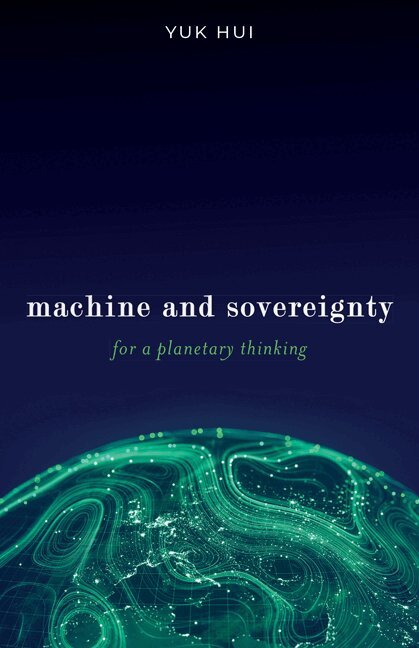
    Machine and Sovereignty

    For a Planetary Thinking

    AvYuk Hui

    Häftad, Engelska, 2024

    320 kr

    Beställningsvara. Skickas inom 5-8 vardagar. Fri frakt över 249 kr.

    Fler format och utgåvor

    Inbunden

    1 314 kr

    Beskrivning

    Developing a new political thought to address today’s planetary crisesWhat is “planetary thinking” today? Arguing that a new approach is urgently needed, Yuk Hui develops a future-oriented mode of political thought that encompasses the unprecedented global challenges we are confronting: the rise of artificial intelligence, the ecological crisis, and intensifying geopolitical conflicts. Machine and Sovereignty starts with three premises. The first affirms the necessity of developing a new language of coexistence that surpasses the limits of nation-states and their variations; the second recognizes that political forms, including the polis, empire, and the state, are technological phenomena, which Lewis Mumford terms “megamachines.” The third suggests that a particular political form is legitimated and rationalized by a corresponding political epistemology. The planetary thinking that this book sketches departs from the opposition between mechanism and organism, which characterized modern thought, to understand the epistemological foundations of Hegel’s political state and Schmitt’s Großraum and their particular ways of conceiving the question of sovereignty. Through this reconstruction, Hui exposes the limits of the state and reflects on a new theoretical matrix based on the interrelated concepts of biodiversity, noodiversity, and technodiversity. Arguing that we are facing the limit of modernity, of the eschatological view of history, of globalization, and of the human, Hui conceives necessary new epistemological and technological frameworks for understanding and rising to the crises of our present and our future. Retail e-book files for this title are screen-reader friendly.

    Produktinformation

    • Utgivningsdatum:2024-10-29
    • Mått:140 x 216 x 18 mm
    • Vikt:425 g
    • Format:Häftad
    • Språk:Engelska
    • Antal sidor:368
    • Förlag:University of Minnesota Press
    • ISBN:9781517917418

    Utforska kategorier

    • Filosofiska discipliner inom Filosofi och religion
    • Naturvetenskap:allmänt inom Naturvetenskap och teknik

    Mer om författaren

    Yuk Hui is professor of philosophy at Erasmus University Rotterdam and professor at City University of Hong Kong. He is author of Art and Cosmotechnics, Recursivity and Contingency, The Question Concerning Technology in China: An Essay in Cosmotechnics, and On the Existence of Digital Objects (Minnesota, 2016).

    Recensioner i media

    "Machine and Sovereignty is a profound, groundbreaking, and timely call for a refoundation of political order and governance in light of current technological and ecological challenges at the planetary scale. Reinterpreting classical concepts of sovereignty and the state, Yuk Hui’s advocacy for an epistemological diplomacy incorporating technodiversity, noodiversity, and biodiversity inaugurates a new language of planetary coexistence beyond the nation-state and Anthropocene. This book is destined to become a seminal text in political philosophy and technology studies. It is not only an intellectual tour de force but also a crucial guide for navigating the complexities of the twenty-first century." -Antoinette Rouvroy, University of Namur   "Machine and Sovereignty responds to the growing call for a new planetary thinking in contemporary political culture and across the sciences and humanities. By replacing earlier theologico- and logico- settings of philosophy and the political with the technological, Yuk Hui both builds on his earlier work on techno-logic and expands it into a thinking of the planetary techno-political. This book is an important contribution to contemporary understanding of the political implications of thinking and acting in an increasingly digitalized planet." -Howard Caygill, author of Force and Understanding: Writings on Philosophy and Resistance

    Innehållsförteckning

    • Contents Preface Introduction: For a Planetary Thinking §1. On the Planetary Condition §2. Planetary Thinking as Political Epistemologies §3. Search for a Planetary Politics beyond the Nation-State §4. Toward a Tractatus Politico-Technologicus of the Planetary 1. World Spirit as Planetary Thinking §5. Individuation of the Spirit as Historical Process §6. World Spirit as Planetary Thinking and the Place of Reason in History §7. Freedom as the Drive of the Transitions of Political Forms §8. Recursivity of Reason and Freedom in the Modern State 2. The Organism of the State and Its Limit §9. Spirit and the Organic Becoming of the Externalized §10. Organism of the State versus Organism of the Animal §11. The Impasse from the State to Planetary Freedom 3. From Noetic Reflection to Planetary Reflection §12. Noetic Reflection: Consciousness and Life §13. Bioeconomical Reflection: Georgescu-Roegen Reads Hegel §14. Cybernetic Reflection: Toward the Consciousness of Machines §15. Noospheric Reflection: In Search of a Planetary Freedom? 4. Mechanism, Organism, or Decisionism §16. From Political Theology to Political Epistemology §17. Machine and Organism in The Leviathan in the State Theory of Thomas Hobbes §17. Political Epistemology in Hobbes’s Leviathan §19. Catholicism and the Logic of Complexio Oppositorum §20. The Death of Hegel and the Triumph of Political Vitalism 5. Nomos of the Digital Earth §21. First Deconstruction on the Contingency of Sovereignty §22. Second Deconstruction on the Contingency of Friend and Enemy §23. Sovereignty and the Elementary Philosophy of Space §24.GroßrÄume as Post-Static Political Form and the Problem of Pluralism §25. Giving Colonialism, New GroßrÄume, and Digital Sovereignty 6. An Organology of Wars §26. The Disproportion of Organs and the Hubris of Wars §27. From a Cybernetics of Freedom to an Organology of Differences §28. The Conflict of Tendencies and the Recurrence of Mysticism §29. The Dynamics of the Technical Tendency and Technical Fact §30. On the Organological Relation between Technology and Democracy §31. Biodiversity, Noodiversity, and Technodiversity 7. Toward an Epistemological Diplomacy §32. Acceleration, Automation, and the Prosthetic Future §33. Universality Seen from the Perspective of Technodiversity §34. Sovereignty Seen from the Perspective of Technodiversity §35. Technodiversity Analyzed via an Anatomy of Technical Objects §36. Technodiversity as Epistemological Diplomacy Notes Bibliography Index