• Fri frakt över 249 kr
  • •
  • Snabba leveranser
  • •
  • Billiga böcker
Kundservice

Du är på sajten för privatpersoner.

Företag, bibliotek eller offentlig verksamhet?

Du handlar på classic.bokus.com, där alla dina funktioner finns intakta.
Till classic.bokus.com
Bokus logotyp. Gå till startsidan.
  • Erbjudanden
  • Nyheter
  • Student
  • Topplistor
  • Barn & ungdom
  • Bokus Play
  • E-böcker
  • Pocketböcker
  • Spel & pussel

10% rabatt på allt med kod NYSTART10 →

Sidfot

Mina sidor

    Hjälp

    • Kundservice
    • Vanliga frågor och svar
    • Frakt och leverans
    • Retur vid ångerrätt
    • Reklamera vara
    • Betalning
    • Köpvillkor
    • Allmänna villkor
    • Information om webbplatsens tillgänglighet

    Om Bokus

    • Om oss
    • Pressrum
    • För studenter
    • För företag
    • För bibliotek och offentlig verksamhet
    • För leverantörer
    • Hållbarhet

    Populärt

    • Aktuella erbjudanden
    • Presentkort
    • Studentlitteratur
    • Nya böcker
    • Topplistor
    • Signerade böcker
    • Engelska böcker

    Inspiration

    • Boktips
    • BookTok
    • Populära bokserier
    • Barnbokskaraktärer
    • Populära författare
    Logotyp för Bokus
    Följ oss på Facebook (extern länk)Följ oss på Instagram (extern länk)Följ oss på YouTube (extern länk)Följ oss på TikTok (extern länk)
    bokus @ CookiesAnpassa cookiesIntegritetspolicyKöpvillkor
    Till Citymail hemsida (extern länk)Till Budbee hemsida (extern länk)Till Postnord hemsida (extern länk)Till Schenker hemsida (extern länk)Till Early Bird hemsida (extern länk)Till Walleys hemsida (extern länk)
    1. Samhälle och politik
    2. Samhälle och kultur
    3. Kultur och medier
    4. Medievetenskap

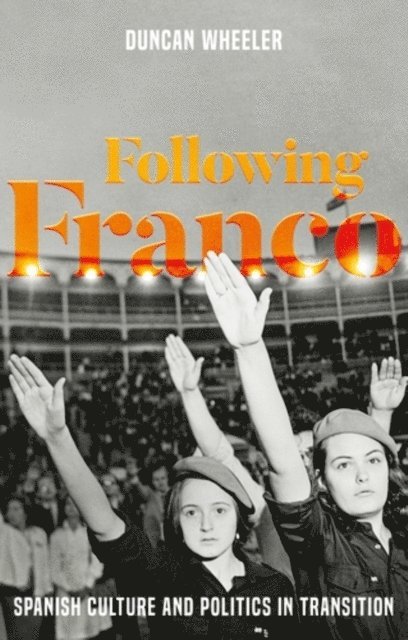
    Following Franco

    Spanish Culture and Politics in Transition

    AvDuncan Wheeler

    E-bok
    Engelska, 2020

    357 kr

    Läs direkt i Bokus Reader – eller ladda ned till din enhet

    Fler format och utgåvor

    Inbunden

    442 kr

    E-bok

    356 kr

    Beskrivning

    The transition to democracy that followed the death of Spanish dictator Francisco Franco in 1975 was once hailed as a model of political transformation. But since the 2008 financial crisis it has come under intense scrutiny. Today, a growing divide exists between advocates of the Transition and those who see it as the source of Spain’s current socio-political bankruptcy. This book revisits the crucial period from 1962 to 1992, exposing the networks of art, media and power that drove the Transition and continue to underpin Spanish politics in the present. Drawing on rare archival materials and over three hundred interviews with politicians, artists, journalists and ordinary Spaniards, including former prime minister Felipe Gonzalez (1982–96), Following Franco unlocks the complex and often contradictory narratives surrounding the foundation of contemporary Spain.

    Produktinformation

    • Utgivningsdatum:2020-10-15
    • Språk:Engelska
    • Filformat:EPUB
    • Kopieringsskydd:LCP
    • ISBN:9781526105202
    • Förlag:Manchester University Press

    Utforska kategorier

    • Medievetenskap inom Samhälle och politik
    • Socialhistoria och kulturhistoria inom Historia och arkeologi

    Mer om författaren

    Duncan Wheeler is Professor and Chair of Spanish Studies at the University of Leeds

    Recensioner i media

    '[Wheeler's] book is a model of how to write cultural history in its refusal to put things into tidy boxes. In particular, it demonstrates how attention to popular culture allows the historian to prise out the complexity of cultural processes.'Jo Labanyi, Hispanic Research Journal'[A] fascinating, forensic analysis of Spanish culture and politics during the transition from dictatorship to democracy.'Jim Lawley, La Revista'Wheeler has done a superb job in interpreting the complex process of the Spanish transition through the mirror of its cultural life, while also tackling class and gender issues.'Morning Star‘The years of Spain’s transition from dictatorship to democracy could hardly have been more tumultuous, with terrorism, military subversion and political chicanery in abundance. Duncan Wheeler’s fascinating, utterly original and endlessly entertaining book is one of the best introductions imaginable to a story as murky as it is uplifting.’Sir Paul Preston, Director of Cañada Blanch Centre, London School of Economics and Political Science‘Studies of 1960s, '70s, and '80s Spain usually focus on its entrenched dictatorship and compromise-ridden transition to democracy and rarely invoke the "swinging 60s", the "me decade" or the "decade of greed". Yet there was in Spain no shortage of swinging, egotism or getting rich in the streets and homes, in the bullfighting arenas and on the soccer fields, on the popular press' pages and the screens of increasingly affordable TV sets. In Following Franco, Duncan Wheeler takes the reader on a fun-driven journey through the media- and gossip-scapes of these transformative years. In this fascinating book, he leaves no cultural icon unturned and his trove of facts, large and small, crafts a picture of a country's culture that was, after all, quite similar to that of its neighbours.’Eugenia Afinoguénova, Professor of Spanish Language and Cultural History, Marquette University‘Duncan Wheeler's excellent book offers a thorough study of post-Francoist Spain's cultural logics, from mass media to public policies, paying critical attention to celebrities as well as to art museums. It represents a savvy and well-researched panoramic account of a fascinating time.’Germán Labrador Méndez, Professor of Spanish and Portuguese, Princeton University‘Following Franco takes the reader on an exciting journey through Spanish culture and politics that reaches back to Francoism and beyond: from the culture of the bull and bullfighters to the symbolic significance of Guernica, from Almodóvar to the Movida, from Olympic Barcelona to the centrifugal movements of Catalonia and the Basque Country, from the uses of censorship to the social role of television and the examples of musical counterculture. Duncan Wheeler gives an enriching and comprehensive account that allows us to understand the idiosyncrasies of contemporary Spain.’Manuel Palacio, Professor of Audiovisual Communication and Advertising, University Carlos III of Madrid

    Innehållsförteckning

    • IntroductionPart I: CelebrityIntroduction1 Fandom and mass-culture in late-Francoist Spain: Manuel Benítez 'El Cordobés' and Raphael2 Aristocracy and generational change: The houses of Alba, Franco and Bourbon 3 ¡Hola! in the age of champagne socialism: Isabel Preysler, Miguel Boyer, Julio Iglesias, Francisco Rivera 'Paquirri' and Isabel PantojaPart II: CensorshipIntroduction4 The regulation of cultural production during and after Manuel Fraga (1962–75)5 Key performance indicators: Democratisation and freedom of speech (1975–81)6 The regime of '81: Patronage and permissivenessPart III: CitiesIntroduction7 Urbanisation and development: Class, gender and race8 The Movida and the reinvention of Madrid 9 An Olympic renaissance: The Barcelona modelPart IV: CommunitiesIntroduction10 Culture as a democratic weapon: Pablo Picasso’s Guernica11 The historical nationalities: Culture and community in the Basque Country, Catalonia and Galicia12 What qualifies as Spanish culture? The State, autonomous communities and the culture warsConclusionIndex