• Fri frakt över 249 kr
  • •
  • Snabba leveranser
  • •
  • Billiga böcker
Kundservice

Du är på sajten för privatpersoner.

Företag, bibliotek eller offentlig verksamhet?

Du handlar på classic.bokus.com, där alla dina funktioner finns intakta.
Till classic.bokus.com
Bokus logotyp. Gå till startsidan.
  • Erbjudanden
  • Nyheter
  • Student
  • Topplistor
  • Barn & ungdom
  • Bokus Play
  • E-böcker
  • Pocketböcker
  • Spel & pussel

10% rabatt på allt med kod: NYSTART10 →

Sidfot

Mina sidor

    Hjälp

    • Kundservice
    • Vanliga frågor och svar
    • Frakt och leverans
    • Retur vid ångerrätt
    • Reklamera vara
    • Betalning
    • Köpvillkor
    • Allmänna villkor
    • Information om webbplatsens tillgänglighet

    Om Bokus

    • Om oss
    • Pressrum
    • För studenter
    • För företag
    • För bibliotek och offentlig verksamhet
    • För leverantörer
    • Hållbarhet

    Populärt

    • Aktuella erbjudanden
    • Presentkort
    • Studentlitteratur
    • Nya böcker
    • Topplistor
    • Signerade böcker
    • Engelska böcker

    Inspiration

    • Boktips
    • BookTok
    • Populära bokserier
    • Barnbokskaraktärer
    • Populära författare
    Logotyp för Bokus
    Följ oss på Facebook (extern länk)Följ oss på Instagram (extern länk)Följ oss på YouTube (extern länk)Följ oss på TikTok (extern länk)
    bokus @ CookiesAnpassa cookiesIntegritetspolicyKöpvillkor
    Till Citymail hemsida (extern länk)Till Budbee hemsida (extern länk)Till Postnord hemsida (extern länk)Till Schenker hemsida (extern länk)Till Early Bird hemsida (extern länk)Till Walleys hemsida (extern länk)
    1. Historia och arkeologi
    2. Historia
    3. Historia: särskilda händelser och ämnen
    4. Socialhistoria och kulturhistoria

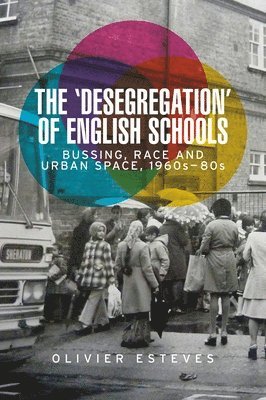
    'Desegregation' of English Schools

    Bussing, Race and Urban Space, 1960s–80s

    AvOlivier Esteves

    Inbunden, Engelska, 2018

    1 224 kr

    Beställningsvara. Skickas inom 5-8 vardagar. Fri frakt över 249 kr.

    Fler format och utgåvor

    Häftad

    371 kr

    Beskrivning

    Dispersal, or ‘bussing’, was introduced in England in the early-1960s after white parents expressed concerns that the sudden influx of non-Anglophone South Asian children was holding back their own children’s education. It consisted in sending busloads of mostly Asian children to predominantly white suburban schools in an effort to ‘spread the burden’ and to promote linguistic and cultural integration. Although seemingly well-intentioned, dispersal proved a failure: it was based on racial identity rather than linguistic deficiency and ultimately led to an increase in segregation, as bussed pupils were daily confronted with racial bullying in dispersal schools. This is the first ever book on English bussing, based on an in-depth study of local and national archives, alongside interviews with formerly-bussed pupils decades later.

    Produktinformation

    • Utgivningsdatum:2018-12-14
    • Mått:156 x 234 x 14 mm
    • Vikt:517 g
    • Format:Inbunden
    • Språk:Engelska
    • Antal sidor:240
    • Förlag:Manchester University Press
    • ISBN:9781526124852
    • Utmärkelser:Winner of Winner of Prix de la Recherche SAES/AFEA 2019 2019 (UK)

    Utforska kategorier

    • Socialhistoria och kulturhistoria inom Historia och arkeologi
    • Utbildningsstrategier och utbildningspolitik inom Psykologi och pedagogik
    • Etnicitet inom Samhälle och politik

    Mer om författaren

    Olivier Esteves is Professor of British Studies at the University of Lille

    Recensioner i media

    'This book is a brilliant and timely study bringing together a history of English public policies on race, post-colonial thinking on immigration and the realities of urban education. It examines the failed attempt over forty years ago, to 'de-segregate' schools attended by migrant, especially Asian children, by their forced dispersal - 'bussing' them to 'white' schools. The hysterical reaction to immigrant minorities, the nostalgia for an all white England, the ignorance of central and local government in the 1960s and 1970s, were all still apparent around the 2016 Brexit vote.'Sally Tomlinsom, Emeritus Professor at Goldsmiths, Honorary Fellow in the Department of Education, University of Oxford, and is also an Associate in the Department of Sociology University of Warwick 'With ‘bussing’ still best known as an American phenomenon, The ‘desegregation’ of English schools uses the history of dispersal policies to shed new light on racism in British education and public life at both the local and national level. Olivier Esteves explores ethnic minority experiences, memories, and resistance with insight and sensitivity in a study that is sure to provoke readers to ask new questions about the history of diversity in 1960s, 1970s, and early 1980s Britain.'Elizabeth Buettner, University of Amsterdam‘This book challenges the popular wisdom which seeks to position the debates of racial segregation, schooling and bussing within the US context. Esteves should be congratulated for the depth and the breadth of archival research which locates the question of desegregation and schooling firmly within a historical context of English towns and cities. Drawing upon rich empirical data and theoretical insight, Esteves clinically shows how the policy of Bussing developed, how it was contested and finally rejected during the 80s. This book is an essential read for anyone interested in the question of race and schooling’. Shamim Miah, Senior Lecturer University of Huddersfield and author of Muslim, Schooling and Question of Self-Segregation and Muslims, Security and Schooling: Trojan Horse, Prevent and Racial Politics.'Esteves’ new work constitutes a place-by-place treatment of the troubling phenomena of bussing and educational dispersal. It is by far the most extensive and thorough examination of the topic. More than this, it provides a window onto the various social and cultural conflicts engendered by various schemes in urban development, race relations, and migration control. It is a fine piece of scholarship and a sensitive analysis of an important moment in postwar British history, complete with transatlantic resonances.'Brett Bebber, Associate Professor of History at Old Dominion University, USA'Olivier Esteves has written an important and timely book. In this deeply researched and clearly written study, Esteves traces how different communities addressed class, ethnic, and religious segregation in British schools. Weaving together postwar and postcolonial history, Esteves illuminates the differences and similarities between bussing and school segregation in England and the United States. The insights Esteves provides regarding immigration, assimilation, and citizenship will be of interest to a wide range of readers.'Matthew Delmont, Professor of History at Dartmouth College and the author of Why Busing Failed: Race, Media, and the National Resistance to School Desegregation.‘Esteves has produced a long overdue definitive account of bussing in England, his study is essential reading for those interested in race and education in the UK as well as broader debates about racism in British society, particularly in the wake of Brexit and the recent Windrush scandal.’Timothy Peace, University of Glasgow, Ethnic and Racial Studies‘Esteves has completed a valuable piece of work. Bringing together a considerable amount of information and material, he has succeeded in shining a light on a neglected part of modern British history.’Journal of Contemporary History

    Innehållsförteckning

    • Introduction 1 “To allay people’s fears on numbers”: the introduction of dispersal in Southall 2 Improvisation in high places? Setting the national framework for bussing 3 “Before it gets out of hand”: the introduction of dispersal in Bradford 4 Reluctant cities: how London and Birmingham said no to dispersal5 Dispersing in diverse places: how the other L.E.A.s fared6 Taking the bullying by the horns: the emergence of resistance against bussing7 Babylon by bus: the quotidian experience of being bussed ConclusionIndex