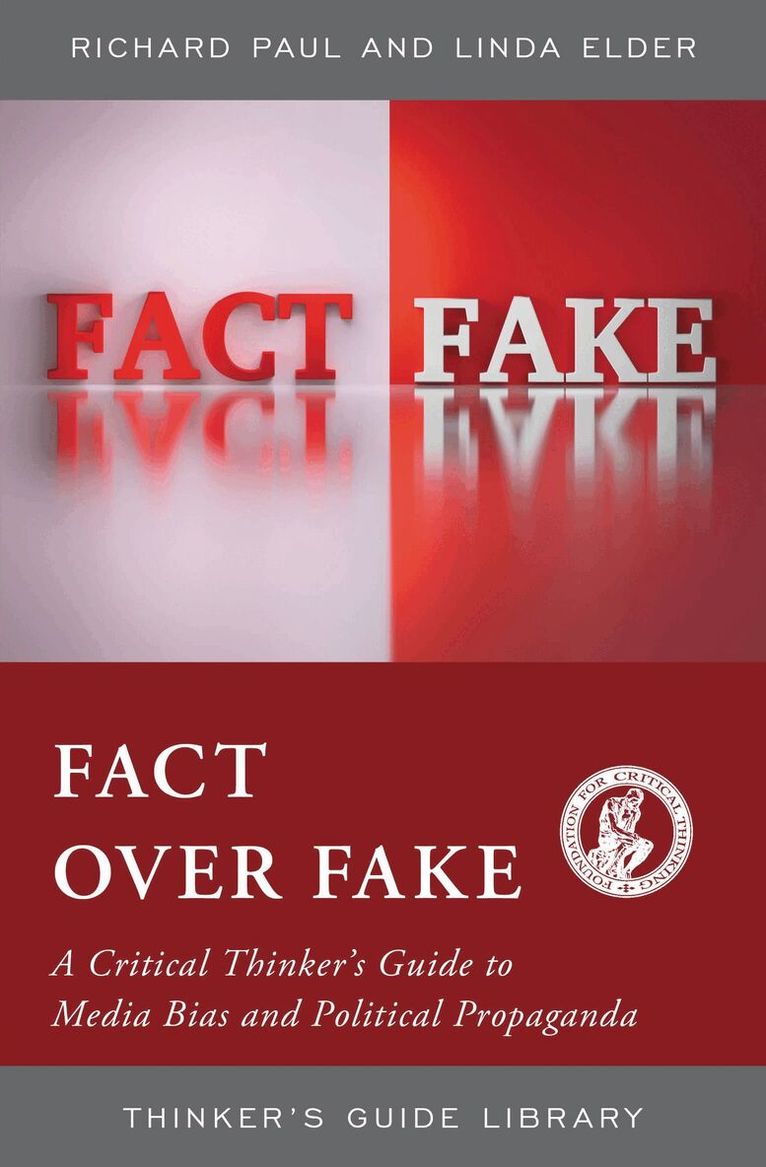
Fact over Fake
A Critical Thinker's Guide to Media Bias and Political Propaganda
622 kr
Beställningsvara. Skickas inom 10-15 vardagar. Fri frakt över 249 kr.
Fler format och utgåvor
Beskrivning
Produktinformation
- Utgivningsdatum:2020-11-15
- Mått:142 x 202 x 14 mm
- Vikt:277 g
- Format:Inbunden
- Språk:Engelska
- Serie:Thinker's Guide Library
- Antal sidor:108
- Förlag:Bloomsbury Publishing Plc
- ISBN:9781538143933
Utforska kategorier
Mer om författaren
Dr. Linda Elder is an educational psychologist who has taught both psychology and critical thinking at the college level. She has been President of the Foundation for Critical Thinking and the Executive Director of the Center for Critical Thinking for almost 25 years. She has a special interest in the relation of thought and emotion, as well as the cognitive and affective. She has developed an original theory of the stages of critical thinking development. Elder has coauthored four books on critical thinking, as well as all 23 titles found in the Thinker's Guide Library.Dr. Richard Paul was a leading proponent of critical thinking and through his work and legacy remains an international authority in the field. He founded the Center for Critical Thinking at Sonoma State University in 1980, followed by the Foundation for Critical Thinking. He developed concepts, principles, and theory essentials to a robust and fairminded conception of critical thinking and authored more than 200 articles and seven books on the topic. He presented workshops to hundreds of thousands of educators over his 35-year career as a leader in the critical thinking movement.
Recensioner i media
A timely revision to an essential volume for any critical thinker’s library, Fact Over Fake provides aconcise, cogent, and insightful examination of the challenges and opportunities presented by the news media landscape of the early 21st century, as well as practical tools to help navigate that daunting terrain—even for those unfamiliar with, or unaccustomed to, thinking critically about how it affects their lives every day. An indispensable guide for all who aspire to think for themselves and for any conscientious citizen seeking to foster free, fairminded societies.
Innehållsförteckning
- Introduction: Why Critical Thinking is Essential to Making Sense of the NewsThe Logic of the News MediaWhat is News?Political Views in the News – Understanding the Liberal MindPolitical Influences, Advertising, and Group ThinkTechnological Noise in the NewsWhat We Need the News Media to Do for UsChapter 1: Current Trends Affecting How We See the News Key Critical Thinking Questions to Ask When Seeking the NewsRealities That Impede Our Ability to Get Objective News The Problem of Fake NewsSocial Media as an Unreliable News SourceChapter 2: Essential Critical Thinking Tools for Understanding Media Logic Defining Critical ThinkingA Comprehensive Approach to Critical ThinkingAll Humans Use Their Thinking to Make Sense of the WorldAll Thinking Is Defined by the Eight Elements That Make It UpAnalyze Thinking Through its Elemental StructuresQuestion the Reasoning Embedded in a News ArticleQuestion Your Own Reasoning While Reading the NewsReason Through News Articles, Editorials, and Stories – a ChecklistEvaluate Reasoning Through Critical Thinking StandardsCritical Thinking Standards for Assessing News Articles, Editorials, andStoriesDefining Characteristics of the Disciplined Mind – and How They Help Us See Through Bias and PropagandaRational or Irrational Tendencies Can Control the MindHumans Distort Reality Through Irrational LensesThe Problem of Egocentric ThinkingThe Problem of Sociocentric ThoughtChapter 3: Objectivity, Bias, and Underlying AgendasDemocracy and the News Media Myths That Obscure the Logic of the News Media Bias and Objectivity in the News Media How the News Media Views ObjectivityForms of Objectivity The Perception of Bias in the Mainstream Propaganda and News Story Writing Protecting the Home Audience from Feelings of Guilt How the News Media Fosters Sociocentric Thinking Chapter 4: Become an Astute Media ConsumerHow to Obtain Useful Information from Propaganda and Typical News Stories Steps in Becoming a Critical Consumer of the NewsMedia Awareness of Media Bias Sensitivity to Advertisers Sensitivity to Politicians and the GovernmentSensitivity to Powerful Interests Sensitivity to Their Competitors The Bias Toward “Novelty” and “Sensationalism” Critical Consumers of the News Dominant and Dissenting Views: Finding Alternative Sources of Information Buried, Ignored, or Underreported StoriesReadings that Help You Become a More Independent Thinker? Chapter 5: The Future of the NewsIs It Possible for the News Media to Reform? Is the Emergence of a “Critical Society” Possible? Afterword: How the Internet and Other Technologies Pervade Our LivesHow the Internet Works: The Big PictureAssess a Given Website Using Critical Thinking StandardsAppendix: An Abbreviated Glossary of Critical Thinking Concepts and Terms
Mer från samma författare
Guide for Educators to Critical Thinking Competency Standards
Richard Paul, Linda Elder
Häftad, 2007
308 kr
Thinker's Guide to Engineering Reasoning
Richard Paul, Robert Niewoehner, Linda Elder
Häftad, 2013
308 kr
Mer från samma serie
Guide for Educators to Critical Thinking Competency Standards
Richard Paul, Linda Elder
Häftad, 2007
308 kr
Thinker's Guide to Engineering Reasoning
Richard Paul, Robert Niewoehner, Linda Elder
Häftad, 2013
308 kr
Du kanske också är intresserad av
Thinker's Guide for Students on How to Study & Learn a Discipline
Richard Paul, Linda Elder
Häftad, 2014
307 kr
Guide for Educators to Critical Thinking Competency Standards
Richard Paul, Linda Elder
Häftad, 2007
308 kr