• Fri frakt över 249 kr
  • •
  • Snabba leveranser
  • •
  • Billiga böcker
Kundservice

Du är på sajten för privatpersoner.

Företag, bibliotek eller offentlig verksamhet?

Du handlar på classic.bokus.com, där alla dina funktioner finns intakta.
Till classic.bokus.com
Bokus logotyp. Gå till startsidan.
  • Erbjudanden
  • Nyheter
  • Student
  • Topplistor
  • Barn & ungdom
  • Bokus Play
  • E-böcker
  • Pocketböcker
  • Spel & pussel

10% rabatt på allt med kod: NYSTART10 →

Sidfot

Mina sidor

    Hjälp

    • Kundservice
    • Vanliga frågor och svar
    • Frakt och leverans
    • Retur vid ångerrätt
    • Reklamera vara
    • Betalning
    • Köpvillkor
    • Allmänna villkor
    • Information om webbplatsens tillgänglighet

    Om Bokus

    • Om oss
    • Pressrum
    • För studenter
    • För företag
    • För bibliotek och offentlig verksamhet
    • För leverantörer
    • Hållbarhet

    Populärt

    • Aktuella erbjudanden
    • Presentkort
    • Studentlitteratur
    • Nya böcker
    • Topplistor
    • Signerade böcker
    • Engelska böcker

    Inspiration

    • Boktips
    • BookTok
    • Populära bokserier
    • Barnbokskaraktärer
    • Populära författare
    Logotyp för Bokus
    Följ oss på Facebook (extern länk)Följ oss på Instagram (extern länk)Följ oss på YouTube (extern länk)Följ oss på TikTok (extern länk)
    bokus @ CookiesAnpassa cookiesIntegritetspolicyKöpvillkor
    Till Citymail hemsida (extern länk)Till Budbee hemsida (extern länk)Till Postnord hemsida (extern länk)Till Schenker hemsida (extern länk)Till Early Bird hemsida (extern länk)Till Walleys hemsida (extern länk)
    1. Psykologi och pedagogik
    2. Pedagogik

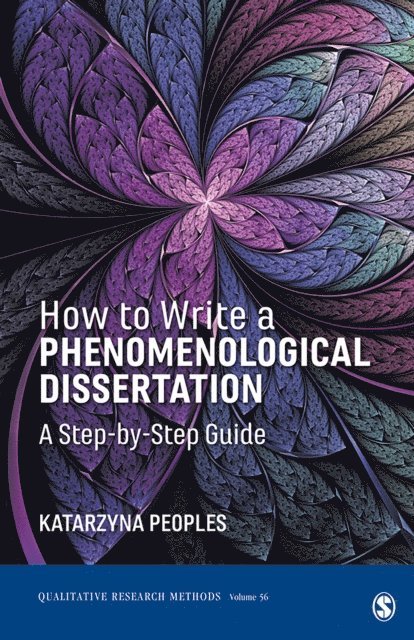
    How to Write a Phenomenological Dissertation

    A Step-by-Step Guide

    AvKatarzyna Peoples

    Häftad, Engelska, 2020

    Del 56 i serien Qualitative Research Methods

    533 kr

    Beställningsvara. Skickas inom 5-8 vardagar. Fri frakt över 249 kr.

    Fler format och utgåvor

    E-bok

    458 kr

    Beskrivning

    Conducting phenomenological research for dissertations can be an involved and challenging process, and writing it up is often the most challenging part. How to Write a Phenomenological Dissertation gives students practical, applied advice on how to structure and develop each chapter of the dissertation specifically for phenomenological research. 

    Phenomenology is about personal experience and personal experience varies from researcher to researcher. However, this variation is a big source of confusion for new researchers in the social, behavioral, or health sciences. This brief text is written in a simple, step-by-step fashion to account for this flexibility and variation while also providing structure necessary for a successful dissertation. Broken up into chapters that follow each chapter of the dissertation, this text logically addresses the various parts of phenomenological research, starting with ensuring phenomenology is the right method for your research, writing the literature review, going through methods and results sections to analysis and discussion. The author, using experience gleaned from supervising phenomenological dissertations for many years, gives time-tested advice on how structure the dissertation to fit into more common frameworks, using checklists and tables throughout. Each chapter includes a list of helpful resources for students to use alongside this book with specific information on methods and research. Unique to this text is a chapter on creating your own phenomenological method which allows students to expand their viewpoints and experiment in future studies after the dissertation. 

    Produktinformation

    • Utgivningsdatum:2020-05-19
    • Mått:139 x 215 x 9 mm
    • Vikt:230 g
    • Format:Häftad
    • Språk:Engelska
    • Serie:Qualitative Research Methods
    • Antal sidor:192
    • Upplaga:1
    • Förlag:SAGE Publications
    • ISBN:9781544328362

    Utforska kategorier

    • Pedagogik inom Psykologi och pedagogik
    • Skrivande och redigering inom Språk och ordböcker
    • Filosofiska discipliner inom Filosofi och religion

    Mer om författaren

    Dr. Peoples studied Existential Psychology at Duquesne University (Pittsburgh, PA) and earned both her Bachelor’s and her Master’s in Psychology at Duquesne University before moving over to earn her Doctorate in Counseling Psychology at Duquesne University. She started working in the addictions field in 1999 and shortly after started relationship and marriage counseling simultaneously.  Dr. Peoples currently works as a core faculty member in the Counselor Education and Supervision Doctoral program at Walden University. She has written books, book chapters, and journal articles on numerous topics related to counseling, teaching, and philosophy. Dr. Peoples also has an online marriage counseling and coaching practice where she offers virtual counseling.

    Recensioner i media

    Overall, I feel this is possibly the best work I have seen on this type of a dissertation. It is clear and concise as well as complete in mechanics.

    Innehållsförteckning

    • AcknowledgmentsAbout the AuthorPart I: Before the DissertationChapter 1: How to BeginWhat Is Phenomenological Research?Purpose of This BookOrganization of This BookLiterature ReviewTheoretical FrameworkReferencesPart II: Writing the DissertationChapter 2: Introduction and Literature ReviewBeginning the Literature Review: What’s Your Topic?Literature Search StrategyCreate an OutlineWriting the First Dissertation Chapter: The IntroductionProblem StatementPurpose StatementResearch QuestionsTheoretical FrameworkDefinitionsAssumptionsDelimitations and LimitationsSummary SectionsCompleting the Literature ReviewReferences and Suggested ReadingChapter 3: MethodologyIntroductionDesign and RationaleResearcher RoleParticipantsInstrumentationProceduresData CollectionData AnalysisUsing SoftwareValidity and ReliabilityEthicsSummaryWrite the AbstractReferences and ResourcesChapter 4: ResultsIntroductionSettingParticipant DemographicsData CollectionFindingsConnecting to the Theoretical FrameworkValidity and ReliabilityGoing Back to Chapter 3SummaryAppendicesReferences and ResourcesChapter 5: DiscussionIntroductionInterpretation of Findings: A Dialogue with the LiteratureIncluding Theory ThroughoutLimitationsRecommendations for Future ResearchImplicationsConclusionUpdate the AbstractExample of AbstractReferences and ResourcesPart III: After your DissertationChapter 6: Other Phenomenological MethodsExistential PhenomenologyCritical Narrative Analysis (Langdridge)Dialogal Approach (Halling, Leifer, & Rowe)Dallas Approach (Garza)Embodied Life-World Approach (Todres)Interpretive Phenomenological Analysis (Smith, Flowers, & Larkin)Life-World Approach (Ashworth)Lived Experience Human Science Inquiry (van Manen)Reflective Life-World Approach (Dahlberg)ReferencesChapter 7: Creating Your Own Phenomenological MethodGiorgi’s Five Basic Stepsvan Manen’s Four ReflectionsResultsParticipant DemographicsGeneral DescriptionReflectionReferences and ResourcesAppendix A: Recruitment FlyerAppendix B: ScreeningAppendix C: Semi-Structured Interview GuideAppendix D: Consent to ParticipateAppendix E: Sample Dissertation Literature ReviewIndex