• Fri frakt över 249 kr
  • •
  • Snabba leveranser
  • •
  • Billiga böcker
Kundservice

Du är på sajten för privatpersoner.

Företag, bibliotek eller offentlig verksamhet?

Du handlar på classic.bokus.com, där alla dina funktioner finns intakta.
Till classic.bokus.com
Bokus logotyp. Gå till startsidan.
  • Erbjudanden
  • Student
  • Topplistor
  • Barn & ungdom
  • Bokus Play
  • E-böcker
  • Ljudböcker
  • Pocketböcker
  • Spel och pussel

Skapa nya rutiner – hälsoböcker upp till 50% →

Sidfot

Mina sidor

    Hjälp

    • Kundservice
    • Vanliga frågor och svar
    • Frakt och leverans
    • Retur vid ångerrätt
    • Reklamera vara
    • Betalning
    • Köpvillkor
    • Allmänna villkor
    • Information om webbplatsens tillgänglighet

    Om Bokus

    • Om oss
    • Pressrum
    • För studenter
    • För företag
    • För bibliotek och offentlig verksamhet
    • För leverantörer
    • Hållbarhet

    Populärt

    • Aktuella erbjudanden
    • Presentkort
    • Studentlitteratur
    • Nya böcker
    • Topplistor
    • Signerade böcker
    • Engelska böcker

    Inspiration

    • Boktips
    • BookTok
    • Barnbokskaraktärer
    • Populära författare
    Logotyp för Bokus
    Följ oss på Facebook (extern länk)Följ oss på Instagram (extern länk)Följ oss på YouTube (extern länk)Följ oss på TikTok (extern länk)
    bokus @ CookiesAnpassa cookiesIntegritetspolicyKöpvillkor
    Till Citymail hemsida (extern länk)Till Budbee hemsida (extern länk)Till Postnord hemsida (extern länk)Till Schenker hemsida (extern länk)Till Early Bird hemsida (extern länk)Till Walleys hemsida (extern länk)
    1. Samhälle och politik
    2. Samhälle och kultur
    3. Kultur och medier
    4. Referensverk och tvärvetenskap

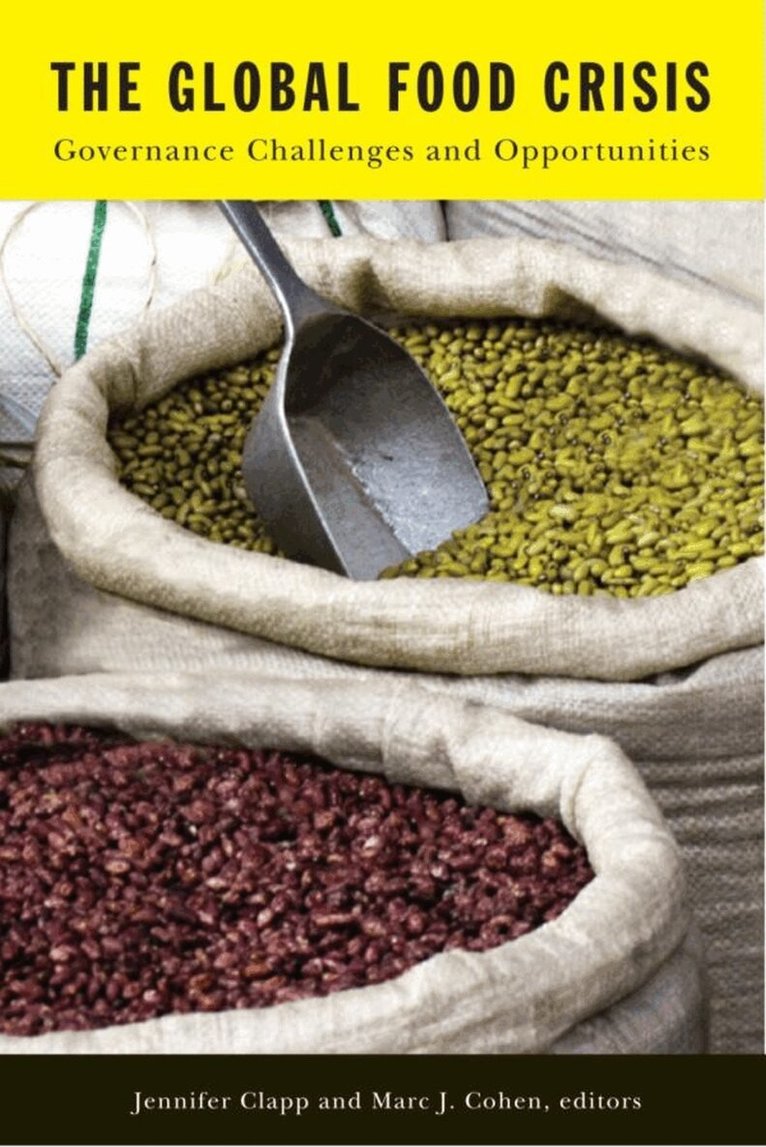
    Global Food Crisis

    Governance Challenges and Opportunities

    AvJennifer Clapp,Marc J. Cohen

    Häftad, Engelska, 2009

    Del i serien Studies in International Governance

    519 kr

    Beställningsvara. Skickas inom 10-15 vardagar. Fri frakt över 249 kr.

    Beskrivning

    The global food crisis is a stark reminder of the fragility of the global food system. The Global Food Crisis: Governance Challenges and Opportunities captures the debate about how to go forward and examines the implications of the crisis for food security in the world's poorest countries, both for the global environment and for the global rules and institutions that govern food and agriculture. In this volume, policy-makers and scholars assess the causes and consequences of the most recent food price volatility and examine the associated governance challenges and opportunities, including short-term emergency responses, the ecological dimensions of the crisis, and the longer-term goal of building sustainable global food systems. The recommendations include vastly increasing public investment in small-farm agriculture; reforming global food aid and food research institutions; establishing fairer international agricultural trade rules; promoting sustainable agricultural methods; placing agriculture higher on the post-Kyoto climate change agenda; revamping biofuel policies; and enhancing international agricultural policy-making. Co-published with the Centre for International Governance Innovation

    Produktinformation

    • Utgivningsdatum:2009-09-30
    • Mått:152 x 229 x 25 mm
    • Vikt:450 g
    • Format:Häftad
    • Språk:Engelska
    • Serie:Studies in International Governance
    • Antal sidor:288
    • Förlag:Wilfrid Laurier University Press
    • ISBN:9781554581924

    Utforska kategorier

    • Referensverk och tvärvetenskap inom Samhälle och politik

    Mer om författaren

    Jennifer Clapp is CIGI Research Chair in International Governance and a professor in the Balsillie School of International Affairs, Waterloo. Among her recent books are Paths to a Green World: The Political Economy of the Global Environment (MIT Press) and Corporate Power in Global Agrifood Governance (MIT Press). She is co-editor of the journal Global Environmental Politics.Marc Cohen is Humanitarian Researcher at Oxfam America. His research focuses on the links between humanitarian emergencies and climate change, protection of civilians in situations of armed conflict, and humanitarian assistance reform. He is also an adjunct faculty member in the international development program at the Paul H. Nitze School of Advanced International Studies at Johns Hopkins University.

    Recensioner i media

    ``The Global Food Crisis amasses a nice set of thoughtful papers by respected authorities. Collectively, they offer useful insights on the genesis and implications of the global food crisis that began in late 2006 and exploded on the world stage in 2008. This book especially highlights underlying governance questions that are fundamental but far too often overlooked.'' -- Christopher B. Barrett, Director, African Food Security and Natural Resources Management Program, Cornell University -- 09/2009

    Innehållsförteckning

    • The Global Food Crisis: Governance Challenges and Opportunities, edited by Jennifer Clapp and Marc J. CohenList of Acronyms and AbbreviationsIntroduction1. The Food Crisis and Global Governance Jennifer Clapp and Marc J. CohenPart 1: The Causal Factors behind the Food Crisis2. The Blame Game: Understanding Structural Causes of the Food Crisis Anuradha Mittal3. The 1974 and 2008 Food Price Crisis: Déjà-Vu? Sue Horton4. Responding to Food Price Volatility and Vulnerability: Considering the Global Economic Context Jennifer Clapp5. US Biofuels Policy and the Global Food Price Crisis: A Survey of the Issues Kimberly Ann ElliottPart 2: Immediate Governance Challenges and Proposals: Food Aid, Trade Measures, and International Grain Reserves 6. Responding to the 2008 ""Food Crisis"": Lessons from the Evolution of the Food Aid Regime Raymond F. Hopkins7. Preparing for an Uncertain Global Food Supply: A New Food Assistance Convention C. Stuart Clark8. From Food Handouts to Integrated Food Policies Frederic Mousseau9: The Uses of Crisis: Progress on Implementing US Local/Regional Procurement of Food Aid Gawain KripkePart 3: Longer-Term Ecological Concerns and Governance Responses 10. The Impact of Climate Change on Nutrition Cristina Tirado, Marc J. Cohen, Noora-Lisa Aberman, and Brian Thompson11. Fossil Energy and the Biophysical Roots of the Food Crisis Tony Weis12. Setting the Global Dinner Table: Exploring the Limits of the Marketization of Food Security Noah ZerbePart 4: Strategies to Promote Food Security and Sustainable Agriculture: The Way Ahead13. A Stronger Global Architecture for Food and Agriculture: Some Lessons from FAO's History and Recent Evaluation Daniel J. Gustafson and John Markie14. Improving the Effectiveness of US Assistance in Transforming the Food Security Outlook in Sub-Saharan Africa Emmy Simmons and Julie Howard15. Urban Agriculture and Changing Food Markets Mark Redwood16. Reorienting Local and Global Food Systems: Institutional Challenges and Policy Options from the UN Agricultural Assessment Marcia Ishii-Eiteman17. The Governance Challenges of Improving Global Food Security Alex McCallaContributorsNoora-Lisa Aberman is a program analyst and communications specialist in the Poverty, Health and Nutrition Division (formerly the Food Consumption and Nutrition Division) of the International Food Policy Research Institute in Washington, DC. Jennifer Clapp is a CIGI Chair in International Governance and a professor in the Faculty of Environmental Studies at the University of Waterloo. Her recent books include Paths to a Green World: The Political Economy of the Global Environment (co-authored with Peter Dauvergne, MIT Press, 2005) and Corporate Power in Global Agri-Food Governance (co-edited with Doris Fuchs, MIT Press, 2009). She is also co-editor of the journal Global Environmental Politics (MIT Press). Marc J. Cohen is a humanitarian policy researcher at Oxfam America in Washington, DC and professorial lecturer in international development at the Paul H. Nitze School of Advanced International Studies, Johns Hopkins University. He previously was a research fellow in the Food Consumption and Nutrition Division of the International Food Policy Research Institute (IFPRI), and was the lead author of the 2008 IFPRI-FAO study Impact of Climate Change and Bioenergy on Nutrition. Kimberly Ann Elliott is a senior fellow with the Peterson Institute for International Economics and the Center for Global Development. Her most recent books include Delivering on Doha: Farm Trade and the Poor, which was co-published by CGD and PIIE in 2006 and Economic Sanctions Reconsidered (with Gary Hufbauer and Jeffrey Schott, 3rd. ed., 2007). Daniel Gustafson is the director of the FAO Liaison Office for North America. He has worked for the past thirty years on agricultural and rural development in Latin America, Africa, and Asia as well as in the United States. Previously, he was program director of the International Development Management Center at the University of Maryland. Raymond Hopkins has taught at Swarthmore College since 1967. He is the author or co-author of six books and over sixty articles. He has been a consultant to the State Department, the Food and Agriculture Organization of the United Nations, the World Food Programme, the Agency for International Development, the Canadian International Development Association, the International Food Policy Research Institute, and the World Bank. Sue Horton is a professor of Economics at Wilfrid Laurier University. She has worked in over twenty developing countries and has consulted for the World Bank, the Asian Development Bank, several UN agencies, and the International Development Research Centre. She served as the associate dean of the Faculty of Arts and Science, chair of the Department of Social Science and interim dean at the University of Toronto at Scarborough, and as vice-president academic at Laurier.Julie Howard is executive director of the Partnership to Cut Hunger and Poverty in Africa, an independent nonprofit coalition dedicated to increasing the level and effectiveness of US assistance and private investment in Africa through research, dialogue, and advocacy. She also serves as an adjunct assistant professor of development at Michigan State University. Marcia Ishii-Eitema is a senior scientist at Pesticide Action Network North America and director of PANNA's Sustainable Solutions Program. She previously directed PANNA's World Bank Accountability program and was a lead author of the UN-led International Assessment of Agricultural Knowledge, Science and Technology for Development (IAASTD). Prior to joining PANNA in 1996, she worked in Asia and Africa facilitating farmer-NGO collaborations on sustainable agriculture. Gawain Kripke is the director of policy and research for Oxfam America, based in Washington, DC. Prior to this position, he served as a senior policy advisor on Oxfam's Make Trade Fair campaign. He is author of numerous opinion pieces and briefing papers on trade and development issues. Before to joining Oxfam, he served as director of economic programs for the environmental organization Friends of the Earth. John Markie is an independent consultant. Previously he held positions with the United Nations Committee for the Promotion and Advancement of Cooperatives (COPAC), the Food and Agriculture Organization of the United Nations and the United Nations Evaluation Group. Alex McCalla is professor emeritus of economics at the University of California, Davis, where he served as dean of the College of Agricultural and Environmental Sciences, associate director of the California Agricultural Experiment Station, and founding dean of the Graduate School of Management. He also directed the Agriculture and Natural Resources Department at the World Bank, chaired the Technical Advisory Committee of the Consultative Group on International Agricultural Research, and was a founding member and co-convenor of the International Agricultural Trade Research Consortium.Anuradha Mittal is executive director of the Oakland Institute, a progressive policy think-tank she founded in Oakland, California in 2004. She is an expert on trade, development, human rights, and agriculture issues. Mittal is the author and editor of numerous articles and books including America Needs Human Rights and The Future in the Balance: Essays on Globalization and Resistance. Previously, she was co-director of Food First Institute for Food and Development Policy.Frederic Mousseau is a senior fellow at the Oakland Institute and a food security consultant who works with international relief agencies including Action Against Hunger, Doctors Without Borders and Oxfam International. He is author of Food Aid or Food Sovereignty? Ending World Hunger in Our Time, and his work has involved the design of food security interventions in a number of countries. Mark Redwood is program leader of the Urban Poverty and Environment section of the International Development Research Centre in Ottawa, Canada. He has published numerous articles on wastewater use for agriculture and his most recent book is Agriculture in Urban Planning: Generating Livelihood and Food Security (IDRC 2008). Emmy Simmons is an independent consultant on international development issues. She is co-chair of the Roundtable on Science and Technology for Sustainability at the U.S. National Academies of Science and leads a Roundtable working group on Partnerships for Sustainability. Previously, she had a long career and held a number of positions at the US Agency for International Development (USAID), including assistant administrator for Economic Growth, Agriculture and Trade. Cristina Tirado is an independent consultant on environment, food, climate change, and health policy issues for the UN, governmental, and non-governmental international organizations and universities. She participated in the first international European Commission/World Health Organization (WHO) research project on Climate Change and Adaptation Strategies for Human Health in Europe. She has also advised the Food and Agriculture Organization of the United Nations and the International Food Policy Research Institute. Brian Thompson is a senior nutrition officer in the Nutrition and Consumer Protection Division of the Food and Agriculture Organization of the United Nations, based in Rome, Italy.Tony Weis is an assistant professor in the Department of Geography at the University of Western Ontario, Canada. He is author of The Global Food Economy: The Battle for the Future of Farming (Zed Books, 2007) as well as numerous articles on the global food system, agriculture and environment. Noah Zerbe is an assistant professor of politics at Humboldt State University, California. He is the author of Agricultural Biotechnology Reconsidered: Western Narratives, African Alternatives (Africa World Press, 2004) as well asnumerous articles on the political economy of agricultural biotechnology.
    Hoppa över listan

    Du kanske också är intresserad av

    Andrew F. Cooper, Agata Antkiewicz - Emerging Powers in Global Governance, Häftad

    Emerging Powers in Global Governance

    Andrew F. Cooper, Agata Antkiewicz

    Häftad, 2010

    492 kr

    Walter C. Soderlund, E. Donald Briggs - Independence of South Sudan, Häftad

    Independence of South Sudan

    Walter C. Soderlund, E. Donald Briggs

    Häftad, 2014

    478 kr

    Debra P. Steger - Redesigning the World Trade Organization for the Twenty-first Century, Häftad

    Redesigning the World Trade Organization for the Twenty-first Century

    Debra P. Steger

    Häftad, 2009

    478 kr

    Jeremy de Beer - Implementing the World Intellectual Property Organization's Development Agenda, Häftad

    Implementing the World Intellectual Property Organization's Development Agenda

    Jeremy de Beer

    Häftad, 2009

    385 kr

    Yasmine Shamsie, Andrew S. Thompson - Haiti, Häftad

    Haiti

    Yasmine Shamsie, Andrew S. Thompson

    Häftad, 2006

    430 kr

    Paul Heinbecker, Patricia Goff - Irrelevant or Indispensable?, Häftad

    Irrelevant or Indispensable?

    Paul Heinbecker, Patricia Goff

    Häftad, 2005

    450 kr

    Mokhtar Lamani, Bessma Momani - From Desolation to Reconstruction, Häftad

    From Desolation to Reconstruction

    Mokhtar Lamani, Bessma Momani

    Häftad, 2010

    506 kr

    Jennifer Welsh, Ngaire Woods - Exporting Good Governance, Häftad

    Exporting Good Governance

    Jennifer Welsh, Ngaire Woods

    Häftad, 2007

    492 kr

    Geoffrey Hayes, Mark Sedra - Afghanistan, Häftad

    Afghanistan

    Geoffrey Hayes, Mark Sedra

    Häftad, 2008

    492 kr

    Alan S. Alexandroff - Can the World Be Governed?, Häftad

    Can the World Be Governed?

    Alan S. Alexandroff

    Häftad, 2008

    519 kr