• Fri frakt över 249 kr
  • •
  • Snabba leveranser
  • •
  • Billiga böcker
Kundservice

Du är på sajten för privatpersoner.

Företag, bibliotek eller offentlig verksamhet?

Du handlar på classic.bokus.com, där alla dina funktioner finns intakta.
Till classic.bokus.com
Bokus logotyp. Gå till startsidan.
  • Erbjudanden
  • Nyheter
  • Student
  • Topplistor
  • Barn & ungdom
  • Bokus Play
  • E-böcker
  • Pocketböcker
  • Spel & pussel

10% rabatt på allt med kod: NYSTART10 →

Sidfot

Mina sidor

    Hjälp

    • Kundservice
    • Vanliga frågor och svar
    • Frakt och leverans
    • Retur vid ångerrätt
    • Reklamera vara
    • Betalning
    • Köpvillkor
    • Allmänna villkor
    • Information om webbplatsens tillgänglighet

    Om Bokus

    • Om oss
    • Pressrum
    • För studenter
    • För företag
    • För bibliotek och offentlig verksamhet
    • För leverantörer
    • Hållbarhet

    Populärt

    • Aktuella erbjudanden
    • Presentkort
    • Studentlitteratur
    • Nya böcker
    • Topplistor
    • Signerade böcker
    • Engelska böcker

    Inspiration

    • Boktips
    • BookTok
    • Populära bokserier
    • Barnbokskaraktärer
    • Populära författare
    Logotyp för Bokus
    Följ oss på Facebook (extern länk)Följ oss på Instagram (extern länk)Följ oss på YouTube (extern länk)Följ oss på TikTok (extern länk)
    bokus @ CookiesAnpassa cookiesIntegritetspolicyKöpvillkor
    Till Citymail hemsida (extern länk)Till Budbee hemsida (extern länk)Till Postnord hemsida (extern länk)Till Schenker hemsida (extern länk)Till Early Bird hemsida (extern länk)Till Walleys hemsida (extern länk)
    1. Naturvetenskap och teknik
    2. Geovetenskap
    3. Miljövetenskap och miljöpolitik

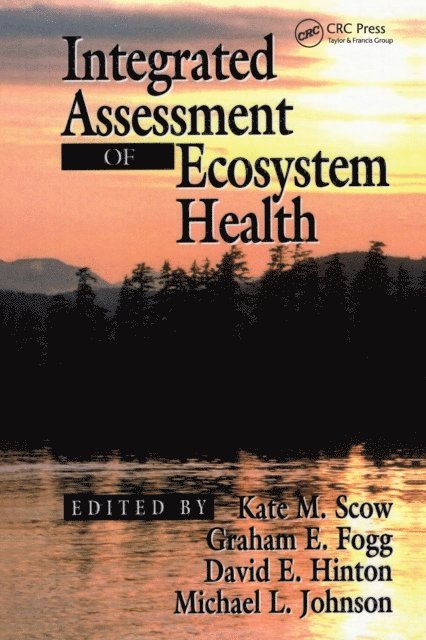
    Integrated Assessment of Ecosystem Health

    AvK.M. Scow,Graham E. Fogg

    Inbunden, Engelska, 1999

    3 203 kr

    Beställningsvara. Skickas inom 3-6 vardagar. Fri frakt över 249 kr.

    Beskrivning

    The new approach to ecosystem health is proactive. As a result, the scope of environmental studies is growing and the methods are evolving. Integrated Assessment of Ecosystem Health aggressively broadens the range of ecotoxicology to include its related fields.The book begins with John Cairns, Jr.'s predictions and recommendations for the future ecotoxicology: "New goals must lead to new techniques.... the field of ecotoxicology is in the early stages of a major paradigm shift that is driven by three interrelated forces: 1) heightened interest in sustainable use of the planet, 2) protection of ecosystem , and 3) the shift from emphasis on avoiding deleterious effects to maintaining them in robust health."Later chapters explore the integration of data, intrinsic remediation studies and the ever- increasing number of associated disciplines that are improving our environmental potential. Methodology, itself, is considered as an evolving tool, always in need examination and revision. Cairns, and his co-authors all advocate a constructive, offensive new form of ecoscience.The consensus of scientists is clear: toxic threat and, especially, habitat destruction are the most important environmentl issues, today. The mandate from Integrated Assessment of Ecosystem Health is also decisive: expand the parameters of ecoscience. The future of life on earth depends upon our ability to grow and learn.

    Produktinformation

    • Utgivningsdatum:1999-10-12
    • Mått:156 x 234 x 23 mm
    • Vikt:680 g
    • Format:Inbunden
    • Språk:Engelska
    • Antal sidor:384
    • Förlag:Taylor & Francis Inc
    • ISBN:9781566704533

    Utforska kategorier

    • Miljövetenskap och miljöpolitik inom Naturvetenskap och teknik
    • Biovetenskap inom Naturvetenskap och teknik

    Mer om författaren

    K.M. Scow, Graham E. Fogg, David E. Hinton, Michael L. Johnson

    Innehållsförteckning

    • Chapter 1: The Genesis and Future of the Field of Ecotoxicology; Section I: Fate; Chapter 2: A Predictor Of Seasonal Nitrogenous Dry Deposition In A Mixed Conifer Forest Stand In The San Bernardino Mountains; Chapter 3: Integrating Chemical, Water Quality, Habitat, And Fish Assemblage Data From The San Joaquin River Drainage, California; Chapter 4: Subsurface Contaminant Fate Determination Through Integrated Studies Of Intrinsic Remediation; Chapter 5: The Cantara Spill: A Case Study - Pesticide Transport In A Riverine Environment; Chapter 6: Distribution And Transport Of Air Pollutants To Vulnerable California Ecosystems; Chapter 7: The History Of Human Impacts In The Clear Lake Watershed (California) As Deduced From Lake Sediment Cores *; Section II: Effects; Chapter 8: The Development Of Cumulative Effects Assessment Tools Using Fish Populations; Chapter 9: Air Pollutants And Forests: Effect At The Organismal Scale; Chapter 10: Dna Fingerprinting As A Means To Identify Sources Of Soil-Derived Dust: Problems And Potential; Chapter 11: Microbial Proteins As Biomarkers Of Ecosystem Health; Chapter 12: Application Of A Random Amplified Polymorphic Dna (Rapd) Method For Characterization Of Microbial Communities In Agricultural Soils; Chapter 13: Air Pollution And Forests: Effects At The Landscape Level; Chapter 14: Mercury In Lower Trophic Levels Of The Clear Lake Aquatic Ecosystem, California; Section III: Risk; Chapter 15: Resources At Risk: A Forest Fire-Based Hazard/Risk Assessment; Chapter 16: Uncovering Mechanisms Of Lnterannual Variability From Short Ecological Time Series; Chapter 17: Developing Realistic Air Pollution Exposure/Dose Criteria For Ecological Risk Assessments; Chapter 18: Survey Methodologies For The Study Of Ecosystem Restoration And Management: The Importance Of Q-Methodology; Chapter 19: The California Water Quality Assessment Spatial Database: A Preliminary Look At Sierra Nevada Riverine Water Quality