• Fri frakt över 249 kr
  • •
  • Snabba leveranser
  • •
  • Billiga böcker
Kundservice

Du är på sajten för privatpersoner.

Företag, bibliotek eller offentlig verksamhet?

Du handlar på classic.bokus.com, där alla dina funktioner finns intakta.
Till classic.bokus.com
Bokus logotyp. Gå till startsidan.
  • Erbjudanden
  • Student
  • Topplistor
  • Barn & ungdom
  • Bokus Play
  • E-böcker
  • Ljudböcker
  • Pocketböcker
  • Spel och pussel

Pocketfynda! Hundratals böcker för 49 kr/st →

Sidfot

Mina sidor

    Hjälp

    • Kundservice
    • Vanliga frågor och svar
    • Frakt och leverans
    • Retur vid ångerrätt
    • Reklamera vara
    • Betalning
    • Köpvillkor
    • Allmänna villkor
    • Information om webbplatsens tillgänglighet

    Om Bokus

    • Om oss
    • Pressrum
    • För studenter
    • För företag
    • För bibliotek och offentlig verksamhet
    • För leverantörer
    • Hållbarhet

    Populärt

    • Aktuella erbjudanden
    • Presentkort
    • Studentlitteratur
    • Nya böcker
    • Topplistor
    • Signerade böcker
    • Engelska böcker

    Inspiration

    • Boktips
    • BookTok
    • Barnbokskaraktärer
    • Populära författare
    Logotyp för Bokus
    Följ oss på Facebook (extern länk)Följ oss på Instagram (extern länk)Följ oss på YouTube (extern länk)Följ oss på TikTok (extern länk)
    bokus @ CookiesAnpassa cookiesIntegritetspolicyKöpvillkor
    Till Citymail hemsida (extern länk)Till Budbee hemsida (extern länk)Till Postnord hemsida (extern länk)Till Schenker hemsida (extern länk)Till Early Bird hemsida (extern länk)Till Walleys hemsida (extern länk)
    1. Samhälle och politik
    2. Samhälle och kultur
    3. Kultur och medier
    4. Referensverk och tvärvetenskap

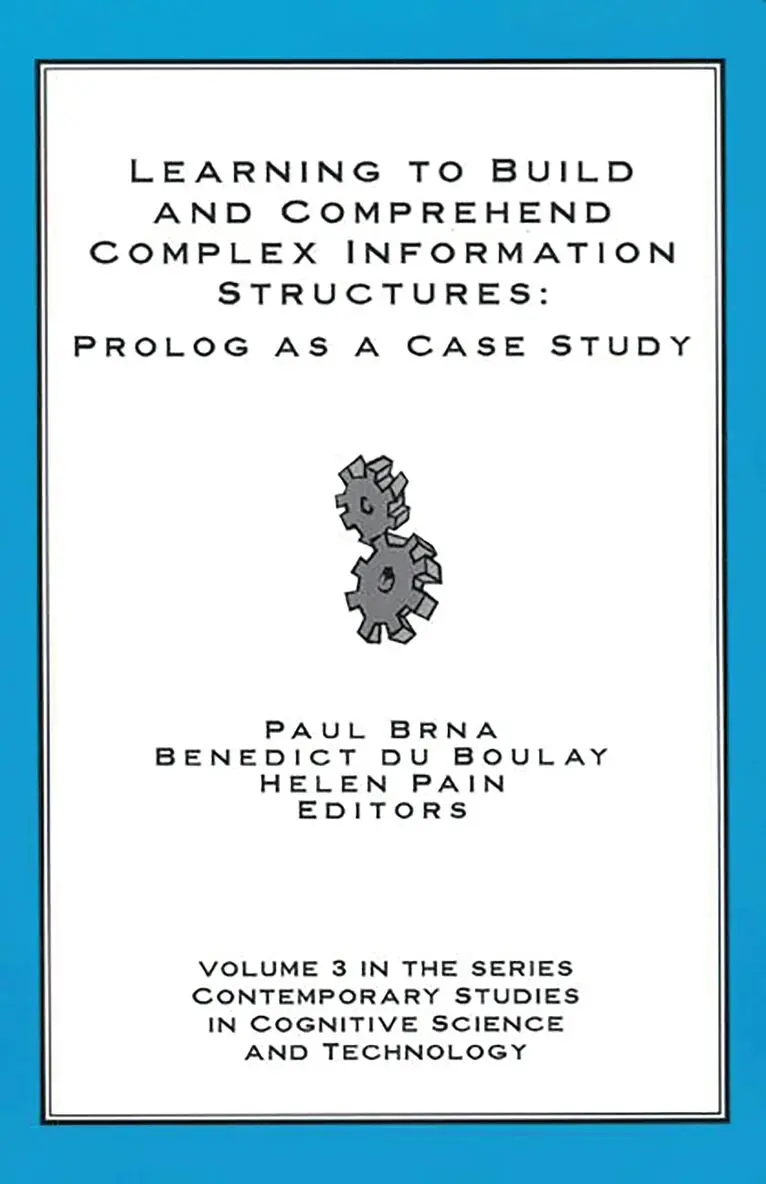
    Learning to Build and Comprehend Complex Information Structures

    Prolog as a Case Study

    AvPaul Brna,Benedict du Boulay

    Inbunden, Engelska, 1999

    Del i serien Contemporary Studies in Cognitive Science and Technology

    1 014 kr

    Beställningsvara. Skickas inom 10-15 vardagar. Fri frakt över 249 kr.

    Fler format och utgåvor

    Häftad

    544 kr

    Beskrivning

    Complex information structures are found in many disciplines including physics, genetics, biology and all branches of the information sciences. The current increasing, widespread use of information technology in all academic activities' emphasizes the need to understand how people construct and use such structures. The practices and activities found within the community of programmers provides a rich study area. The contents of this book are devoted to fundamental research that directly informs: the teaching community about some of the recent issues and problems that should help readers to increase their awareness when designing systems to support teaching, learning and using information technology; the psychology of the programming community about work in the area of learning to build, and debug programs; and the software engineering community in terms of the issues that implementors need to take into account when designing and building tools and environments for computer-based systems.

    Produktinformation

    • Utgivningsdatum:1999-08-13
    • Mått:156 x 235 x 28 mm
    • Vikt:697 g
    • Format:Inbunden
    • Språk:Engelska
    • Serie:Contemporary Studies in Cognitive Science and Technology
    • Antal sidor:430
    • Förlag:Bloomsbury Publishing Plc
    • ISBN:9781567504347

    Utforska kategorier

    • Referensverk och tvärvetenskap inom Samhälle och politik
    • Pedagogisk psykologi inom Psykologi och pedagogik
    • Programmeringsböcker inom Data och IT

    Mer om författaren

    PAUL BRNA is Reader in Interactive Learning Systems in the Computer Based Learning Unit at the University of Leeds./e Paul works on the applications of Artificial Intelligence to Education, including research into the interpretation and use of external representations and narrative in collaborative program construction and debugging.BENEDICT DU BOULAY is Professor of Artificial Intelligence Subject Group within the School of Cognitive and Computer Sciences. He is a member of the Human Centred Technology Research Group working in the areas of Artificial Intelligence in Education and the Psychology of Programming, University of Sussex.HELEN PAIN is Senior Lecturer at the Division of Informatics, University of Edinburgh.

    Innehållsförteckning

    • AcknowledgmentsPart I: Introduction, Paul Brna, Benedict du Boulay, and Helen PainBuilding and Manipulating Complex Information Structures: Issues in Prolog Programming, Thomas GreenDetecting Design Decisions About Data Structures in Prolog Programs, Diana BentalAnalyzing Novices Analyzing Prolog: What stories do novices tell themselves about Prolog? Josie TaylorTowards a Taxonomy of Novices' Misconceptions of the Prolog Interpreter, Pat Fung, Mike Brayshaw, Benedict du Boulay, and Mark Elsom-CookThe Use of Examples in Expository Texts: Outline of an Interpretation Theory for Text Analysis, Ian Robertson.Part II: Intermediate Representations: Effective Support for Novice Programmers? Paul BrnaProgramming Techniques for Prolog, Paul Brna, Alan Bundy, Tony Dodd, Marc Eisenstadt, Chee-Kit Looi, Helen Pain, Dave Robertson, Barbara Smith, and Maarten van SomersonIntroductory Prolog: A Suitable Selection of Programming Techniques, Andy Bowles and Paul BrnaAn Empirical Evaluation of Ted, A Techniques Editor for Prolog Programming, Thomas C. Ormerod and Linden J. BallA Case-Based Reasoning Approach to Supporting Novice Programmers, Andy Bowles, Dave Robertston, and Paul BrnaPart III: Support for Program Analysis, Benedict du BoulayAbstract Views of Prolog Executions in Opium, Mireille DucasséTracing and Debugging Prolog and PARLOG: an information management approachA Revised Textual Tree Trace Notation For Prolog, Chris Taylor, Benedict du Boulay, and Mukesh PatelThe ISM Framework: Understanding and Evaluating Software Visualization Tools, Paul MulhollandSoftware Visualization as a Pedagogical Tool: Redressing Some ITS Fallacies, Marc Eisenstadt, Blaine A. Price, and John DominguePart IV: Teaching and Learning Environments for Novice Programmers, Paul BrnaExploiting Program Schemata to Teach Recursive Programming, Timothy S. Gegg-HarrisonLearning Prolog Debugging Skills, Paul Brna, Edmundo Robert Hernanzes, and Helen PainTeaching Prolog Debugging in a Motivation Manner, Teresa del Soldato and Benedict du BoulayAuthor IndexSubject Index