• Fri frakt över 249 kr
  • •
  • Snabba leveranser
  • •
  • Billiga böcker
Kundservice

Du är på sajten för privatpersoner.

Företag, bibliotek eller offentlig verksamhet?

Du handlar på classic.bokus.com, där alla dina funktioner finns intakta.
Till classic.bokus.com
Bokus logotyp. Gå till startsidan.
  • Erbjudanden
  • Nyheter
  • Student
  • Topplistor
  • Barn & ungdom
  • Bokus Play
  • E-böcker
  • Pocketböcker
  • Spel & pussel

10% rabatt på allt med kod NYSTART10 →

Sidfot

Mina sidor

    Hjälp

    • Kundservice
    • Vanliga frågor och svar
    • Frakt och leverans
    • Retur vid ångerrätt
    • Reklamera vara
    • Betalning
    • Köpvillkor
    • Allmänna villkor
    • Information om webbplatsens tillgänglighet

    Om Bokus

    • Om oss
    • Pressrum
    • För studenter
    • För företag
    • För bibliotek och offentlig verksamhet
    • För leverantörer
    • Hållbarhet

    Populärt

    • Aktuella erbjudanden
    • Presentkort
    • Studentlitteratur
    • Nya böcker
    • Topplistor
    • Signerade böcker
    • Engelska böcker

    Inspiration

    • Boktips
    • BookTok
    • Populära bokserier
    • Barnbokskaraktärer
    • Populära författare
    Logotyp för Bokus
    Följ oss på Facebook (extern länk)Följ oss på Instagram (extern länk)Följ oss på YouTube (extern länk)Följ oss på TikTok (extern länk)
    bokus @ CookiesAnpassa cookiesIntegritetspolicyKöpvillkor
    Till Citymail hemsida (extern länk)Till Budbee hemsida (extern länk)Till Postnord hemsida (extern länk)Till Schenker hemsida (extern länk)Till Early Bird hemsida (extern länk)Till Walleys hemsida (extern länk)
    1. Samhälle och politik
    2. Politik och statsskick
    3. Politiskt förtryck

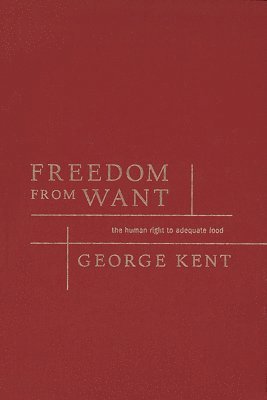
    Freedom from Want

    The Human Right to Adequate Food

    AvGeorge Kent

    Inbunden, Engelska, 2005

    Del i serien Advancing Human Rights series

    1 821 kr

    Tillfälligt slut

    Fler format och utgåvor

    Häftad

    710 kr

    E-bok

    758 kr

    Beskrivning

    There is, literally, a world of difference between the statements "Everyone should have adequate food," and "Everyone has the right to adequate food." In George Kent's view, the lofty rhetoric of the first statement will not be fulfilled until we take the second statement seriously. Kent sees hunger as a deeply political problem. Too many people do not have adequate control over local resources and cannot create the circumstances that would allow them to do meaningful, productive work and provide for themselves. The human right to an adequate livelihood, including the human right to adequate food, needs to be implemented worldwide in a systematic way.Freedom from Want makes it clear that feeding people will not solve the problem of hunger, for feeding programs can only be a short-term treatment of a symptom, not a cure. The real solution lies in empowering the poor. Governments, in particular, must ensure that their people face enabling conditions that allow citizens to provide for themselves.In a wider sense, Kent brings an understanding of human rights as a universal system, applicable to all nations on a global scale. If, as Kent argues, everyone has a human right to adequate food, it follows that those who can empower the poor have a duty to see that right implemented, and the obligation to be held morally and legally accountable, for seeing that that right is realized for everyone, everywhere.

    Produktinformation

    • Utgivningsdatum:2005-06-02
    • Mått:152 x 229 x 29 mm
    • Vikt:544 g
    • Format:Inbunden
    • Språk:Engelska
    • Serie:Advancing Human Rights series
    • Antal sidor:290
    • Förlag:Georgetown University Press
    • ISBN:9781589010550

    Utforska kategorier

    • Politiskt förtryck inom Samhälle och politik
    • Folkrätt inom Juridik

    Mer om författaren

    George Kent is a professor in the Department of Political Science at the University of Hawai'i, and author of The Politics of Children's Survival and Children in the International Political Economy.

    Recensioner i media

    "As a legal claim, the 'human right to adequate food' may seem thin gruel, but George Kent enriches the concept with data-based policy analysis, compelling ethical arguments, and a full review of concerned international, national, and nongovernmental organizations. He persuasively makes the case for accountability where the face of famine, malnutrition, and starvation confront the hands of those who hold political power at every level in our new global economy." -- Richard Pierre Claude, founding editor of Human Rights Quarterly and professor emeritus, University of Maryland

    Innehållsförteckning

    • List of Tables and Figures Foreword by Jean Ziegler Acknowledgments Introduction: Taking Rights Seriously Part I. Foundations Chapter 1. Food and Nutrition Malnutrition Causes of Malnutrition Growth Measurement Numbers of Malnourished People Malnutrition and Mortality Comparative Morality Food and Nutrition Security Varieties of Government Action Chapter 2. The International Human Rights System Historical Foundations International Humanitarian Law The International Bill of Human Rights Children's Rights Regional Human Rights Agreements Human Rights Agencies United Nations Charter Bodies United Nations Treaty Bodies Civil Society Organizations Informal Civil Society Chapter 3. Adequate Food is a Human Right Economic, Social, and Cultural RightsFood in International Human Rights Law Food in International Humanitarian Law Global Declarations and Commitments General Comment 12The Special RapporteurThe Voluntary Guidelines Part II. Human Rights Systems Chapter 4. Human Rights, Governance, and Law Human Rights and Governance Studying Human Rights in National Governance The Role of National LawUniversal Human Rights and the Role of International Law Chapter 5. Rights/Entitlements DefinitionMoral versus Legal RightsSoft versus Hard RightsRights as Goals Rights Imply EntitlementsDetermining Local EntitlementsHaving versus Realizing Rights Chapter 6. Obligations and Commitments Moral Responsibilities When Do Governments Do Human Rights Work? Levels of Government ObligationEconomic Rights The Obligation of Good Governance Obligations of Nonstate Actors Questionable Charity Chapter 7. Accountability MechanismsVarieties of Accountability Justiciability Remedies for Rights Holders National and Local Human Rights AgenciesAccountability through Public Action Chapter 8. India The Supreme Court Case Starvation is Not the Problem The Missing Piece in India's Rights SystemThe Tamil Nadu Integrated Nutrition Project Chapter 9. Brazil Chapter 10. The United States Chapter 11. Feeding InfantsBreast-Feeding RightsInfants' Human Right to Adequate Food Principles Women's Right to Breast-Feed versus Infants' Right to be Breast-FedChapter 12. Feeding Infants of HIV-Positive Mothers Official Guidance on HIV/AIDS and Infant Feeding Issues A Court Case Informed Choice PrinciplesChapter 13. Water The Household Water Problem Water Rights are DifferentGeneral Comment 15Chapter 14. TradeIssues The Human Right to Adequate Food in Relation to Trade Reconciling Different Frameworks Food SovereigntyChapter 15. RefugeesIssues in Refugee NutritionExplanations and Justifications for Uneven ServicesThe Human Right to Adequate FoodThe Adequacy QuestionSpecifying the ObligationsLimiting the ObligationsThe Work AheadChapter 16. International Humanitarian AssistanceIssuesRights to AssistanceThe Provider's Motivation ImplementationChapter 17. Global Human RightsGlobal Rights and Global ObligationsGlobal Accountability Strategic PlanningSources ReferencesIndex