• Fri frakt över 249 kr
  • •
  • Snabba leveranser
  • •
  • Billiga böcker
Kundservice

Du är på sajten för privatpersoner.

Företag, bibliotek eller offentlig verksamhet?

Du handlar på classic.bokus.com, där alla dina funktioner finns intakta.
Till classic.bokus.com
Bokus logotyp. Gå till startsidan.
  • Erbjudanden
  • Nyheter
  • Student
  • Topplistor
  • Barn & ungdom
  • Bokus Play
  • E-böcker
  • Pocketböcker
  • Spel & pussel

10% rabatt på allt med kod NYSTART10 →

Sidfot

Mina sidor

    Hjälp

    • Kundservice
    • Vanliga frågor och svar
    • Frakt och leverans
    • Retur vid ångerrätt
    • Reklamera vara
    • Betalning
    • Köpvillkor
    • Allmänna villkor
    • Information om webbplatsens tillgänglighet

    Om Bokus

    • Om oss
    • Pressrum
    • För studenter
    • För företag
    • För bibliotek och offentlig verksamhet
    • För leverantörer
    • Hållbarhet

    Populärt

    • Aktuella erbjudanden
    • Presentkort
    • Studentlitteratur
    • Nya böcker
    • Topplistor
    • Signerade böcker
    • Engelska böcker

    Inspiration

    • Boktips
    • BookTok
    • Populära bokserier
    • Barnbokskaraktärer
    • Populära författare
    Logotyp för Bokus
    Följ oss på Facebook (extern länk)Följ oss på Instagram (extern länk)Följ oss på YouTube (extern länk)Följ oss på TikTok (extern länk)
    bokus @ CookiesAnpassa cookiesIntegritetspolicyKöpvillkor
    Till Citymail hemsida (extern länk)Till Budbee hemsida (extern länk)Till Postnord hemsida (extern länk)Till Schenker hemsida (extern länk)Till Early Bird hemsida (extern länk)Till Walleys hemsida (extern länk)
    1. Naturvetenskap och teknik
    2. Matematik och naturvetenskap
    3. Biologi
    4. Biokemi

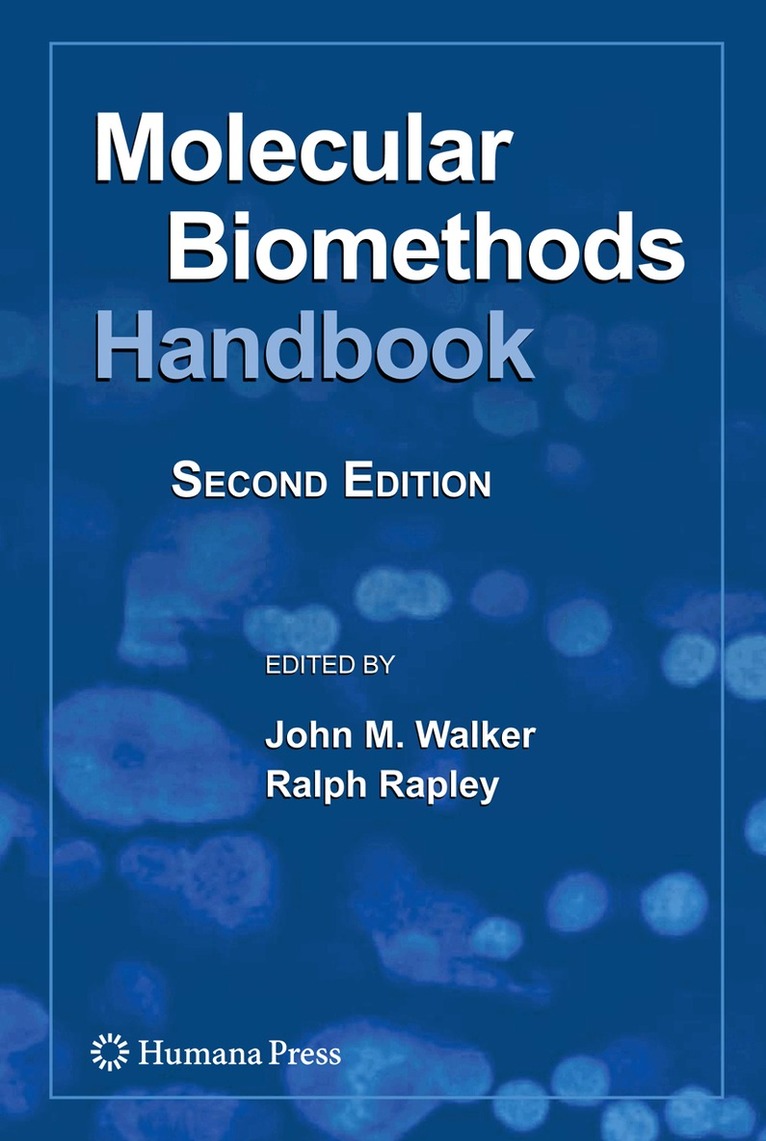
    Molecular Biomethods Handbook

    AvJohn M. Walker,Ralph Rapley

    Inbunden, Engelska, 2008

    2 164 kr

    Beställningsvara. Skickas inom 10-15 vardagar. Fri frakt över 249 kr.

    Beskrivning

    Recent advances in the biosciences have led to a range of powerful new technologies, particularly nucleic acid, protein and cell-based methodologies. The most recent insights have come to affect how scientists investigate and define cellular processes at the molecular level. Molecular Biomethods Handbook, 2nd Edition expands upon the techniques included in the first edition, providing theory, outlines of practical procedures, and applications for a range of techniques. Part A of the book describes nucleic acid methods, such as gene expression profiling, microarray analysis and quantitative PCR. In Part B, protein and cell-based methods are outlined, in subjects ranging from protein engineering to high throughput screening. Written by a well-established panel of research scientists, Molecular Biomethods Handbook, 2nd Edition provides an up to date collection of methods used regularly in the authors’ own research programs. This book will prove to be an invaluable reference for those engaged in or entering the field of molecular biology, and will provide the necessary background for those interested in setting up and using the latest molecular techniques.

    Produktinformation

    • Utgivningsdatum:2008-08-25
    • Mått:183 x 260 x 66 mm
    • Vikt:2 305 g
    • Format:Inbunden
    • Språk:Engelska
    • Antal sidor:1 124
    • Upplaga:2
    • Förlag:Humana Press Inc.
    • ISBN:9781603273701

    Utforska kategorier

    • Biokemi inom Naturvetenskap och teknik
    • Biologi inom Naturvetenskap och teknik
    • Naturvetenskap:allmänt inom Naturvetenskap och teknik

    Recensioner i media

    From the reviews of the second edition: "If you want to know the theoretical basis of how a technique works, how it might be applied, or what techniques are available to allow you to ask a particular question, then this book could prove very useful. ... this book will be of interest to young (and not so young) scientists who want to better understand the techniques they use, or may wish to use, and would be a useful addition to a library or PhD room." (Bob Dalziel, Microbiology Today, February, 2009) "The book is a second edition and this includes several new sections which deal with new areas e.g. microarray technology and nanotechnology ... . These deal with the physical concepts behind the techniques in an accessible way and will be useful to a large number of researchers. ... In summary, I found the book to be generally comprehensive, clearly written and logically organised. ... it would be a useful addition to any molecular biology laboratory bookshelf." (Nicola J Stonehouse, British Toxicology Society Newsletter, June-August, 2009) "Written by experts in their fields, the book gives a wide scope of molecular biology experimentation really living out only the most specialized uncommon techniques while at the same time giving reference to each chapter and sharing full information with readers. This handbook is suitable for research scientists, technicians, and graduate research students in molecular and cell biology, proteomics, and related branches of science." (G. Ya. Wiederschain, Biochemistry, Vol. 74 (9), 2009)

    Innehållsförteckning

    • Nucleic Acid Methods.- The Manipulation of Nucleic Acids.- Restriction Enzymes.- Principles and Medical Applications of the Polymerase Chain Reaction.- Probe Design, Production, and Applications.- Southern Blotting as a Diagnostic Method.- Capillary Electrophoresis of DNA.- Denaturing High-Performance Liquid Chromatography (DHPLC) for Nucleic Acid Analysis.- Denaturing Gradient Gel Electrophoresis (DGGE).- Single Strand Conformation Polymorphism (SSCP) Analysis.- Randomly Amplified Polymorphic DNA (RAPD).- Quantification of mRNA Using Real Time RT-PCR.- Quantitative Analysis of DNA Sequences by PCR and Solid-Phase Minisequencing.- Multiplex Amplifiable Probe Hybridization (MAPH).- Gene Expression Profiling.- Comparative Genomic Hybridization in Clinical and Medical Research.- Subtractive Hybridization.- Fluorescence In Situ Hybridization.- Quantitative Trait Locus Mapping to Identify Genes for Complex Traits in Mice.- cDNA Microarrays.- Mapping Techniques.- Single Nucleotide Polymorphisms.- Gene/Protein Sequence Analysis.- Protein and Cell Methods.- Protein Electrophoresis.- Protein Blotting.- Capillary Electrophoresis of Proteins.- Autoradiography and Fluorography.- Mass Spectrometry of Proteins and Peptides.- Post-Translational Modif ications of Proteins.- Protein Microarray Technology.- Protein–Protein Interactions.- Glycoprotein Analysis.- Solid-Phase Peptide Synthesis.- Monoclonal Antibodies.- Antibody Phage Display.- Protein Engineering.- Directed Protein Evolution.- Enzyme Linked Immunosorbent Assay (ELISA).- Epitope Mapping.- Quantum Dots.- Ion-Exchange Chromatography.- Size-Exclusion Chromatography.- Hydrophobic Interaction Chromatography.- Affinity Chromatography.- High Performance Liquid Chromatography (HPLC) of Peptides and Proteins.- Amino Acid Analysis.- Surface Plasmon Resonance.- Macromolecular Crystallography.- Microchip Devices for Bioanalysis.- Mammalian Cell Culture.- Plant Tissue Culture.- Stem Cells and Regenerative Medicine.- Cryopreservation.- Magnetic Resonance Imaging.- Electron Microscopy.- Confocal Microscopy.- Laser Microdissection.- Biomedical Uses of Flow Cytometry.- Immunomicroscopy.- In Situ Hybridization.- High Throughput Screening.