• Fri frakt över 249 kr
  • •
  • Snabba leveranser
  • •
  • Billiga böcker
Kundservice

Du är på sajten för privatpersoner.

Företag, bibliotek eller offentlig verksamhet?

Du handlar på classic.bokus.com, där alla dina funktioner finns intakta.
Till classic.bokus.com
Bokus logotyp. Gå till startsidan.
  • Erbjudanden
  • Nyheter
  • Student
  • Topplistor
  • Barn & ungdom
  • Bokus Play
  • E-böcker
  • Pocketböcker
  • Spel & pussel

10% rabatt på allt med kod: NYSTART10 →

Sidfot

Mina sidor

    Hjälp

    • Kundservice
    • Vanliga frågor och svar
    • Frakt och leverans
    • Retur vid ångerrätt
    • Reklamera vara
    • Betalning
    • Köpvillkor
    • Allmänna villkor
    • Information om webbplatsens tillgänglighet

    Om Bokus

    • Om oss
    • Pressrum
    • För studenter
    • För företag
    • För bibliotek och offentlig verksamhet
    • För leverantörer
    • Hållbarhet

    Populärt

    • Aktuella erbjudanden
    • Presentkort
    • Studentlitteratur
    • Nya böcker
    • Topplistor
    • Signerade böcker
    • Engelska böcker

    Inspiration

    • Boktips
    • BookTok
    • Populära bokserier
    • Barnbokskaraktärer
    • Populära författare
    Logotyp för Bokus
    Följ oss på Facebook (extern länk)Följ oss på Instagram (extern länk)Följ oss på YouTube (extern länk)Följ oss på TikTok (extern länk)
    bokus @ CookiesAnpassa cookiesIntegritetspolicyKöpvillkor
    Till Citymail hemsida (extern länk)Till Budbee hemsida (extern länk)Till Postnord hemsida (extern länk)Till Schenker hemsida (extern länk)Till Early Bird hemsida (extern länk)Till Walleys hemsida (extern länk)
    1. Psykologi och pedagogik
    2. Pedagogik
    3. Utbildningsstrategier och utbildningspolitik

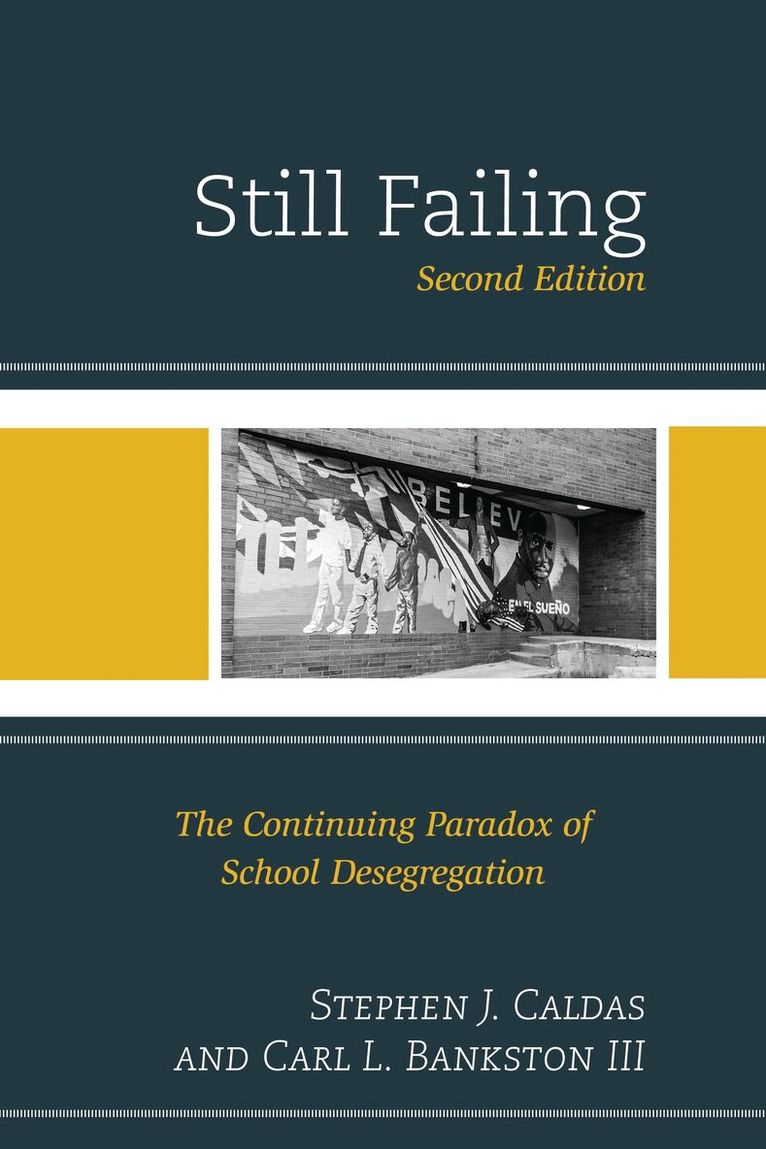
    Still Failing

    The Continuing Paradox of School Desegregation

    AvStephen J. Caldas,Carl L. Bankston III

    Inbunden, Engelska, 2014

    Del i serien Rowman & Littlefield Publishers

    951 kr

    Beställningsvara. Skickas inom 10-15 vardagar. Fri frakt över 249 kr.

    Fler format och utgåvor

    Häftad

    519 kr

    Beskrivning

    Still Failing: The Continuing Paradox of School Desegregation is a significantly updated and revised version of Caldas and Bankston’s previous book Forced to Fail: The Paradox of School Desegregation. The book includes an analysis of the most significant Supreme Court cases that have been decided in the ten years since the first edition of the book appeared. The authors consider the important implications of these recent rulings for the future of school desegregation in America’s schools. Social capital theory is used to explain why schools and communities continue to be segregated along racial and ethnic lines. Still Failing also provides the most recent U.S. census and Department of Education statistics documenting the continuing segregation of American schools and districts. The book also continues to track the persistent racial achievement gap, using the newest ACT, SAT, and NAEP testing figures. Finally, the book considers what present segregation trends portend for future efforts to racially and ethnically integrate schools, and close achievement gaps. Additional key features of this book include:Historical antecedents showing how and why American schooling became racially segregatedSocial capital theory to explain school and community segregationThe legal history of all important supreme court cases, congressional laws and presidential executive orders related to school segregation and desegregationEasy-to-read and interpret graphs and figuresThe most up-to-date school population and census information

    Produktinformation

    • Utgivningsdatum:2014-12-24
    • Mått:152 x 229 x 14 mm
    • Vikt:449 g
    • Format:Inbunden
    • Språk:Engelska
    • Serie:Rowman & Littlefield Publishers
    • Antal sidor:186
    • Upplaga:2
    • Förlag:Bloomsbury Publishing Plc
    • ISBN:9781610489621

    Utforska kategorier

    • Utbildningsstrategier och utbildningspolitik inom Psykologi och pedagogik
    • Skolan och förskolan inom Psykologi och pedagogik

    Mer om författaren

    Stephen J. Caldas has published many articles and books on school desegregation. He also publishes in the area of bilingual education. He currently teaches quantitative research methodology and education policy at Manhattanville College in New York.Carl L. Bankston III is an American sociologist and author. He is best known for his work on immigration to the United States, particularly on the adaptation of Vietnamese-American immigrants, and for his work on ethnicity, social capital, sociology of religion, and the sociology of eduction.

    Recensioner i media

    Still Failing reveals America’s daunting reality of the persistent racial gap in academic achievement despite decades of judicial actions on school desegregation. Critical of top-down social engineering, the authors offer an alternative account to explain why desegregation still fails to meet its intended goal, guiding readers toward a better understanding of how race, class, and social networks influence educational outcomes and help them envision a more realistic approach to equal access to educational opportunities.

    Innehållsförteckning

    • ContentsChapter 1 — School Desegregation: Irrelevant Public Policy?The Continuing Racial and Socioeconomic Segregation of American SchoolsResegregation by the NumbersFailure of Will or Failure of Command and Control?Redistributing Children’s “Social Capital”The Fallacy of “Diversity”Unintended ConsequencesA Noble, Misguided VisionBlinders of Moral CommitmentChapter 2 — How Did We Get Here?The Long Legal RoadThe Genesis of Civil RightsThe Paradox of Slavery in Free Market SocietyReconstruction and the Origins of “Affirmative” Protection of Group RightsRetreat from Reconstruction and the Protection of Group RightsPlessy v. Ferguson and “Separate but Equal”The Era of Jim Crow and American “Apartheid”Black Grass Roots Resistance to “Separate but Equal”The Earthquake of Brown IGrass Roots Civil Rights StruggleA Return to ReconstructionThe Desegregation Battle IntensifiesA Sea Change of Civil RightsFreedom of Choice“Affirmative” ActionMaximum Federal InvolvementChapter 3—Desegregation Expansion—and LimitsSetting LimitsUnitary Status and the End of OversightThe Diversity Doctrine and Supreme Court SchizophreniaThe Future of Desegregation LitigationChapter 4 — The Demographic Transformation of AmericaA Changing SocietyFamily StructureDemographic Change: New Student PopulationsHispanic ExplosionThe Asian AdvantageThe Problem of PovertyDemographics and School DesegregationChapter 5 – It takes “a certain” Kind of Village to Raise a ChildWhat is Social Capital?Families, Schools and Communities: Social Capital and School EnvironmentsSocial Capital in Child and Parent InteractionsSocial Capital in Parent-to-Parent InteractionsSocial Capital in Parent and School InteractionsSocial Capital in Student-to-Student InteractionsThe Power of School Peer CulturesChapter 6 – The Power of School Peers and the Power of CommunityThe Positive Power of PeersDisruptive School ClimatesSchools and the Creation of Community Social CapitalDesegregation and the Destruction of Community Social CapitalUnderstanding the Importance of CommunityChapter 7 — School Desegregation and the Racial Achievement GapA Controversial TopicIs There Really a Gap?The SAT/ACT GapThe High School GapThe Higher Ed GapWhy the Continuing Gap?The Origins of the Black-White GapHistory of Racial Oppression as Cause of the Black/White Achievement GapEnvironmental Hazards and Educational AchievementSchool CurriculumStereotype ThreatWhy the Need for School Racial Integration?Do Blacks Achieve Better in Majority White Schools?Is White Achievement Hurt in Majority Black Schools?Are Standardized Tests Culturally Biased Against Minorities?The Stubborn GapHow Can We Close the Gap?Chapter 8 — A New Perspective of Race and Schooling: Attaining the DreamNew ParadigmsResistanceSocioeconomic IntegrationStrategies that WorkNeighborhood SchoolsStrengthening CommunitiesPublic Support for Public EducationLocal Control in Minority CommunitiesApproach Reforms with Caution and Limited ExpectationsLet Schools Be Schools