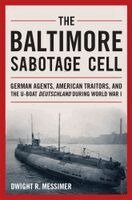
Baltimore Sabotage Cell
German Agents, American Traitors, and the U-boat Deutschland During World War I
E-bok
Engelska, 2015320 kr
Läs direkt i Bokus Reader – eller ladda ned till din enhet
Fler format och utgåvor
Beskrivning
By the summer of 1915, Germany was faced with two related, but somewhat dissimilar problems; how to break the British blockade and how to stop or seriously disrupt the British supply line across the Atlantic. The solution to breaking the blockade was to find a way over it, through it, or under it. Aircraft in those days were too primitive, underpowered, and short range to accomplish the first and Germany lacked the naval strength to force a passage through the blockade. But if a fleet of cargo U-boats could be built that were large enough to carry meaningful loads and had the range to make a round trip between Germany and the United States without having to refuel, the blockade might be successfully broken. Responsibility for implementing this solution rested with a section of German Navy Intelligence known as the Etappendienst.
The Germans also lacked the naval strength to effect the solution to the other problem; cutting Britain''s supply line to America. The German Navy could not defeat the Royal Navy in a slug-fest and there were not enough U-boats to effectively block Britain''s cross-Atlantic sea trade. The answer lay in sabotage--blowing up the munitions factories, the depots, and the ships, and infecting the remounts--horses and mules--with Anthrax and Glanders at the western end of the supply line.
Responsibility for carrying out sabotage of all types in the United States rested with a newly established subsection of the German Army Intelligence called the Sektion Politik that sent trained saboteurs to the United States beginning in 1915. German agents, together with American sympathizers, carried out more than fifty successful attacks involving fire and explosion before America''s entry into the war on 6 April 1917, in addition to spreading Anthrax and Glanders on the East Coast.
Of the two solutions to those problems, sabotage was incompatible with Germany''s primary diplomatic goal to keep the United States out of the war, while the other, breaking the blockade with a fleet of cargo U-boats, provided the least danger of bringing the United States into the war. The two solutions were widely dissimilar, but the fact that the cargo U-boat project and the sabotage campaign were run by intelligence agencies--the Etappendienst (Navy) and the Geheimdienst (Army), through the agency of one man--Paul Hilken, in one US city--Baltimore, make them inseparable. Those separate solutions created the dichotomy that produced the U-Boat Deutschland and the Baltimore Sabotage Cell.
The Germans also lacked the naval strength to effect the solution to the other problem; cutting Britain''s supply line to America. The German Navy could not defeat the Royal Navy in a slug-fest and there were not enough U-boats to effectively block Britain''s cross-Atlantic sea trade. The answer lay in sabotage--blowing up the munitions factories, the depots, and the ships, and infecting the remounts--horses and mules--with Anthrax and Glanders at the western end of the supply line.
Responsibility for carrying out sabotage of all types in the United States rested with a newly established subsection of the German Army Intelligence called the Sektion Politik that sent trained saboteurs to the United States beginning in 1915. German agents, together with American sympathizers, carried out more than fifty successful attacks involving fire and explosion before America''s entry into the war on 6 April 1917, in addition to spreading Anthrax and Glanders on the East Coast.
Of the two solutions to those problems, sabotage was incompatible with Germany''s primary diplomatic goal to keep the United States out of the war, while the other, breaking the blockade with a fleet of cargo U-boats, provided the least danger of bringing the United States into the war. The two solutions were widely dissimilar, but the fact that the cargo U-boat project and the sabotage campaign were run by intelligence agencies--the Etappendienst (Navy) and the Geheimdienst (Army), through the agency of one man--Paul Hilken, in one US city--Baltimore, make them inseparable. Those separate solutions created the dichotomy that produced the U-Boat Deutschland and the Baltimore Sabotage Cell.