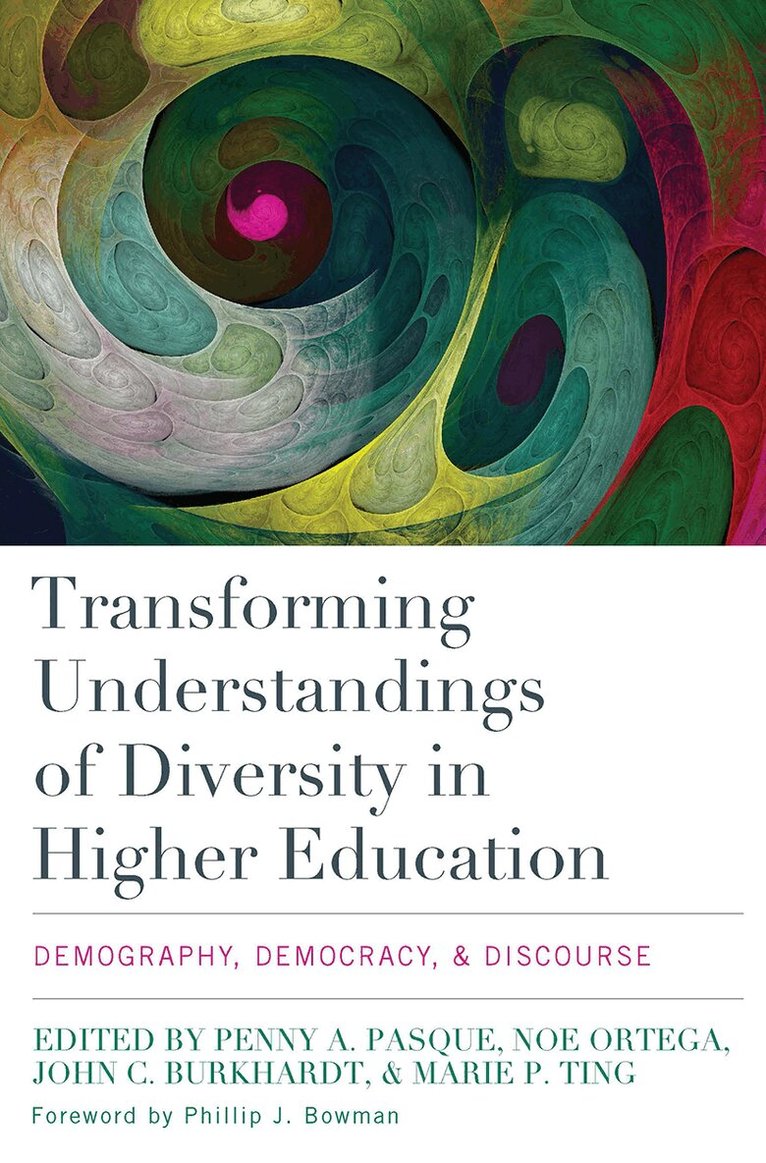
Transforming Understandings of Diversity in Higher Education
Demography, Democracy, and Discourse
536 kr
Beställningsvara. Skickas inom 10-15 vardagar. Fri frakt över 249 kr.
Du är på sajten för privatpersoner.
536 kr
Beställningsvara. Skickas inom 10-15 vardagar. Fri frakt över 249 kr.
Penny A. Pasque is professor in Educational Studies, director of the QualLab, and director of Qualitative Methods in the Office of Research, Innovation and Collaboration (ORIC), College of Education and Human Ecology, The Ohio State University. Pasque is editor of The Review of Higher Education (with Dr. Thomas F. Nelson Laird). RHE is considered one of the leading research journals in the field and is the official journal of the Association for the Study of Higher Education. Her research addresses complexities in qualitative inquiry, in/equities in higher education, and dis/connections between higher education and society. She works with qualitative methodologies as well as studies qualitative methodologies that work toward social justice and educational equity. Pasque’s research has appeared in over 100 journal articles and books, including in The Journal of Higher Education, Qualitative Inquiry, The Review of Higher Education, Peabody Journal of Education, Diversity in Higher Education, Cultural StudiesCritical Methodologies, among others.Her books include Qualitative Inquiry in Higher Education Organization and Policy Research (with Lechuga, Routledge), Qualitative Inquiry for Equity in Higher Education: Methodological Innovations, Implications, and Interventions (with Carducci, Kuntz & Gildersleeve, Jossey-Bass), Critical Qualitative Inquiry: Foundations and Futures (with Cannella & Salazar Pérez, Left Coast Press), American Higher Education Leadership and Policy: Critical Issues and the Public Good (Palgrave Macmillan), Empowering Women in Higher Education and Student Affairs (with Nicholson, Stylus), Transforming Understandings of Diversity in Higher Education (with Ortega, Burkhardt, & Ting, Stylus) and Engaged Research and Practice (with Overton & Burkhardt, Stylus).Currently, she’s editor for the “critical & social justice” section of the upcoming Routledge Encyclopedia (Salvo & Ulmer, eds.), writing a chapter / reviewing for a Handbook on Critical Appr
“The timing of [this book] is prescient. A divisive presidential election and a polarizing outcome have forced us to reflect on our shared values as a nation. Specifically, how do we value diversity in a country that is divided? Many people in higher education feel a pressing need to reinvigorate the discourse on diversity, particularly as it pertains to our college and university campuses today. This volume seeks to meet the current challenge and is committed to future possibilities of greater insight, justice, and opportunity in higher education.If we seek to transform our present understandings of diversity as the title of the text asserts, we must first acknowledge where we are positioned during the current moment. Have we achieved the diversity we desire across higher education? What remains to be accomplished? Do we risk losing ground in the coming years? In some ways, American colleges and universities have made significant strides in promoting a more diverse student body. However, these successes at diversifying educational opportunity are at risk.We find ourselves at a political, legal, and intellectual crossroads regarding diversity in higher education. The authors believe that it remains unclear what the term diversity actually means, who it includes, and how it encompasses them as students. This intellectual honesty from diversity scholars is refreshing in today’s climate of angry political rhetoric and sharp divisions.As such, Transforming Understandings of Diversity in Higher Education effectively contextualizes the problem of diversity. It demonstrates that the term has come to be viewed as an objective of, or even an agenda in, higher education today. Court rulings have been central to shaping how universities engage with diversity as part of a fluid discourse on this topic. Supreme Court decisions in Regents of the University of California v. Baake (1978), Grutter v. Bollinger (2003), Gratz v. Bollinger (2003), and Fisher v. University of Texas (2013, 2016) recognize diversity as beneficial to student learning. They also state that diversity is important in fulfilling the educational mission of the modern multiversity. Simultaneously, the Supreme Court has narrowed how race and ethnicity could be considered in college admissions decisions.Prior to the burgeoning and important work of critical race theorists, scholars like Kimberle Crenshaw were critical of the legal discourse on diversity. In her seminal article "Demarginalizing the Intersection of Race and Sex: A Black Feminist Critique of Antidiscrimination Doctrine, Feminist Theory, and Antiracist Politics" (1989), she persuasively articulates how the courts have often obscured the multidimensionality or intersectionality of people’s lived experiences. Relative to several court rulings, Crenshaw finds that the courts fail to recognize more nuanced understandings of discrimination, particularly when cases involve compound or double discrimination. As she aptly noted regarding discrimination several decades ago, the same might be said about diversity discourse in higher education today. In short, we need to re-center this critical discourse at these intersections.Transforming Understandings of Diversity in Higher Education attempts to contribute to this process and make the discourse more nuancedThe book encourages young scholars and student affairs professionals to contribute to our developing understandings of diversity. These emerging diversity scholars and practitioners, accompanied by several veteran trailblazers, are our best hope at envisioning a brighter future and transforming higher education for the twenty-first-century.”Teachers College Record“This book features many dynamic scholar activists whose collective works push us to complicate and re-conceptualize our staid notions of student and institutional diversity experiences. They also provide us with important new perspectives and frameworks on diversity discourses that help to bridge scholarship with engagement, thus serving as a practical guide for scholars and practitioners alike. Ultimately, the contributors succeed in helping us to transform our understandings of diversity to better reflect the complex and intersectional realities of our higher education contexts.”Victor B. Sáenz, Ph.D, Department of Educational Administration, The University of Texas at Austin"While diversity in all its forms has always been a natural aspect of our world and of higher education, the scholarship in this book takes the term and its usage to a leading-edge level. Chapter authors dig deep into entrenched belief systems, policies and practices to illuminate newly-appearing challenges and to fashion breakthroughs in our understanding of diversity. For all who seek to fashion a transformational vision of higher education operating in its natural state of diversity, look no further than this revelatory body of work."Laura I Rendón, Professor Emerita, University of Texas-San Antonio"This carefully curated edited book highlights the work of emerging scholars who offer a fresh perspective on diversity in higher education. They challenge old notions of diversity and assign it with new meaning, repurposing diversity to elevate the impact of higher education. Interviews with authors added in between chapters provide additional insights into their unique positions and experiences that shape their research. If how we think about diversity during the University of Michigan's defense of race conscious admissions is regarded as Diversity 1.0 and the University of Texas' subsequent defense is version 2.0, then the fine collection of work in this volume moves us toward version 3.0. This new version stands to position diversity for deeper and broader impact."Mitchell J. Chang, Ph.D., Graduate School of Education & Information Studies, University of California, Los Angeles
John C. Burkhardt, Marie P. Ting, Noe Ortega, Penny A. Pasque
626 kr
Penny A. Pasque, Noe Ortega, Marie P. Ting, John C. Burkhardt
Inbunden, 2016
2 401 kr
Betty Overton, Penny A. Pasque, John C. Burkhardt
Inbunden, 2016
2 401 kr
John C. Burkhardt, Marie P. Ting, Noe Ortega, Penny A. Pasque
626 kr
John C. Burkhardt, Jessica Y. Joslin
Häftad, 2020
298 kr
John C. Burkhardt, Anthony C. Chambers, Adrianna Kezar
568 kr
Kezar, Burkhardt, Adrianna Kezar, Anthony C. Chambers, John C. Burkhardt
Inbunden, 2005
489 kr
Du är på sajten för privatpersoner.
536 kr
Beställningsvara. Skickas inom 10-15 vardagar. Fri frakt över 249 kr.
Penny A. Pasque is professor in Educational Studies, director of the QualLab, and director of Qualitative Methods in the Office of Research, Innovation and Collaboration (ORIC), College of Education and Human Ecology, The Ohio State University. Pasque is editor of The Review of Higher Education (with Dr. Thomas F. Nelson Laird). RHE is considered one of the leading research journals in the field and is the official journal of the Association for the Study of Higher Education. Her research addresses complexities in qualitative inquiry, in/equities in higher education, and dis/connections between higher education and society. She works with qualitative methodologies as well as studies qualitative methodologies that work toward social justice and educational equity. Pasque’s research has appeared in over 100 journal articles and books, including in The Journal of Higher Education, Qualitative Inquiry, The Review of Higher Education, Peabody Journal of Education, Diversity in Higher Education, Cultural StudiesCritical Methodologies, among others.Her books include Qualitative Inquiry in Higher Education Organization and Policy Research (with Lechuga, Routledge), Qualitative Inquiry for Equity in Higher Education: Methodological Innovations, Implications, and Interventions (with Carducci, Kuntz & Gildersleeve, Jossey-Bass), Critical Qualitative Inquiry: Foundations and Futures (with Cannella & Salazar Pérez, Left Coast Press), American Higher Education Leadership and Policy: Critical Issues and the Public Good (Palgrave Macmillan), Empowering Women in Higher Education and Student Affairs (with Nicholson, Stylus), Transforming Understandings of Diversity in Higher Education (with Ortega, Burkhardt, & Ting, Stylus) and Engaged Research and Practice (with Overton & Burkhardt, Stylus).Currently, she’s editor for the “critical & social justice” section of the upcoming Routledge Encyclopedia (Salvo & Ulmer, eds.), writing a chapter / reviewing for a Handbook on Critical Appr
“The timing of [this book] is prescient. A divisive presidential election and a polarizing outcome have forced us to reflect on our shared values as a nation. Specifically, how do we value diversity in a country that is divided? Many people in higher education feel a pressing need to reinvigorate the discourse on diversity, particularly as it pertains to our college and university campuses today. This volume seeks to meet the current challenge and is committed to future possibilities of greater insight, justice, and opportunity in higher education.If we seek to transform our present understandings of diversity as the title of the text asserts, we must first acknowledge where we are positioned during the current moment. Have we achieved the diversity we desire across higher education? What remains to be accomplished? Do we risk losing ground in the coming years? In some ways, American colleges and universities have made significant strides in promoting a more diverse student body. However, these successes at diversifying educational opportunity are at risk.We find ourselves at a political, legal, and intellectual crossroads regarding diversity in higher education. The authors believe that it remains unclear what the term diversity actually means, who it includes, and how it encompasses them as students. This intellectual honesty from diversity scholars is refreshing in today’s climate of angry political rhetoric and sharp divisions.As such, Transforming Understandings of Diversity in Higher Education effectively contextualizes the problem of diversity. It demonstrates that the term has come to be viewed as an objective of, or even an agenda in, higher education today. Court rulings have been central to shaping how universities engage with diversity as part of a fluid discourse on this topic. Supreme Court decisions in Regents of the University of California v. Baake (1978), Grutter v. Bollinger (2003), Gratz v. Bollinger (2003), and Fisher v. University of Texas (2013, 2016) recognize diversity as beneficial to student learning. They also state that diversity is important in fulfilling the educational mission of the modern multiversity. Simultaneously, the Supreme Court has narrowed how race and ethnicity could be considered in college admissions decisions.Prior to the burgeoning and important work of critical race theorists, scholars like Kimberle Crenshaw were critical of the legal discourse on diversity. In her seminal article "Demarginalizing the Intersection of Race and Sex: A Black Feminist Critique of Antidiscrimination Doctrine, Feminist Theory, and Antiracist Politics" (1989), she persuasively articulates how the courts have often obscured the multidimensionality or intersectionality of people’s lived experiences. Relative to several court rulings, Crenshaw finds that the courts fail to recognize more nuanced understandings of discrimination, particularly when cases involve compound or double discrimination. As she aptly noted regarding discrimination several decades ago, the same might be said about diversity discourse in higher education today. In short, we need to re-center this critical discourse at these intersections.Transforming Understandings of Diversity in Higher Education attempts to contribute to this process and make the discourse more nuancedThe book encourages young scholars and student affairs professionals to contribute to our developing understandings of diversity. These emerging diversity scholars and practitioners, accompanied by several veteran trailblazers, are our best hope at envisioning a brighter future and transforming higher education for the twenty-first-century.”Teachers College Record“This book features many dynamic scholar activists whose collective works push us to complicate and re-conceptualize our staid notions of student and institutional diversity experiences. They also provide us with important new perspectives and frameworks on diversity discourses that help to bridge scholarship with engagement, thus serving as a practical guide for scholars and practitioners alike. Ultimately, the contributors succeed in helping us to transform our understandings of diversity to better reflect the complex and intersectional realities of our higher education contexts.”Victor B. Sáenz, Ph.D, Department of Educational Administration, The University of Texas at Austin"While diversity in all its forms has always been a natural aspect of our world and of higher education, the scholarship in this book takes the term and its usage to a leading-edge level. Chapter authors dig deep into entrenched belief systems, policies and practices to illuminate newly-appearing challenges and to fashion breakthroughs in our understanding of diversity. For all who seek to fashion a transformational vision of higher education operating in its natural state of diversity, look no further than this revelatory body of work."Laura I Rendón, Professor Emerita, University of Texas-San Antonio"This carefully curated edited book highlights the work of emerging scholars who offer a fresh perspective on diversity in higher education. They challenge old notions of diversity and assign it with new meaning, repurposing diversity to elevate the impact of higher education. Interviews with authors added in between chapters provide additional insights into their unique positions and experiences that shape their research. If how we think about diversity during the University of Michigan's defense of race conscious admissions is regarded as Diversity 1.0 and the University of Texas' subsequent defense is version 2.0, then the fine collection of work in this volume moves us toward version 3.0. This new version stands to position diversity for deeper and broader impact."Mitchell J. Chang, Ph.D., Graduate School of Education & Information Studies, University of California, Los Angeles
John C. Burkhardt, Marie P. Ting, Noe Ortega, Penny A. Pasque
626 kr
Penny A. Pasque, Noe Ortega, Marie P. Ting, John C. Burkhardt
Inbunden, 2016
2 401 kr
Betty Overton, Penny A. Pasque, John C. Burkhardt
Inbunden, 2016
2 401 kr
John C. Burkhardt, Marie P. Ting, Noe Ortega, Penny A. Pasque
626 kr
John C. Burkhardt, Jessica Y. Joslin
Häftad, 2020
298 kr
John C. Burkhardt, Anthony C. Chambers, Adrianna Kezar
568 kr
Kezar, Burkhardt, Adrianna Kezar, Anthony C. Chambers, John C. Burkhardt
Inbunden, 2005
489 kr