• Fri frakt över 249 kr
  • •
  • Snabba leveranser
  • •
  • Billiga böcker
Kundservice

Du är på sajten för privatpersoner.

Företag, bibliotek eller offentlig verksamhet?

Du handlar på classic.bokus.com, där alla dina funktioner finns intakta.
Till classic.bokus.com
Bokus logotyp. Gå till startsidan.
  • Erbjudanden
  • Nyheter
  • Student
  • Topplistor
  • Barn & ungdom
  • Bokus Play
  • E-böcker
  • Pocketböcker
  • Spel & pussel

10% rabatt på allt med kod NYSTART10 →

Sidfot

Mina sidor

    Hjälp

    • Kundservice
    • Vanliga frågor och svar
    • Frakt och leverans
    • Retur vid ångerrätt
    • Reklamera vara
    • Betalning
    • Köpvillkor
    • Allmänna villkor
    • Information om webbplatsens tillgänglighet

    Om Bokus

    • Om oss
    • Pressrum
    • För studenter
    • För företag
    • För bibliotek och offentlig verksamhet
    • För leverantörer
    • Hållbarhet

    Populärt

    • Aktuella erbjudanden
    • Presentkort
    • Studentlitteratur
    • Nya böcker
    • Topplistor
    • Signerade böcker
    • Engelska böcker

    Inspiration

    • Boktips
    • BookTok
    • Populära bokserier
    • Barnbokskaraktärer
    • Populära författare
    Logotyp för Bokus
    Följ oss på Facebook (extern länk)Följ oss på Instagram (extern länk)Följ oss på YouTube (extern länk)Följ oss på TikTok (extern länk)
    bokus @ CookiesAnpassa cookiesIntegritetspolicyKöpvillkor
    Till Citymail hemsida (extern länk)Till Budbee hemsida (extern länk)Till Postnord hemsida (extern länk)Till Schenker hemsida (extern länk)Till Early Bird hemsida (extern länk)Till Walleys hemsida (extern länk)
    1. Psykologi och pedagogik
    2. Psykologi
    3. Barnpsykologi och utvecklingspsykologi

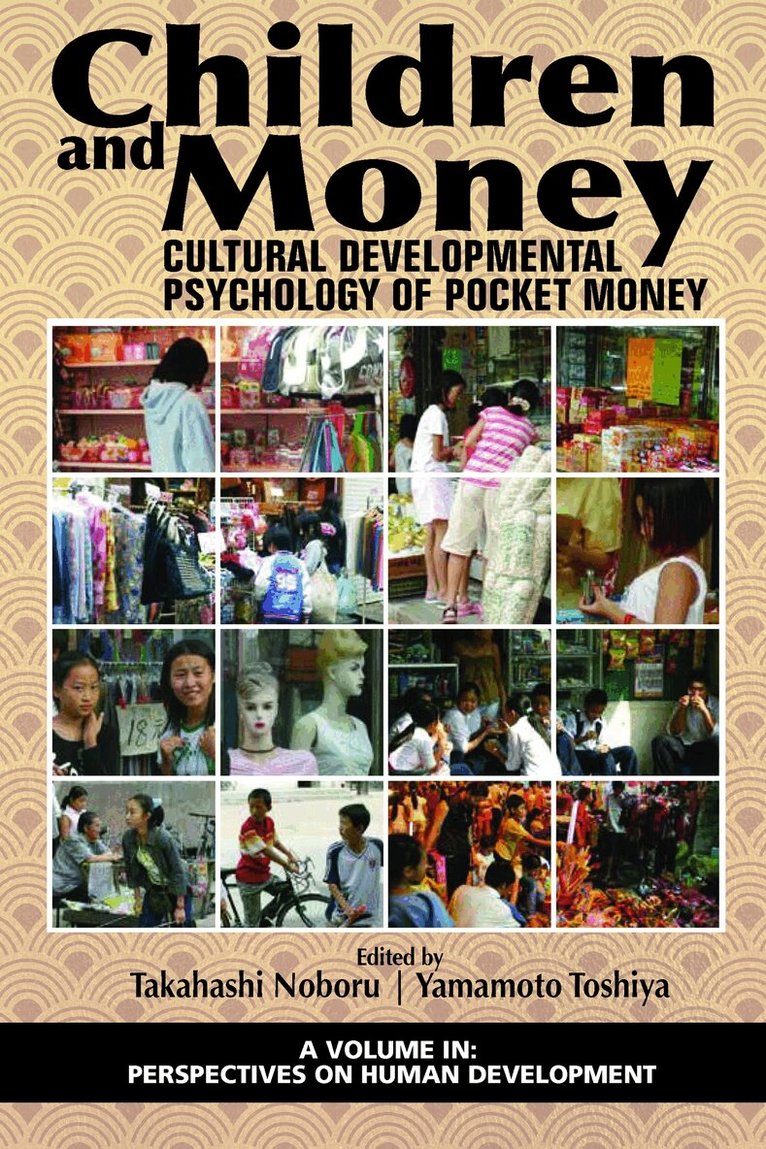
    Children and Money

    Cultural Developmental Psychology of Pocket Money

    AvTakahashi Noboru,Yamamoto Toshiya

    Häftad, Engelska, 2020

    Del i serien Perspectives on Human Development

    606 kr

    Beställningsvara. Skickas inom 5-8 vardagar. Fri frakt över 249 kr.

    Beskrivning

    In the 'Pocket Money Project,' researchers from four countries, Japan, Korea, China, and Vietnam collaborated and studied how children in those four countries were involved with money, combining various research methods and approaches. What our project tries to present throughout this book is that money is not only just a tool of exchange in the context of the market economy; but, it also serves as a tool to mediate human relationships in individual cultures; and the tool is used and mediated by norms. The structure of the norms differs among cultures, and the same action has different meanings; thus, when the structure of norms in a culture is identified, the meaning of an action in the culture becomes clear.The research practice of 'the Cultural Psychology of Differences' does not aim to create inventories of static differences. When a researcher, who is also a member of a specific culture, witnesses common behavior (cultural practices) among the others belonging to a different culture, the researcher is surprised, and, at the same time, reflects on his or her own common behavior (cultural practices); by doing so, mutual understanding and empathy are deepened, and this is exactly what 'the Cultural Psychology of Differences' aims to do. Culture of the others appears dynamically, swaying ourselves; theorizing such a process is the task of our 'Cultural Psychology of Differences'.We believe this practice of understanding different cultures will provide a practical prescription for mutual understanding through tensions and surprise not only for psychology but also for members of the countries that historically and constantly have had strained relationships. 'Cultural Psychology of Differences' is the ideal that cultural psychology to study the relationships between mind and culture should be pursued in the future.

    Produktinformation

    • Utgivningsdatum:2020-03-06
    • Mått:156 x 234 x 16 mm
    • Vikt:419 g
    • Format:Häftad
    • Språk:Engelska
    • Serie:Perspectives on Human Development
    • Antal sidor:296
    • Förlag:Emerald Publishing Inc
    • ISBN:9781641139540

    Utforska kategorier

    • Barnpsykologi och utvecklingspsykologi inom Psykologi och pedagogik
    • Etnicitet inom Samhälle och politik

    Innehållsförteckning

    • Introduction: Why Do We Compare Cultures? What Does Money Mean to Children? Takahashi Noboru.Chapter 1. Children Living in Consumer Society; Pian Chengnan.Chapter 2. Children's Meanings of Growing up and the Structures of Parent-Child Relationships; Takeo Kazuko.Chapter 3. Structure of Peer Relationships Mediated by Money; Oh Sun Ah.Chapter 4. Korean Children's Lifeworld Revolving Around Money; Choi Soonja and Kim Soonja.Chapter 5. Chinese Children in Urban Cities and Their Financial Intelligence; Zhou Nianli.Chapter 6. Children and Pocket Money in Vietnam; Phan Thi Mai Huong and Nguyen Thi Hoa.Chapter 7. Money for Children in Japan: From an Ecological Perspective of Child Development; Takahashi Noboru.Chapter 8. Ambivalence of Parent-Child Relationships Found in Beliefs Underlying Pocket Money; Pian Chengnan.Chapter 9. Birth of Trajectory Equifinality Approach (TEA) and the Pocket Money Project: Effort to Theorize the Flow of Time; Sato Tatsuya.Chapter 10. When Difference Appears, and How to Overcome the Difference; Oh Sun Ah.Chapter 11. The Pocket Money Project and the Cultural Psychology of Differences; Yamamoto Toshiya.Chapter 12. Supplementary Chapter: Outline of the Project, Summary of the Results, and a Support Runner's Suggestions for a New Dialogue; Watanabe Tadaharu.Appendix: Tables.