• Fri frakt över 249 kr
  • •
  • Snabba leveranser
  • •
  • Billiga böcker
Kundservice

Du är på sajten för privatpersoner.

Företag, bibliotek eller offentlig verksamhet?

Du handlar på classic.bokus.com, där alla dina funktioner finns intakta.
Till classic.bokus.com
Bokus logotyp. Gå till startsidan.
  • Erbjudanden
  • Nyheter
  • Student
  • Topplistor
  • Barn & ungdom
  • Bokus Play
  • E-böcker
  • Pocketböcker
  • Spel & pussel

10% rabatt på allt med kod: NYSTART10 →

Sidfot

Mina sidor

    Hjälp

    • Kundservice
    • Vanliga frågor och svar
    • Frakt och leverans
    • Retur vid ångerrätt
    • Reklamera vara
    • Betalning
    • Köpvillkor
    • Allmänna villkor
    • Information om webbplatsens tillgänglighet

    Om Bokus

    • Om oss
    • Pressrum
    • För studenter
    • För företag
    • För bibliotek och offentlig verksamhet
    • För leverantörer
    • Hållbarhet

    Populärt

    • Aktuella erbjudanden
    • Presentkort
    • Studentlitteratur
    • Nya böcker
    • Topplistor
    • Signerade böcker
    • Engelska böcker

    Inspiration

    • Boktips
    • BookTok
    • Populära bokserier
    • Barnbokskaraktärer
    • Populära författare
    Logotyp för Bokus
    Följ oss på Facebook (extern länk)Följ oss på Instagram (extern länk)Följ oss på YouTube (extern länk)Följ oss på TikTok (extern länk)
    bokus @ CookiesAnpassa cookiesIntegritetspolicyKöpvillkor
    Till Citymail hemsida (extern länk)Till Budbee hemsida (extern länk)Till Postnord hemsida (extern länk)Till Schenker hemsida (extern länk)Till Early Bird hemsida (extern länk)Till Walleys hemsida (extern länk)
    1. Psykologi och pedagogik
    2. Pedagogik
    3. Högskola och universitet

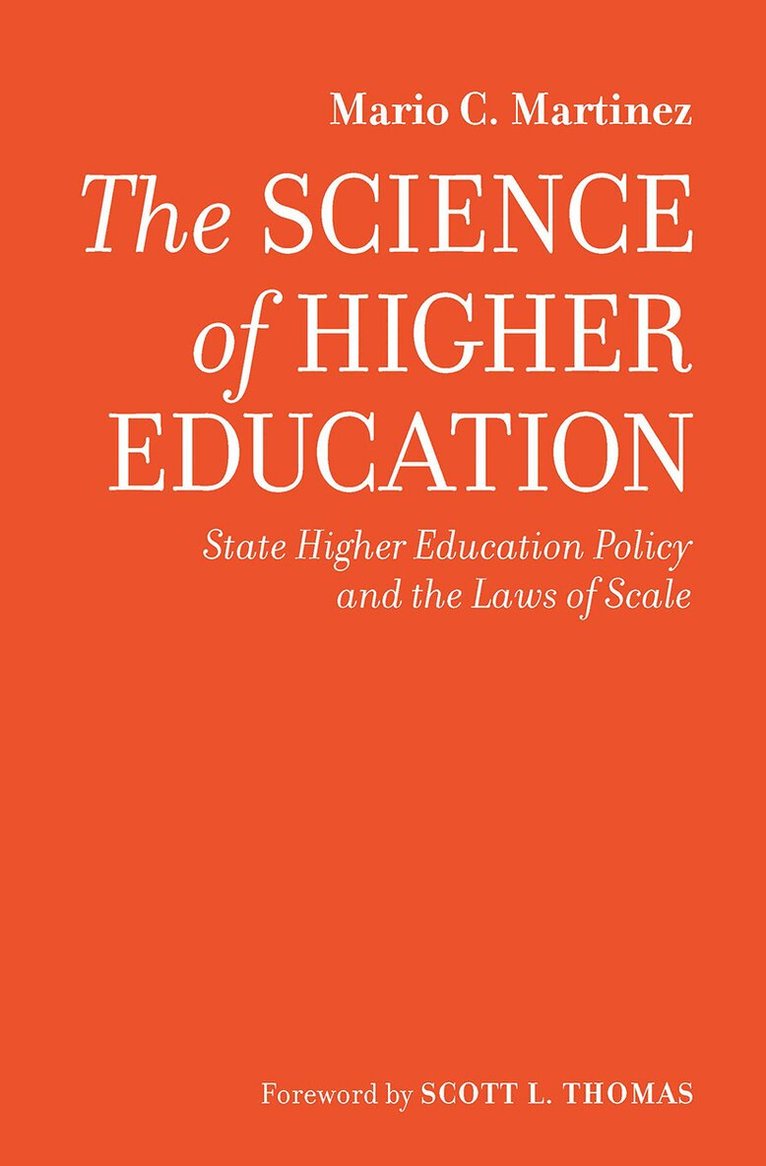
    Science of Higher Education

    State Higher Education Policy and the Laws of Scale

    AvMario C. Martinez

    Inbunden, Engelska, 2021

    2 352 kr

    Beställningsvara. Skickas inom 10-15 vardagar. Fri frakt över 249 kr.

    Fler format och utgåvor

    E-bok

    603 kr

    E-bok

    603 kr

    Häftad

    511 kr

    Beskrivning

    Perennial conclusions from state-by-state funding-per-student analyses of underfunding and weak state commitment have become so common that they have diluted the potency of the argument to state policymakers for more higher education funding. In addition, there has been little in the way of testing or questioning the assumptions embedded in traditional funding per student analysis and its accompanying conclusions.As state legislators balance the competing needs of education, health, trans­portation, and public safety budgets, they increasingly ask what return on investment (ROI) they get for the funding they provide, including from higher education. The ROI language, while potentially unsettling for its corporate-like and neoliberal connotation, will persist into the foreseeable future. We must ask questions both of adequacy (How much funding should the states provide?) and benefit (What benefits do states receive for the higher education funding they provide?). The focus on traditional funding per student analysis has remained static for over forty years, indicating the need for new ideas and methods to probe questions of adequacy and benefit.The Science of Higher Education is an introduction to a new paradigm that explores state higher education funding, enrollment, completion, and supply (the number and type of institutions in a state) through the lens of what are commonly known as power laws. Power laws explain patterns in biological systems and characteristics of cities. Like cities, state higher educa­tion systems are complex adaptive systems, so it is little surprise that power laws also explain funding, enrollment, completion, and supply.The scale relationships uncovered in the Science of Higher Education sug­gest the potential benefits state policymakers could derive by emphasizing enrollment, completion, or capacity policies, based on economies of scale, marginal benefits, and the return state’s get on enrollment and completion for the funding they provide.The various features of state higher education systems that conform to scale patterns do not alone provide definitive answers for appropriate funding levels, however. As this book addresses, policymakers need to take into account the macro forces, from demography to geography and the economy, that situate the system, as well the interactions between government and market actors that are at the core of every state higher education system and influence the outcomes it achieves.

    Produktinformation

    • Utgivningsdatum:2021-07-06
    • Mått:152 x 229 x 16 mm
    • Vikt:417 g
    • Format:Inbunden
    • Språk:Engelska
    • Antal sidor:216
    • Förlag:Taylor & Francis Inc
    • ISBN:9781642670882

    Utforska kategorier

    • Högskola och universitet inom Psykologi och pedagogik
    • Utbildningsstrategier och utbildningspolitik inom Psykologi och pedagogik

    Mer om författaren

    Mario C. Martinez is Vice Chancellor of Strategy and Innovation for the National University System. He has written several books in the area of higher education innovation, strategy and policy. He is a founding partner of SoftSkillsPros.com, a training and resource company serving higher education institutions and the many professionals who work within them. Scott L. Thomas is John P. “Jack” Ellbogen Dean of the College of Education at the University of Wyoming.

    Recensioner i media

    From the Foreword:"The context of higher education has changed, and Martinez is no longer content with incremental approaches to evolving our thinking and work in higher education finance. Adapting methods used to model dynamic systems, he offers scale analysis as a new way of capturing public benefits. His is not a minor attempt to advance our thinking. Throughout the book, Martinez provides a wealth of examples, analyses, and comparisons to demonstrate this approach's utility. While admittedly oversimplified, his approach does represent a genuine shift in our paradigm—one that is likely to cause discomfort and controversy among many in the field. More important is the work he has put into the conceptualization, the logic, and warrant for reframing our approach to the analysis of finance policy. By design, Martinez is provoking the reader. He is challenging our purchase on traditional assumptions about policymaking and policy analysis. Along with the challenge, we get a well-developed conceptual rationale, a new set of measures, and results to stimulate debate in the field. The framing almost ensures that this debate will necessarily revolve around equity and context.Do the contents of this book constitute the beginning of a Science of Higher Education? I leave that to the reader to decide. Regardless of your opinion on that count, I hope you will agree that this book offers more science than this area has seen since Berdahl and his contemporaries laid the foundation of our current knowledge base in the 1970s."Scott L. ThomasJohn P. “Jack” Ellbogen Dean of the College of Education, University of Wyoming"It is increasingly clear that states and the federal government must undertake major reforms in how they finance higher education to meet the challenges of excessive college costs and reliance on loans as well as insufficient attention to equity and quality concerns. Mario C. Martinez’s dynamic scale-based approach offers an innovative and likely controversial perspective that promises to provoke healthy and needed debate in this important field of public policy."Arthur M. Hauptman, Independent Public Policy Consultant Specializing in Domestic and International Higher Education Finance"Mario C. Martinez is a big, broad thinker in higher education scholarship. For those who care deeply about college policy and finance, this book will give you a lot of ideas to chew on.”Michael BastedoProfessor and Director, Center for the Study of Higher and Postsecondary Education, University of Michigan School of Education

    Innehållsförteckning

    • Foreword Acknowledgments Preface Part One 1. Foundations for a Science of Higher Education 1. Complex Systems and State Higher Education 2. A New Paradigm 3. Actor Interactions. Nature and Context Part Two. Scale Patterns 4. Lessons from Life Sciences and Cities 5. Scale and State Higher Education Funding 6. Scale and State Policy 7. Higher Education Supply Part Three. Outcomes and Return on Investment 8. Higher Education Outcomes 9. Return on Investment. Funding and Outcomes 10. Policy Implications Appendix 1. Glossary of Terms Appendix 2. 2015 All State Data (original units. Appendix 3. Logarithmic Regression Results (Predictions. Appendix 4. Population. Funding Scale Results Appendix 5. Population. Enrollment Scale Results Appendix 6. Population. Completion Scale Results Appendix 7. Population. # of Institutions (Supply. Scale Results Appendix 8. Funding. Enrollment Scale Results Appendix 9. Funding. Completion Scale Results Appendix 10. Statistical results. All Scale Analyses Appendix 11. Linear and Scale Ranking Comparisons Appendix 12. Exponents, Logarithms and Scale References End Notes About the Author Index