• Fri frakt över 249 kr
  • •
  • Snabba leveranser
  • •
  • Billiga böcker
Kundservice

Du är på sajten för privatpersoner.

Företag, bibliotek eller offentlig verksamhet?

Du handlar på classic.bokus.com, där alla dina funktioner finns intakta.
Till classic.bokus.com
Bokus logotyp. Gå till startsidan.
  • Erbjudanden
  • Nyheter
  • Student
  • Topplistor
  • Barn & ungdom
  • Bokus Play
  • E-böcker
  • Pocketböcker
  • Spel & pussel

10% studentrabatt med kod TERM26

Sidfot

Mina sidor

    Hjälp

    • Kundservice
    • Vanliga frågor och svar
    • Frakt och leverans
    • Retur vid ångerrätt
    • Reklamera vara
    • Betalning
    • Köpvillkor
    • Allmänna villkor
    • Information om webbplatsens tillgänglighet

    Om Bokus

    • Om oss
    • Pressrum
    • För studenter
    • För företag
    • För bibliotek och offentlig verksamhet
    • För leverantörer
    • Hållbarhet

    Populärt

    • Aktuella erbjudanden
    • Presentkort
    • Studentlitteratur
    • Nya böcker
    • Topplistor
    • Signerade böcker
    • Engelska böcker

    Inspiration

    • Boktips
    • BookTok
    • Populära bokserier
    • Barnbokskaraktärer
    • Populära författare
    Logotyp för Bokus
    Följ oss på Facebook (extern länk)Följ oss på Instagram (extern länk)Följ oss på YouTube (extern länk)Följ oss på TikTok (extern länk)
    bokus @ CookiesAnpassa cookiesIntegritetspolicyKöpvillkor
    Till Citymail hemsida (extern länk)Till Budbee hemsida (extern länk)Till Postnord hemsida (extern länk)Till Schenker hemsida (extern länk)Till Early Bird hemsida (extern länk)Till Walleys hemsida (extern länk)
    1. Psykologi och pedagogik
    2. Pedagogik

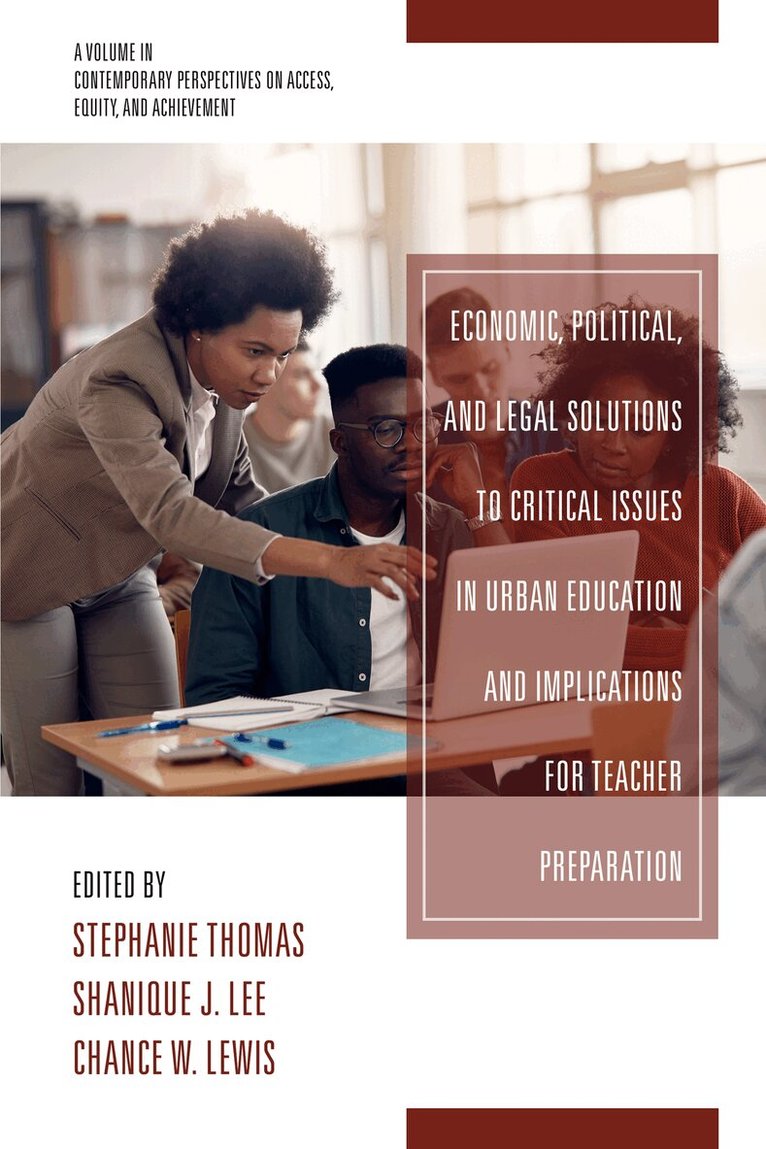
    Economic, Political and Legal Solutions to Critical Issues in Urban Education and Implications for Teacher Preparation

    AvStephanie Thomas,Shanique J. Lee

    Inbunden, Engelska, 2022

    Del i serien Contemporary Perspectives on Access, Equity, and Achievement

    985 kr

    Beställningsvara. Skickas inom 5-8 vardagar. Fri frakt över 249 kr.

    Beskrivning

    The Montgomery bus boycott, Student Nonviolent Coordinating Committee (SNCC), and Brown v. Board of Education reveal incentives to reform as a result of economic, political and legal threat. It is difficult to change a person’s heart, or to change based on moral conviction alone. However, policies and laws can be established that will change a person’s behavior. Historically, there was rarely a time where societal changes were the result of a desire to do what was morally right. Doing what is right was contingent upon economic advantages, political motivation or the threat of litigation. By the mid 1900s the NAACP had learned a valuable lesson in the South, that litigation or the threat of litigation was an effective tool in the quest for educational equality (Douglas, 1995). More recently, the #metoo movement and the Los Angeles teacher’s strike exposed corrupt behavior and insufficient working environments that have existed for decades. What is different? They have been exposed through political, economic and legal means.As it pertains to educating African Americans, there was an ongoing role of servitude in the political economy of the South (Anderson, 1988). This was subsequently disrupted through political, economic, and legal measures during Reconstruction. Racist ideologies and economic advantages were seen through Jim Crow Laws (Roback, 1984) that were again disrupted through political, economic, and legal methods. Education has also been cited as what perpetuates our democracy. It is institutions that afford its citizens the skills and knowledge necessary for political participation (Rury, 2002). Even when legal cases are unsuccessful, such as Puitt v. Commissioners of Gaston County or Plessy v. Ferguson, they can forge the way to successful litigation dismantling racist ideologies that oppress African Americans. Although the Puitt decision did not remove the processes of discrimination against Black schools, it left intact the legal basis on segregated and unequal education (Douglas, 1995). As citizens, it is imperative that we participate in the political process and use our authority to mandate the changes we would like to see in urban education.When theorizing this book, the intent was to provide an interdisciplinary look at solutions to critical issues in urban education through political, economic, and legal avenues. This book seeks to provide an interdisciplinary approach to solving the issues in education while connecting it to the effects on teacher preparation. Using historical and recent examples, scholars can piece together solutions that will guide others to political, economic, and legal action necessary to dismantle systems that have bound Black and Brown children. It is our intent to offer innovative, yet grounded solutions that can purposefully move the conversation about solutions to critical issues in education to political, economic, and legal actions.


    Produktinformation

    • Utgivningsdatum:2022-06-06
    • Mått:156 x 234 x 14 mm
    • Vikt:483 g
    • Format:Inbunden
    • Språk:Engelska
    • Serie:Contemporary Perspectives on Access, Equity, and Achievement
    • Antal sidor:216
    • Förlag:Emerald Publishing Inc
    • ISBN:9781648029394

    Utforska kategorier

    • Pedagogik inom Psykologi och pedagogik
    • Utbildningsstrategier och utbildningspolitik inom Psykologi och pedagogik
    • Lärarutbildning inom Psykologi och pedagogik

    Mer om författaren

    Stephanie Thomas, Lenoir-Rhyne University.Shanique J. Lee, The University of North Carolina at Charlotte.Chance W. Lewis, University of North Carolina at Charlotte.

    Innehållsförteckning

    • Introduction: What Is the Problem and Why Do We Need Solutions?Chapter 1. Student Achievement for All: Afrocentric Curriculum and Abolitionist Pedagogy to Promote Equity and Excellence in Education; Annette Teasdell and Greg Wiggan.Chapter 2. Emancipation Through Culturally Responsive and Transformative Literacy, Curriculum, and Pedagogical Practices; Charlotte R. Hancock and Greg A. Wiggan.Chapter 3. Community-Based Professional Learning Communities (CB-PLCs): Re-Envisioning a Model of PLCs for Urban Education; Sharon Leathers.Chapter 4. Re- Examining Noncognitive Factors: Promoting the Academic Achievement of African American Males at Urban Universities; Harriet Hobbs and Greg Wiggan.Chapter 5. Cultural Capital, Urban Education, and School Privatization: A Critical Race Social Reproduction Analysis; Jordan Boyd and Greg Wiggan.Chapter 6. Prioritizing Teacher Wages on a National Scale; Jordan T. Register, Olanrewaju T. Oriowo, Nicole E. Shanley, and Marquis R. Mason.Chapter 7. One Size Does Not Fit All: Understanding Lemovian Techniques and Multi-Tiered Systems of Support to Create a Better Framework for Behavioral Supports; Mike Friedberg.Chapter 8. Assessing Lemovian Techniques for Supporting Traditionally Marginalized Students and Suggestions for More Equitable Practices in Schools to Support Black and Latinx Students; Mike Friedberg.Chapter 9. Mindfulness ractices and Hip-Hop Therapy for Marginalized Youth; Torie Wheatley.Chapter 10. Making Success: A Legal Solution for Teachers and Students in Alternative Schools; Abby F. Holland.Afterword.