• Fri frakt över 249 kr
  • •
  • Snabba leveranser
  • •
  • Billiga böcker
Kundservice

Du är på sajten för privatpersoner.

Företag, bibliotek eller offentlig verksamhet?

Du handlar på classic.bokus.com, där alla dina funktioner finns intakta.
Till classic.bokus.com
Bokus logotyp. Gå till startsidan.
  • Erbjudanden
  • Student
  • Topplistor
  • Barn & ungdom
  • Bokus Play
  • E-böcker
  • Ljudböcker
  • Pocketböcker
  • Spel & pussel

10% rabatt på allt med kod NYSTART10 →

Sidfot

Mina sidor

    Hjälp

    • Kundservice
    • Vanliga frågor och svar
    • Frakt och leverans
    • Retur vid ångerrätt
    • Reklamera vara
    • Betalning
    • Köpvillkor
    • Allmänna villkor
    • Information om webbplatsens tillgänglighet

    Om Bokus

    • Om oss
    • Pressrum
    • För studenter
    • För företag
    • För bibliotek och offentlig verksamhet
    • För leverantörer
    • Hållbarhet

    Populärt

    • Aktuella erbjudanden
    • Presentkort
    • Studentlitteratur
    • Nya böcker
    • Topplistor
    • Signerade böcker
    • Engelska böcker

    Inspiration

    • Boktips
    • BookTok
    • Populära bokserier
    • Barnbokskaraktärer
    • Populära författare
    Logotyp för Bokus
    Följ oss på Facebook (extern länk)Följ oss på Instagram (extern länk)Följ oss på YouTube (extern länk)Följ oss på TikTok (extern länk)
    bokus @ CookiesAnpassa cookiesIntegritetspolicyKöpvillkor
    Till Citymail hemsida (extern länk)Till Budbee hemsida (extern länk)Till Postnord hemsida (extern länk)Till Schenker hemsida (extern länk)Till Early Bird hemsida (extern länk)Till Walleys hemsida (extern länk)
    1. Samhälle och politik
    2. Samhälle och kultur
    3. Sociala grupper och identitet

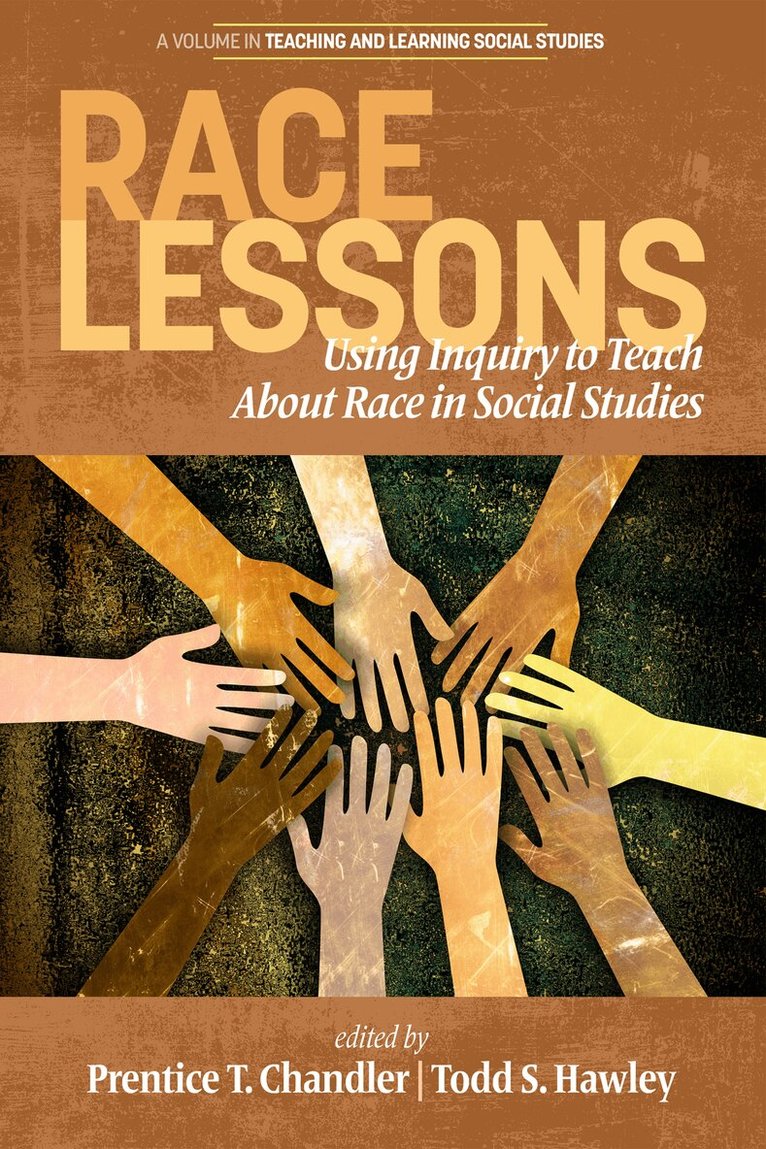
    Race Lessons

    Using Inquiry to Teach About Race in Social Studies

    AvPrentice T. Chandler,Todd S. Hawley

    Häftad, Engelska, 2017

    Del i serien Teaching and Learning Social Studies

    680 kr

    Beställningsvara. Skickas inom 5-8 vardagar. Fri frakt över 249 kr.

    Beskrivning

    We hold that the mission of social studies is not attainable, without attention to the ways in which race and racism play out in society—past, present, and future.In a follow up to the book, Doing Race in Social Studies (2015), this new volume addresses practical considerations of teaching about race within the context of history, geography, government, economics, and the behavioral sciences. Race Lessons: Using Inquiry to Teach About Race in Social Studies addresses the space between the theoretical and the practical and provides teachers and teacher educators with concrete lesson ideas for how to engage learners with social studies content and race. Oftentimes, social studies teachers do not teach about race because of several factors: teacher fear, personal notions of colorblindness, and attachment to multicultural narratives that stress assimilation. This volume will begin to help teachers and teacher educators start the conversation around realistic and practical race pedagogy.The chapters included in this volume are written by prominent social studies scholars and classroom teachers. This work is unique in that it represents an attempt to use Critical Race Theory and inquiry pedagogy (Inquiry Design Model) to teach about race in the social science disciplines.

    Produktinformation

    • Utgivningsdatum:2017-05-26
    • Mått:156 x 234 x 24 mm
    • Vikt:663 g
    • Format:Häftad
    • Språk:Engelska
    • Serie:Teaching and Learning Social Studies
    • Antal sidor:476
    • Förlag:Emerald Publishing Inc
    • ISBN:9781681238906

    Utforska kategorier

    • Sociala grupper och identitet inom Samhälle och politik
    • Etnicitet inom Samhälle och politik

    Mer om författaren

    Prentice T. Chandler, Austin Peay State University.Todd S. Hawley, Kent State University.

    Innehållsförteckning

    • Using Racial Pedagogical Content Knowledge to Reimagine Social Studies Teaching and Learning; Prentice T. Chandler and Todd S. Hawley.Section I. Foundations of Racial Pedagogical Content Knowledge.Chapter 1. Race and Racism in the Social Studies: Foundations of Critical Race Theory; Andrea Hawkman.Chapter 2. The Inquiry Design Model; Kathy Swan, SG Grant and John Lee.Chapter 3. "Do You Feel Me?": Affectively and Effectively Engaging Racial Pedagogical Content Knowledge in Social Studies Classrooms;Christina Villarreal.Section II. Inquiry Based Race Lessons in Social Studies.Chapter 4. Teaching Racial Inequity Through the California Gold Rush (US history); Christopher C. Martell, Jennifer R. Bryson, and William C. Chapman-Hale.Chapter 5. Africans in New Amsterdam (US history); Jane Bolgaz, Tamar Brown and Emily Zweibel.Chapter 6. Settler Schooling: A TribalCrit Approach to Teaching Boarding School Histories in Elementary Social Studies; Sara Shear.Chapter 7. But "Ain't I a Woman? ": An Inquiry on the Intersectionality of Race and Gender During the 19th Century Abolitionist Movement; Lauren Colley.Chapter 8. Teaching the Montgomery Bus Boycott as Citizen Action for Racial and Economic Justice (economics); Todd S. Hawley, Andrew Hostetler and Prentice T. Chandler.Chapter 9. Does Geography Have a Violence? Ken Carano.Chapter 10. Do People Get to Choose Where They Live?: A Case Study of Racial Segregation in Austin, Texas; Tori Davis and Ryan Crowley.Chapter 11. Stories, Counterstories, and Tales of Resistance: Family History Inquiry Projects in World History Classrooms; Juan Gabriel Sánchez and Raquel Y. Sáenz.Chapter 12. Toward a Latin@ Critical Race Theory: Examining Race, Racism, and Afro-Latinidad in World History and Human Geography; Chris Busey.Chapter 13. Are U.S. Citizenship Test Racially Motivated?: Analyzing the Racial Implications of Citizenship "Tests", Historically and Today; William L. Smith.Chapter 14. Countering Single Stories: Inquiring into the Confederate Battle Flag with Students; Jessica F. Kobe and Ashley A. Goodrich.Chapter 15. What is Race? A Compelling Question with a Complex Response; Samina Hadi-Tabassum.Chapter 16. On the Matter of Black Lives: Using CRT and C3 Inquiry to Examine Current Events; John P. Broome and Jason Endacott.Chapter 17. Has Social Media Provided Communities of Color a Platform for Sharing Counternarratives? Jennifer Killham.Chapter 18. Examining the Power Structures That Impact Friendships; Jennifer Burke.Section III. Voices from the Field.Chapter 19. Notes on Understanding and Valuing the Anger of Students Marginalized by the Social Studies Curriculum; Lisa Gilbert.Chapter 20. Counter-Narratives in U.S. History: Race Lessons in a Social Studies Methods Course; Emilie M. Camp.Chapter 21. Teacher Professional Development and CRT: Teaching the Civil Rights Movement in Mississippi: Using Teacher Professional Learning Communities to Promote CRT/RPCK; Jenice L. View.Chapter 22. Race Autobiographies in the Social Studies Classroom: Possibilities and Potential; Adam W. Jordan and Dacario Poole.