• Fri frakt över 249 kr
  • •
  • Snabba leveranser
  • •
  • Billiga böcker
Kundservice

Du är på sajten för privatpersoner.

Företag, bibliotek eller offentlig verksamhet?

Du handlar på classic.bokus.com, där alla dina funktioner finns intakta.
Till classic.bokus.com
Bokus logotyp. Gå till startsidan.
  • Erbjudanden
  • Nyheter
  • Student
  • Topplistor
  • Barn & ungdom
  • Bokus Play
  • E-böcker
  • Pocketböcker
  • Spel & pussel

10% rabatt på allt med kod: NYSTART10 →

Sidfot

Mina sidor

    Hjälp

    • Kundservice
    • Vanliga frågor och svar
    • Frakt och leverans
    • Retur vid ångerrätt
    • Reklamera vara
    • Betalning
    • Köpvillkor
    • Allmänna villkor
    • Information om webbplatsens tillgänglighet

    Om Bokus

    • Om oss
    • Pressrum
    • För studenter
    • För företag
    • För bibliotek och offentlig verksamhet
    • För leverantörer
    • Hållbarhet

    Populärt

    • Aktuella erbjudanden
    • Presentkort
    • Studentlitteratur
    • Nya böcker
    • Topplistor
    • Signerade böcker
    • Engelska böcker

    Inspiration

    • Boktips
    • BookTok
    • Populära bokserier
    • Barnbokskaraktärer
    • Populära författare
    Logotyp för Bokus
    Följ oss på Facebook (extern länk)Följ oss på Instagram (extern länk)Följ oss på YouTube (extern länk)Följ oss på TikTok (extern länk)
    bokus @ CookiesAnpassa cookiesIntegritetspolicyKöpvillkor
    Till Citymail hemsida (extern länk)Till Budbee hemsida (extern länk)Till Postnord hemsida (extern länk)Till Schenker hemsida (extern länk)Till Early Bird hemsida (extern länk)Till Walleys hemsida (extern länk)
    1. Skönlitteratur
    2. Litteraturvetenskap
    3. Litteraturvetenskap

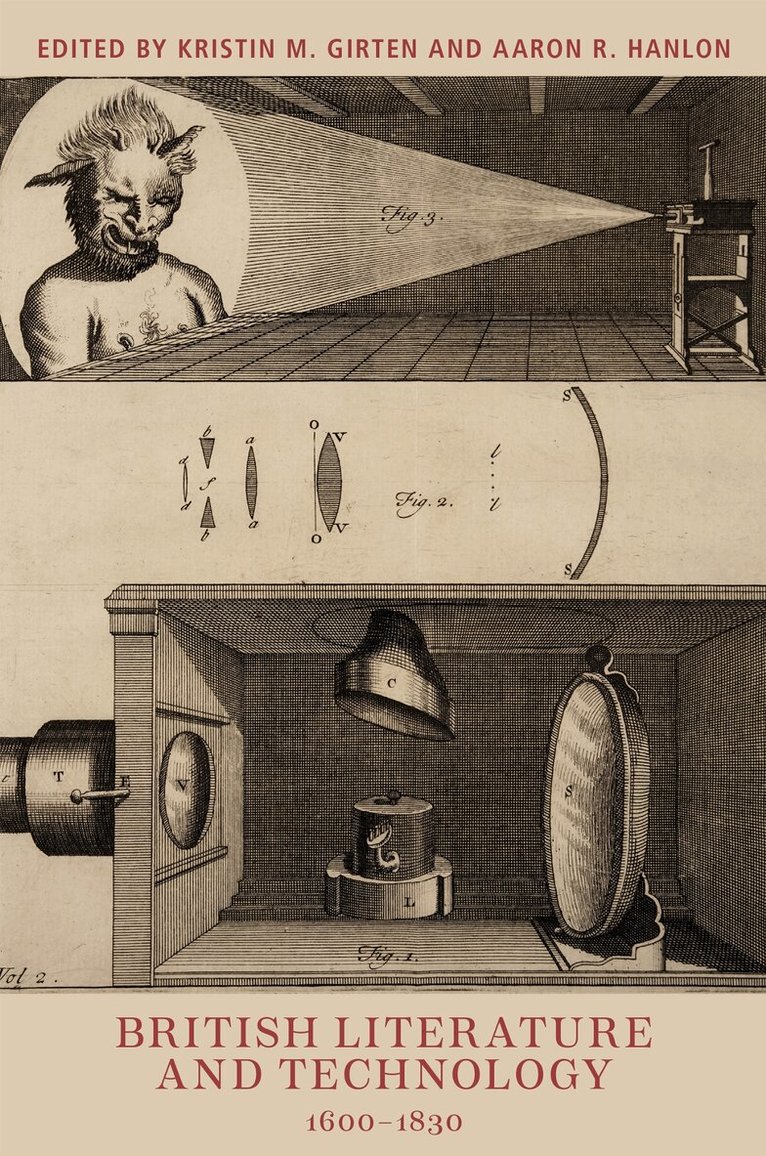
    British Literature and Technology, 1600-1830

    AvKristin M. Girten,Aaron R. Hanlon

    Häftad, Engelska, 2023

    Del i serien Aperçus: Histories Texts Cultures

    480 kr

    Beställningsvara. Skickas inom 5-8 vardagar. Fri frakt över 249 kr.

    Beskrivning

    Enlightenment-era writers had not yet come to take technology for granted, but nonetheless were-as we are today-both attracted to and repelled by its potential. This volume registers the deep history of such ambivalence, examining technology’s influence on Enlightenment British literature, as well as the impact of literature on conceptions of, attitudes toward, and implementations of technology. Offering a counterbalance to the abundance of studies on literature and science in seventeenth- and eighteenth-century Britain, this volume’s focus encompasses approaches to literary history that help us understand technologies like the steam engine and the telegraph along with representations of technology in literature such as the “political machine.” Contributors ultimately show how literature across genres provided important sites for Enlightenment readers to recognize themselves as “chimeras”-“hybrids of machine and organism”-and to explore the modern self as “a creature of social reality as well as a creature of fiction.”

    Produktinformation

    • Utgivningsdatum:2023-01-13
    • Mått:156 x 235 x 18 mm
    • Vikt:59 g
    • Format:Häftad
    • Språk:Engelska
    • Serie:Aperçus: Histories Texts Cultures
    • Antal sidor:216
    • Förlag:Bucknell University Press,U.S.
    • ISBN:9781684483952

    Utforska kategorier

    • Litteraturvetenskap inom Skönlitteratur
    • Naturvetenskapens historia inom Naturvetenskap och teknik
    • Teknik: allmänt inom Naturvetenskap och teknik

    Mer om författaren

    KRISTIN M. GIRTEN is an associate professor of English and assistant vice chancellor for the arts and humanities at the University of Nebraska at Omaha. Her research focuses on intersections between literature, philosophy, and science in the British Enlightenment and in the twenty-first century, giving special emphasis to how women and other marginalized groups contribute to and feel the effects of such intersections.AARON R. HANLON is an associate professor of English and chair of the Science, Technology, and Society Program at Colby College in Waterville, Maine. He is the author of A World of Disorderly Notions: Quixote and the Logic of Exceptionalism.

    Recensioner i media

    "This collection is full of superb scholarship that makes substantial contributions to our understanding of technology." (Technology and Culture) “By focusing exclusively on humanity’s unruly tools, this book opens a compelling ‘mosaic’ view of technology that tiles together everything from the wiles of Jacobean stagecraft to the terza rima utopias of Romantic poets (10). . . . The essays gathered in British Literature and Technology, 1600–1830 will hold broad interest for . . . anyone-critic, teacher, student-seeking tools to comprehend human intervention in the world.” (Eighteenth-Century Fiction) "British Literature and Technology, 1600–1830 has much to offer readers interested in the social history of technology and in literature and science studies more broadly." (Journal of British Studies) “In a series of wide-ranging, thought-provoking, and finely argued essays, this volume marks a major advance in studies of science and literature. By thinking about literature itself as a kind of technology, the collection represents interdisciplinary scholarship at its best.” - Jess Keiser (author of Nervous Fictions: Literary Form and the Enlightenment Origins of Neuroscience) “Innovative in concept, scope, and execution, Girten and Hanlon’s collection studies the rich interplay between literature and technology during the scientific revolution. Prefaced by a sophisticated introduction, this volume is necessary reading for students and scholars interested in literary studies, science, technology and society, and the history of science.” - Tita Chico (author of The Experimental Imagination: Literary Knowledge and Science in the British Enlightenment)

    Innehållsförteckning

    • IntroductionKristin M. Girten and Aaron R. HanlonChapter 1: Webster’s Baroque Experiments and the Testing of Technology in the Early 1600sLaura FrancisChapter 2: Telling Time in the Fiction of Mary Hearne and Daniel DefoeErik L. JohnsonChapter 3: The Technology and Theatricality of Three Hours after Marriage’s “Touch-Stone of Virginity”Thomas A. OldhamChapter 4: Gulliver’s Travels, Automation, and the Reckoning AuthorZachary M. MannChapter 5: Designing the Enlightenment AnthropoceneKevin MacDonnellChapter 6: Technology, Temporality, and Queer Form in Horace Walpole’s GothicEmily M. WestChapter 7: Telegraphic Supremacy in Maria Edgeworth’s “Lame Jervas”Deven M. ParkerChapter 8: Percy Shelley, Political Machines, and the Pre-History of the Post-LiberalJamison KantorAfterword: On the Uses of the History of Technology for Literary Studies and Vice VersaJoseph DruryBibliographyNotes on ContributorsIndex