• Fri frakt över 249 kr
  • •
  • Snabba leveranser
  • •
  • Billiga böcker
Kundservice

Du är på sajten för privatpersoner.

Företag, bibliotek eller offentlig verksamhet?

Du handlar på classic.bokus.com, där alla dina funktioner finns intakta.
Till classic.bokus.com
Bokus logotyp. Gå till startsidan.
  • Erbjudanden
  • Nyheter
  • Student
  • Topplistor
  • Barn & ungdom
  • Bokus Play
  • E-böcker
  • Pocketböcker
  • Spel & pussel

10% rabatt på allt med kod: NYSTART10 →

Sidfot

Mina sidor

    Hjälp

    • Kundservice
    • Vanliga frågor och svar
    • Frakt och leverans
    • Retur vid ångerrätt
    • Reklamera vara
    • Betalning
    • Köpvillkor
    • Allmänna villkor
    • Information om webbplatsens tillgänglighet

    Om Bokus

    • Om oss
    • Pressrum
    • För studenter
    • För företag
    • För bibliotek och offentlig verksamhet
    • För leverantörer
    • Hållbarhet

    Populärt

    • Aktuella erbjudanden
    • Presentkort
    • Studentlitteratur
    • Nya böcker
    • Topplistor
    • Signerade böcker
    • Engelska böcker

    Inspiration

    • Boktips
    • BookTok
    • Populära bokserier
    • Barnbokskaraktärer
    • Populära författare
    Logotyp för Bokus
    Följ oss på Facebook (extern länk)Följ oss på Instagram (extern länk)Följ oss på YouTube (extern länk)Följ oss på TikTok (extern länk)
    bokus @ CookiesAnpassa cookiesIntegritetspolicyKöpvillkor
    Till Citymail hemsida (extern länk)Till Budbee hemsida (extern länk)Till Postnord hemsida (extern länk)Till Schenker hemsida (extern länk)Till Early Bird hemsida (extern länk)Till Walleys hemsida (extern länk)
    1. Samhälle och politik
    2. Samhälle och kultur
    3. Kultur och medier
    4. Referensverk och tvärvetenskap

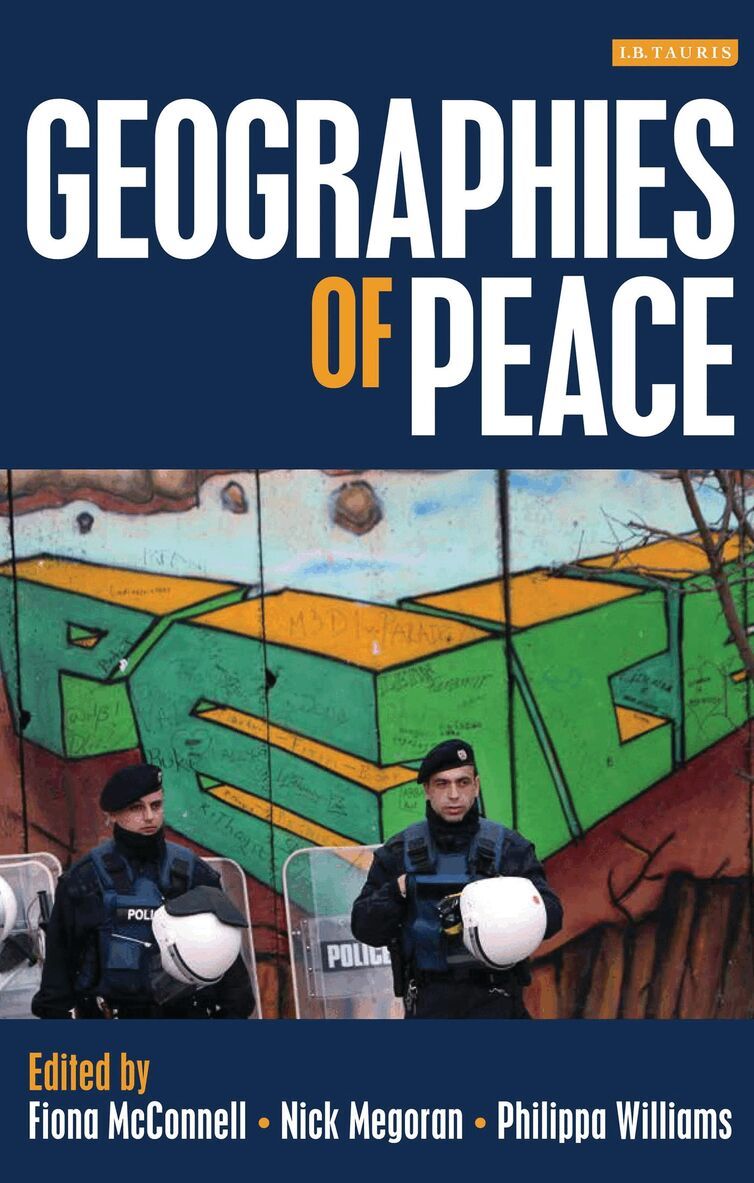
    Geographies of Peace

    New Approaches to Boundaries, Diplomacy and Conflict Resolution

    AvFiona McConnell,Nick Megoran

    Inbunden, Engelska, 2014

    Del i serien Bloomsbury 3PL

    1 950 kr

    Beställningsvara. Skickas inom 10-15 vardagar. Fri frakt över 249 kr.

    Fler format och utgåvor

    E-bok

    1 944 kr

    Beskrivning

    From handshakes on the White House lawn to Picasso's iconic dove of peace, the images and stereotypes of peace are powerful, widespread and easily recognizable. Yet if we try to offer a concise definition of peace it is altogether a more complicated exercise. Not only is peace an emotive and value-laden concept, it is also abstract, ambiguous and seemingly inextricably tied to its antithesis: war. And it is war and violence that have been so compellingly studied within critical geography in recent years. This volume offers an attempt to redress that balance, and to think more expansively and critically about what peace means and what geographies of peace may entail. The editors begin with an examination of critical approaches to peace in other disciplines and a helpful genealogy of peace studies within geography. The book is then divided into three sections. The opening section examines how the idea of peace may be variously constructed and interpreted according to different sites and scales. The chapters in the second section explore a remarkably wide range of techniques of peacemaking.This widens the discussion from the archetypical image of top-down, diplomatic state-led initiatives to imperial boundary making practices, grassroots cultural identity assertion, boycotts, self-immolation, ex-paramilitary community activism, and 'protective accompaniment'.The final section shifts the scale and focus to everyday personal relations and a range of practices around the concept of coexistence. In their concluding chapter the editors spell out some of the key questions that they believe a geography of peace must address: What spatial factors have facilitated the success or precipitated the failure of some peace movements or diplomatic negotiations? Why are some ideologies productive of violence in some places but co-operation in others? How have some communities been better able to deal with religious, racial, cultural and class conflict than others? How have creative approaches to sharing sovereignty mitigated or transformed territorial disputes that once seemed intractable? Geographies of Peace is the first book wholly devoted to exploring the geography of peace.Drawing on both recent advances in social and political theory and detailed empirical research covering four continents, it makes a significant intervention into current debates about peace and violence.

    Produktinformation

    • Utgivningsdatum:2014-06-20
    • Mått:160 x 236 x 32 mm
    • Vikt:660 g
    • Format:Inbunden
    • Språk:Engelska
    • Serie:Bloomsbury 3PL
    • Antal sidor:320
    • Förlag:Bloomsbury Publishing PLC
    • ISBN:9781780761435

    Utforska kategorier

    • Referensverk och tvärvetenskap inom Samhälle och politik
    • Internationella relationer inom Samhälle och politik

    Mer om författaren

    Fiona McConnell is Lecturer in Human Geography and Tutorial Fellow at St Catherine's College, Oxford University. Her research interests include the everyday construction of statehood and sovereignty in cases of tenuous territoriality. Nick Megoran is Lecturer in Political Geography, Newcastle University. He researches the geographies and geopolitics of post-Cold War interstate relations, especially the building of nation-states in Central Asia and the place of religion and the church in war and peace. Philippa Williams is Lecturer in Human Geography, School of Geography, Queen Mary University of London. She is interested in questions of violence and non-violence, citizenship, marginalization, and the politics of development in South Asia.

    Recensioner i media

    'Rich and incisive, these essays offer a number of different significant perspectives - What emerges very strongly - is how important spatial practices are for the interpretation of peace: what looks like peacemaking from one position and scale is much more problematic from other perspectives historical, institutional, state, spatial, political and economic, social, everyday, cultural and so on. This suggests the need for a far more diverse consideration of the dimensions of peace. With this volume, geography is more fully returned - to an eirenist modus operandi rather than as gathered within a framework that provides support for war, interests, domination, or instrumentalisation.' From the Foreword by Oliver Richmond

    Innehållsförteckning

    • List of contributorsAcknowledgementsForeword by Oliver P. Richmond Introduction: geographical approaches to peacePart I : Contesting narratives of peacePart II : Techniques of PeacemakingPart III : Practices of CoexistenceBibliographyIndex