• Fri frakt över 249 kr
  • •
  • Snabba leveranser
  • •
  • Billiga böcker
Kundservice

Du är på sajten för privatpersoner.

Företag, bibliotek eller offentlig verksamhet?

Du handlar på classic.bokus.com, där alla dina funktioner finns intakta.
Till classic.bokus.com
Bokus logotyp. Gå till startsidan.
  • Erbjudanden
  • Nyheter
  • Student
  • Topplistor
  • Barn & ungdom
  • Bokus Play
  • E-böcker
  • Pocketböcker
  • Spel & pussel

10% rabatt på allt med kod: NYSTART10 →

Sidfot

Mina sidor

    Hjälp

    • Kundservice
    • Vanliga frågor och svar
    • Frakt och leverans
    • Retur vid ångerrätt
    • Reklamera vara
    • Betalning
    • Köpvillkor
    • Allmänna villkor
    • Information om webbplatsens tillgänglighet

    Om Bokus

    • Om oss
    • Pressrum
    • För studenter
    • För företag
    • För bibliotek och offentlig verksamhet
    • För leverantörer
    • Hållbarhet

    Populärt

    • Aktuella erbjudanden
    • Presentkort
    • Studentlitteratur
    • Nya böcker
    • Topplistor
    • Signerade böcker
    • Engelska böcker

    Inspiration

    • Boktips
    • BookTok
    • Populära bokserier
    • Barnbokskaraktärer
    • Populära författare
    Logotyp för Bokus
    Följ oss på Facebook (extern länk)Följ oss på Instagram (extern länk)Följ oss på YouTube (extern länk)Följ oss på TikTok (extern länk)
    bokus @ CookiesAnpassa cookiesIntegritetspolicyKöpvillkor
    Till Citymail hemsida (extern länk)Till Budbee hemsida (extern länk)Till Postnord hemsida (extern länk)Till Schenker hemsida (extern länk)Till Early Bird hemsida (extern länk)Till Walleys hemsida (extern länk)
    1. Ekonomi och Ledarskap
    2. Nationalekonomi

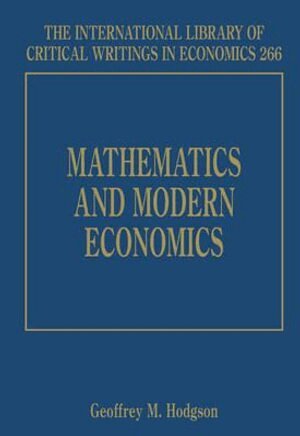
    Mathematics and Modern Economics

    AvGeoffrey M. Hodgson

    Inbunden, Engelska, 2012

    Del 266 i serien The International Library of Critical Writings in Economics series

    5 243 kr

    Beställningsvara. Skickas inom 5-8 vardagar. Fri frakt över 249 kr.

    Beskrivning

    The appropriate role of mathematics in economics has been controversial for two hundred years, and has been a matter of ongoing debate as economics became more mathematical after the Second World War. Controversy has been heightened after extensive criticisms of models used for analysis, prediction and risk assessment prior to the great financial crash of 2008. In this topical collection, Professor Hodgson brings together the seminal classic and recent essays published since 1945 on the role of mathematics in economics, by leading authors including six Nobel Laureates, and from a variety of perspectives.

    Produktinformation

    • Utgivningsdatum:2012-06-29
    • Mått:169 x 244 x undefined mm
    • Format:Inbunden
    • Språk:Engelska
    • Serie:The International Library of Critical Writings in Economics series
    • Förlag:Edward Elgar Publishing Ltd
    • ISBN:9781781000434

    Utforska kategorier

    • Nationalekonomi inom Ekonomi och Ledarskap
    • Tillämpad matematik inom Naturvetenskap och teknik
    • Finansiering inom Ekonomi och Ledarskap

    Mer om författaren

    Edited by Geoffrey M. Hodgson, Emeritus Professor, Loughborough University London, UK

    Innehållsförteckning

    • Contents:AcknowledgementsIntroduction Geoffrey M. Hodgson PART I FROM THE FORMALIST REVOLUTION TO THE AEA COMMISSION1. Mark Blaug (2003), ‘The Formalist Revolution of the 1950s’2. J.M. Clark (1947), ‘Mathematical Economists and Others: A Plea for Communicability’3. Kenneth E. Boulding (1948), ‘Samuelson's Foundations: The Role of Mathematics in Economics’4. Morris A. Copeland (1951), ‘Institutional Economics and Model Analysis’5. David Novick (1954), ‘Mathematics: Logic, Quantity, and Method’6. Paul A. Samuelson (1954), ‘Some Psychological Aspects of Mathematics in Economics’7. Stephen Enke (1955), ‘More on the Misuse of Mathematics in Economics: A Rejoinder’8. Wassily Leontief (1971), ‘Theoretical Assumptions and Nonobserved Facts’9. Alan Coddington (1975), ‘Creaking Semaphore and Beyond: A Consideration of Shackle’s “Epistemics and Economics”’10. Alexander Rosenberg (1975), ‘The Nomological Character of Microeconomics’ 11. Herbert G. Grubel and Lawrence A. Boland (1986), ‘On the Efficient Use of Mathematics in Economics: Some Theory, Facts and Results of an Opinion Survey’ 12. Gerard Debreu (1986), ‘Theoretic Models: Mathematical Form and Economic Content’ 13. Herbert A. Simon (1986), ‘The Failure of Armchair Economics [Interview]’14. Gerard Debreu (1991), ‘The Mathematization of Economic Theory’15. Anne O. Krueger (1991), ‘Report of the Commission on Graduate Education in Economics’16. Alan S. Blinder (1990), ‘Discussion’ PART II MATHEMATICS, FIN DE SIèCLE: 1991–1999 17. Frank Hahn (1991), ‘The Next Hundred Years’18. Donald N. McCloskey (1991), ‘Economics Science: A Search Through the Hyperspace of Assumptions?’19. Philip Mirowski (1991), ‘The When, the How and the Why of Mathematical Expression in the History of Economics Analysis’20. E. Roy Weintraub and Philip Mirowski (1994), ‘The Pure and the Applied: Bourbakism Comes to Mathematical Economics’21. Munir Quddus and Salim Rashid (1994), ‘The Overuse of Mathematics in Economics: Nobel Resistance’22. Robert W. Clower (1995), ‘Axiomatics in Economics’23. Mark Blaug (1997), ‘Ugly Currents in Modern Economics’24. Peter J. Boettke (1997), ‘Where Did Economics Go Wrong? Modern Economics as a Flight from Reality’25. Paul Krugman (1998), ‘Two Cheers for Formalism’26. Roger E. Blackhouse (1998), ‘If Mathematics is Informal, Then Perhaps We Should Accept that Economics Must be Informal Too’27. Victoria Chick (1998), ‘On Knowing One’s Place: The Role of Formalism in Economics’PART III MILLENNIAL MATHEMATICS: METHODOLOGY AND ONTOLOGY 28. Robert Sugden (2000), ‘Credible Worlds: The Status of Theoretical Models in Economics’29. James M. Buchanan (2001), ‘Game Theory, Mathematics, and Economics’ 30. Victoria Chick and Sheila C. Dow (2001), ‘Formalism, Logic and Reality: A Keynesian Analysis’31. Ken Dennis (2002), ‘Nominalising the Numeric: An Alternative to Mathematical Reduction in Economics’32. Tony Lawson (2004), ‘“Reorienting Economics”: On Heterodox Economics, Themata and the Use of Mathematics in Economics’33. Uskali Mäki (2005), ‘Models are Experiments, Experiments are Models’34. K. Vela Velupillai (2005), ‘The Unreasonable Ineffectiveness of Mathematics in Economics’35. D. Wade Hands (2007), ‘2006 HES Presidential Address: A Tale of Two Mainstreams: Economics and Philosophy of Natural Science in the Mid-Twentieth Century’36. Geoffrey M. Hodgson (2006), ‘The Problem of Formalism in Economics’37. Simon Mohun and Roberto Veneziani (2010), ‘Reorienting Economics?’PART IV MATHEMATICAL ECONOMICS AND THE GREAT CRASH OF 2008 38. David Colander, Hans Föllmer, Armin Haas, Michael Goldberg, Katarina Juselius, Alan Kirman, Thomas Lux and Brigitte Sloth (2008), ‘The Financial Crisis and the Systematic Failure of Academic Economics’39. Tony Lawson (2009), ‘The Current Economic Crisis: Its Nature and the Course of Academic Economics’40. Timothy Besley and Peter Hennessy (2009), ‘The Global Financial Crisis – Why Didn’t Anyone Notice?’41. Sheila C. Dow, Peter E. Earl, John Foster, Geoffrey C. Harcourt, Geoffrey M. Hodgson, J. Stanley Metcalfe, Paul Ormerod, Bridget Rosewell, Malcolm C. Sawyer and Andrew Tylecote (2009), ‘Letter to the Queen, 10 August’42. Tony Lawson (2009), ‘Contemporary Economics and the Crisis’ 43. David Colander, Hans Foellmer, Armin Haas, Alan Kirman, Katarina Juselius, Brigitte Sloth and Thomas Lux (2009) ‘How Should the Collapse of the World Financial System Affect Economics?’ 44. Philip Mirowski (2010), ‘The Great Mortification: Economists’ Responses to the Crisis of 2007–(and counting)’45. Peter E. Earl (2010), ‘Economics Fit for the Queen: A Pessimistic Assessment of its Prospects’46. Geoffrey Hodgson (2011), ‘Reforming Economics after the Financial Crisis’Index