• Fri frakt över 249 kr
  • •
  • Snabba leveranser
  • •
  • Billiga böcker
Kundservice

Du är på sajten för privatpersoner.

Företag, bibliotek eller offentlig verksamhet?

Du handlar på classic.bokus.com, där alla dina funktioner finns intakta.
Till classic.bokus.com
Bokus logotyp. Gå till startsidan.
  • Erbjudanden
  • Nyheter
  • Student
  • Topplistor
  • Barn & ungdom
  • Bokus Play
  • E-böcker
  • Pocketböcker
  • Spel & pussel

10% rabatt på allt med kod: NYSTART10 →

Sidfot

Mina sidor

    Hjälp

    • Kundservice
    • Vanliga frågor och svar
    • Frakt och leverans
    • Retur vid ångerrätt
    • Reklamera vara
    • Betalning
    • Köpvillkor
    • Allmänna villkor
    • Information om webbplatsens tillgänglighet

    Om Bokus

    • Om oss
    • Pressrum
    • För studenter
    • För företag
    • För bibliotek och offentlig verksamhet
    • För leverantörer
    • Hållbarhet

    Populärt

    • Aktuella erbjudanden
    • Presentkort
    • Studentlitteratur
    • Nya böcker
    • Topplistor
    • Signerade böcker
    • Engelska böcker

    Inspiration

    • Boktips
    • BookTok
    • Populära bokserier
    • Barnbokskaraktärer
    • Populära författare
    Logotyp för Bokus
    Följ oss på Facebook (extern länk)Följ oss på Instagram (extern länk)Följ oss på YouTube (extern länk)Följ oss på TikTok (extern länk)
    bokus @ CookiesAnpassa cookiesIntegritetspolicyKöpvillkor
    Till Citymail hemsida (extern länk)Till Budbee hemsida (extern länk)Till Postnord hemsida (extern länk)Till Schenker hemsida (extern länk)Till Early Bird hemsida (extern länk)Till Walleys hemsida (extern länk)
    1. Samhälle och politik
    2. Samhälle och kultur
    3. Kultur och medier
    4. Referensverk och tvärvetenskap

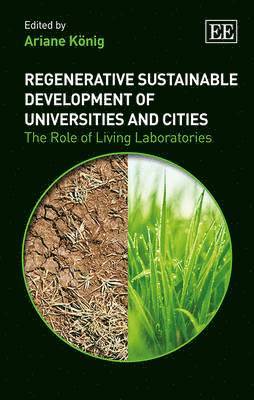
    Regenerative Sustainable Development of Universities and Cities

    The Role of Living Laboratories

    AvAriane König

    Inbunden, Engelska, 2013

    2 280 kr

    Beställningsvara. Skickas inom 5-8 vardagar. Fri frakt över 249 kr.

    Beskrivning

    Now that the Earth has reached the limits of its biophysical carrying capacity, we have to change technologies, social practices and social norms relating to material production and consumption to ensure that we do not further jeopardize the functioning of our planet's life support systems. Through research, education and civic engagement, universities have a pivotal role to play in this transition. This timely book explores how universities are establishing living laboratories for sustainable development, and examines the communication networks and knowledge infrastructures that underpin impact both on and beyond the campus.The expert contributors present case studies of living laboratories being built in leading universities across four continents. Their aim is to cultivate the transition to sustainable development by actively fostering social and technological change to improve use of natural resources and reduce pollution. They are designed to link research, education and practice and to integrate knowledge across disciplines to develop more socially robust approaches to improving sustainability. Directing attention to what enables and constrains learning in communities of multiple and very diverse stakeholders in such laboratories can contribute to a better general understanding of factors influencing the chance of success (or failure), and the institutional arrangements, norms and values that accompany it.Focussing on social learning processes to drive societal change for sustainable development, this fascinating book will prove an invaluable read for academics, researchers, students and policy makers in the fields of higher education, regional and urban studies, public policy and the environment, and development studies.Contributors: B. Baleti , T. Becker, T. Berkhout, A. Campbell, A. Cayuela, S. Chen, M. Dalbro, J. Evans, M. Hesse, J. Holmberg, M. Holme Samsøe, Y. Hua, J.-H. Kain, A. Kildahl, H. Komatsu, A. König, N. Kurata, S. Liao, U. Lundgren, B. Meehan, E. Omrcen, T. Ozasa, M. Polk, C. Powell, J. Robinson, H. Tan, T. Ueno

    Produktinformation

    • Utgivningsdatum:2013-09-30
    • Mått:156 x 234 x undefined mm
    • Format:Inbunden
    • Språk:Engelska
    • Förlag:Edward Elgar Publishing Ltd
    • ISBN:9781781003633

    Utforska kategorier

    • Referensverk och tvärvetenskap inom Samhälle och politik
    • Miljövetenskap och miljöpolitik inom Naturvetenskap och teknik
    • Regional planering inom Naturvetenskap och teknik

    Mer om författaren

    Edited by Ariane König, Head of Sustainable Development and Senior Researcher, University of Luxembourg

    Recensioner i media

    'This book's case studies from North America, Europe and Asia highlight an enormous, but as yet untapped, potential for achieving social and technological change in cities worldwide. The authors show how university campuses around the world can be ''living laboratories'' to investigate and demonstrate the practicality of ''regenerative sustainability'', which looks beyond environmental damage control to a vision of urban development that actually improves environmental quality and human welfare. If these ideas catch on, they could literally change the world.'--Steve Rayner, Oxford University, UK

    Innehållsförteckning

    • Contents:Foreword: A Shared Exploration of ‘Living Laboratories’ for SustainabilityBernd Kasemir and Roland Stulz1. Introduction: Experimenting for Sustainable Development? Living Laboratories, Social Learning and the Role of the UniversityAriane König and James EvansPART I: CAMPUS AS LIVING LABORATORY: ENGAGING COMMUNITIES IN EXPERIMENTATION2. Next Generation Sustainability at The University of British Columbia: The University as Societal Test-bed for SustainabilityJohn Robinson, Tom Berkhout, Alberto Cayuela and Ann Campbell3. Sustainable Campus as a Living Laboratory for Climate Change Mitigation and Adaptation: The Role of Design Thinking ProcessesYing Hua4. Campus Building Energy Management in Tongji University: An Approach to Achieve Energy Efficiency of Buildings for SustainabilityHongwei Tan and Shuqin Chen5. Can an Environmental Management System be a Driving Force for Sustainability in Higher Education? A Case from the University of Gothenburg, Sweden Eddi Omrcen, Ullika Lundgren and Marianne Dalbro6. Creating Change: Building an Environmentally Sustainable CampusBart Meehan7. Reconciling the Pursuit of Excellence with Sustainable Development at the University of Hong Kong Ann Kildahl and Sarah Liao8. What Might a Sustainable University Look Like? Challenges and Opportunities in the Development of the University of Luxembourg and its New CampusAriane KönigPART II: THE CHALLENGE FOR UNIVERSITIES TO FOSTER SUSTAINABLE DEVELOPMENT ACROSS MULTIPLE SCALES9. Mistra Urban Futures: A Living Laboratory for Urban Transformations Merritt Polk, Jaan-Henrik Kain and John Holmberg10. Leading by Example: Developing an Effective Energy Efficiency Program for a Campus and Community Christopher Powell11. How Can Physical Campus Planning Support Universities in their Development and Ultimately Help Cities Change? Bojan Baletić and Mikala Holme Samsøe12. Campus Planning for Promoting Quality of Life in the Community Naomichi Kurata, Takao Ozasa, Takeshi Ueno and Hisashi Komatsu13. Building a Sustainable University from Scratch: Anticipating the Urban, Regional and Planning Dimension of the ‘Cité des Sciences Belval’ in Esch-sur-Alzette and Sanem, Luxembourg Tom Becker and Markus Hesse14. Conclusion: A Cross-cultural Exploration of the Co-creation of Knowledge in Living Laboratories for Societal Transformation Across Four Continents Ariane KönigAnnex A: ISCN/GULF Sustainable Campus Charter Index