• Fri frakt över 249 kr
  • •
  • Snabba leveranser
  • •
  • Billiga böcker
Kundservice

Du är på sajten för privatpersoner.

Företag, bibliotek eller offentlig verksamhet?

Du handlar på classic.bokus.com, där alla dina funktioner finns intakta.
Till classic.bokus.com
Bokus logotyp. Gå till startsidan.
  • Erbjudanden
  • Nyheter
  • Student
  • Topplistor
  • Barn & ungdom
  • Bokus Play
  • E-böcker
  • Pocketböcker
  • Spel & pussel

Upp till 20% på populära nyheter →

Sidfot

Mina sidor

    Hjälp

    • Kundservice
    • Vanliga frågor och svar
    • Frakt och leverans
    • Retur vid ångerrätt
    • Reklamera vara
    • Betalning
    • Köpvillkor
    • Allmänna villkor
    • Information om webbplatsens tillgänglighet

    Om Bokus

    • Om oss
    • Pressrum
    • För studenter
    • För företag
    • För bibliotek och offentlig verksamhet
    • För leverantörer
    • Hållbarhet

    Populärt

    • Aktuella erbjudanden
    • Presentkort
    • Studentlitteratur
    • Nya böcker
    • Topplistor
    • Signerade böcker
    • Engelska böcker

    Inspiration

    • Boktips
    • BookTok
    • Populära bokserier
    • Barnbokskaraktärer
    • Populära författare

    Mina sidor

      Hjälp

      • Kundservice
      • Vanliga frågor och svar
      • Frakt och leverans
      • Retur vid ångerrätt
      • Reklamera vara
      • Betalning
      • Köpvillkor
      • Allmänna villkor
      • Information om webbplatsens tillgänglighet

      Om Bokus

      • Om oss
      • Pressrum
      • För studenter
      • För företag
      • För bibliotek och offentlig verksamhet
      • För leverantörer
      • Hållbarhet

      Populärt

      • Aktuella erbjudanden
      • Presentkort
      • Studentlitteratur
      • Nya böcker
      • Topplistor
      • Signerade böcker
      • Engelska böcker

      Inspiration

      • Boktips
      • BookTok
      • Populära bokserier
      • Barnbokskaraktärer
      • Populära författare
      Logotyp för Bokus
      Följ oss på Facebook (extern länk)Följ oss på Instagram (extern länk)Följ oss på YouTube (extern länk)Följ oss på TikTok (extern länk)
      bokus @ CookiesIntegritetspolicyKöpvillkor
      Till Citymail hemsida (extern länk)Till Budbee hemsida (extern länk)Till Postnord hemsida (extern länk)Till Schenker hemsida (extern länk)Till Early Bird hemsida (extern länk)Till Walleys hemsida (extern länk)
      1. Naturvetenskap och teknik
      2. Matematik och naturvetenskap
      3. Matematik
      4. Optimering

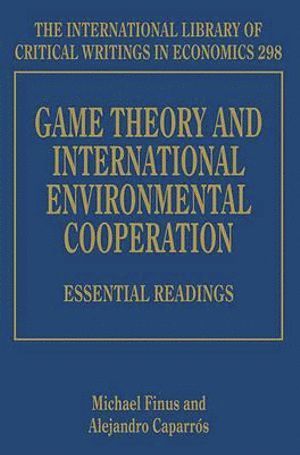
      Game Theory and International Environmental Cooperation

      Essential Readings

      AvMichael Finus,Alejandro Caparrós

      Inbunden, Engelska, 2015

      Del 298 i serien The International Library of Critical Writings in Economics series

      7 950 kr

      Beställningsvara. Skickas inom 5-8 vardagar. Fri frakt över 249 kr.

      Beskrivning

      Key environmental issues, such as biodiversity and climate change, have in recent years become more pressing than ever. Where the critical papers in the early 1990s explained the difficulties of cooperation in tackling transboundary environmental problems, later works have analyzed the various alternatives, and increased our understanding of various institutional designs and negotiation protocols’ impact on the success of cooperation. This collection brings together the most important articles on the game theoretic analysis of international environmental cooperation to both confront the cooperative and non-cooperative approaches to this, and demonstrate the diversity of methods used to analyze international environmental agreements.

      Produktinformation

      • Utgivningsdatum:2015-01-30
      • Mått:169 x 244 x undefined mm
      • Format:Inbunden
      • Språk:Engelska
      • Serie:The International Library of Critical Writings in Economics series
      • Förlag:Edward Elgar Publishing Ltd
      • ISBN:9781782545095

      Utforska kategorier

      • Optimering inom Naturvetenskap och teknik
      • Miljövetenskap och miljöpolitik inom Naturvetenskap och teknik

      Mer om författaren

      Edited by Michael Finus, Department of Economics, Universität Graz, Austria and Alejandro Caparrós, Associate Research Professor, Consejo Superior de Investigaciones Científicas (CSIC), and Deputy Director, Institute for Public Goods and Policies, Spain

      Recensioner i media

      'As the nations of the world struggle to negotiate an effective post-Kyoto international climate agreement, there is no area of economic scholarship that has more to offer than game theory. Michael Finus and Alejandro Caparrós, themselves leading scholars in this realm, have assembled a dream team of authors and a remarkable set of key articles from the best economics journals to produce a book with close to 50 chapters that should be essential reading for novices as well as experienced researchers'

      Innehållsförteckning

      • Contents:AcknowledgementsIntroduction Michael Finus and Alejandro CaparrósPART IFOUNDATIONS 1. Karl-Göran Mäler (1989), ‘The Acid Rain Game’, in H. Folmer and E. van Ierland (eds), Valuation Methods and Policy Making in Environmental Economics, Chapter 12, Amsterdam, The Netherlands: Elsevier, 231–52 2. Scott Barrett (1994), ‘Self-Enforcing International Environmental Agreements’, Oxford Economic Papers, Special Issue on Environmental Economics, 46, October, 878–943. Carlo Carraro and Domenico Siniscalco (1993), ‘Strategies for the International Protection of the Environment’, Journal of Public Economics, 52 (3), October, 309–284. Michael Hoel (1992), ‘International Environment Conventions: The Case of Uniform Reductions of Emissions’, Environmental and Resource Economics, 2 (2), March, 141–595. Parkash Chander and Henry Tulkens (1997), ‘The Core of an Economy with Multilateral Environmental Externalities’, International Journal of Game Theory, 26 (3), October, 379–401PART IITECHNICAL ADVANCES 6. Effrosyni Diamantoudi and Eftichios S. Sartzetakis (2006), ‘Stable International Environmental Agreements: An Analytical Approach’, Journal of Public Economic Theory, 8 (2), May, 247–637. Santiago J. Rubio and Alistair Ulph (2006), ‘Self-Enforcing International Environmental Agreements Revisited’, Oxford Economic Papers, 58 (2), April, 233–638. Larry Karp and Leo Simon (2013), ‘Participation Games and International Environmental Agreements: A Non-Parametric Model’, Journal of Environmental Economics and Management, 65 (2), March, 326–449. Carsten Helm (2001), ‘On the Existence of a Cooperative Solution for a Coalitional Game with Externalities’, International Journal of Game Theory, 30 (1), September, 141–6PART IIICOMPLIANCE 10. Rögnvaldur Hannesson (1997), ‘Fishing as a Supergame’, Journal of Environmental Economics and Management, 32 (3), March, 309–2211. Michael Finus and Sigve Tjøtta (2003), ‘The Oslo Protocol on Sulfur Reduction: The Great Leap Forward?’ Journal of Public Economics, 87 (9–10), September, 2031–4812. Henk Folmer, Pierre v. Mouche and Shannon Ragland (1993), ‘Interconnected Games and International Environmental Problems’, Environmental and Resource Economics, 3 (4), August, 313–3513. Anke Gerber and Philipp C. Wichardt (2009), ‘Providing Public Goods in the Absence of Strong Institutions’, Journal of Public Economics, 93 (3–4), April, 429–39 14. Todd L. Cherry and David M. McEvoy (2013), ‘Enforcing Compliance with Environmental Agreements in the Absence of Strong Institutions: An Experimental Analysis’, Environmental and Resource Economics, 54 (1), January, 63–7715. David M. McEvoy and John K. Stranlund (2009), ‘Self-Enforcing International Environmental Agreements with Costly Monitoring for Compliance’, Environmental and Resource Economics, 42 (4), April, 491–50816. Nori Tarui, Charles F. Mason, Stephen Polasky and Greg Ellis (2008), ‘Cooperation in the Commons with Unobservable Actions’, Journal of Environmental Economics and Management, 55 (1), January, 37–5117. Prajit K. Dutta and Roy Radner (2009) ‘A Strategic Analysis of Global Warming: Theory and Some Numbers’, Journal of Economic Behavior and Organization, 71 (2), August, 187–209PART IV NEGOTIATIONS, SECOND-BEST DESIGNS AND INSTITUTIONS 18. Michael Finus and Bianca Rundshagen (1998), ‘Toward a Positive Theory of Coalition Formation and Endogenous Instrumental Choice in Global Pollution Control’, Public Choice, 96 (1–2), July, 145–8619. Scott Barrett (2002), ‘Consensus Treaties’, Journal of Institutional and Theoretical Economics, 158 (4), December, 529–4720. Pierre Courtois and Guillaume Haeringer (2012), ‘Environmental Cooperation: Ratifying Second-Best Agreements’, Public Choice, 151 (3–4), June, 565–8421. A. Caparrós, J.-C. Péreau and T. Tazdaït (2004), ‘North-South Climate Change Negotiations: A Sequential Game with Asymmetric Information’, Public Choice, 121 (3–4), December, 455–8022. Alejandro Caparrós and Jean-Christophe Péreau (2013), ‘Forming Coalitions to Negotiate North–South Climate Agreements’, Environment and Development Economics, Special Issue on Strategic Behaviour and Environmental Commons, 18 (1), February, 69–9223. Bård Harstad (2012), ‘Climate Contracts: A Game of Emissions, Investments, Negotiations, and Renegotiations’, Review of Economic Studies, 79 (4), October, 1527–5724. Carlo Carraro, Carmen Marchiori and Sonia Oreffice (2009), ‘Endogenous Minimum Participation in International Environmental Treaties’, Environmental and Resource Economics, 42 (3), March, 411–2525. Astrid Dannenberg, Andreas Lange and Bodo Sturm (2014), ‘Participation and Commitment in Voluntary Coalitions to Provide Public Goods’, Economica, 81 (322), April, 257–7526. Scott Barrett (2006), ‘Climate Treaties and “Breakthrough” Technologies’, American Economic Review, 96 (2), May, 22–527. Michael Hoel and Aart de Zeeuw (2010), ‘Can a Focus on Breakthrough Technologies Improve the Performance of International Environmental Agreements?’, Environmental and Resource Economics, 47 (3), November, 395–406PART V TRANSFERS, SHARING AND FAIRNESS 28. Matthew McGinty (2007), ‘International Environmental Agreements among Asymmetric Nations’, Oxford Economic Papers, 59 (1), January, 45–6229. Hans-Peter Weikard (2009), ‘Cartel Stability Under An Optimal Sharing Rule’, Manchester School, 77 (5), September, 575–9330. Carlo Carraro, Johan Eyckmans and Michael Finus (2006), ‘Optimal Transfers and Participation Decisions in International Environmental Agreements’, Review of International Organizations, 1 (4), December, 379–9631. Matthew McGinty, Garrett Milam and Alejandro Gelves (2012), ‘Coalition Stability in Public Goods Provision: Testing an Optimal Allocation Rule’, Environmental and Resource Economics, 52 (3), July, 327–4532. Stefan Ambec and Yves Sprumont (2002), ‘Sharing a River’, Journal of Economic Theory, 107 (2), December, 453–6233. Andreas Lange and Carsten Vogt (2003), ‘Cooperation in International Environmental Negotiations due to a Preference for Equity’, Journal of Public Economics, 87 (9–10), September, 2049–6734. Michael Kosfeld, Akira Okada and Arno Riedl (2009), ‘Institution Formation in Public Goods Games’, American Economic Review, 99 (4), September, 1335–55PART VI MULTIPLE COALITIONS 35. Francesco Bosello, Barabara Buchner and Carlo Carraro (2003), ‘Equity, Development, and Climate Change Control’, Journal of the European Economic Association, 1 (2–3), April–May, 601–1136. Johan Eyckmans and Michael Finus (2006), ‘Coalition Formation in a Global Warming Game: How the Design of Protocols Affects the Success of Environmental Treaty-Making’, Natural Resource Modeling, 19 (3), September, 323–5837. Geir B. Asheim, Camilla Bretteville Froyn, Jon Hovi and Fredric C. Menz (2006), ‘Regional versus Global Cooperation for Climate Control’, Journal of Environmental Economics and Management, 51 (1), January, 93–109PART VII UNCERTAINTY, RISK AND CATASTROPHIC EVENTS 38. Seong-lin Na and Hyun Song Shin (1998), ‘International Environmental Agreements under Uncertainty’, Oxford Economic Papers, 50 (2), April, 173–85 39. Michael Finus and Pedro Pintassilgo (2013), ‘The Role of Uncertainty and Learning for the Success of International Climate Agreements’, Journal of Public Economics, 103, July, 29–4340. Alfred Endres and Cornelia Ohl (2001), ‘International Environmental Cooperation in the One Shot Prisoners' Dilemma’, Schmollers Jahrbuch, Zeitschrift für Wirtschafts- und Sozialwissenschaften/Journal of Applied Social Science Studies, 121 (1), 1–2641. Vincent Boucher and Yann Bramoullé (2010), ‘Providing Global Public Goods under Uncertainty’, Journal of Public Economics, 94 (9–10), October, 591–60342. Scott Barrett (2013), ‘Climate Treaties and Approaching Catastrophes’, Journal of Environmental Economics and Management, 66 (2), September, 235–50 43. Alessandro Tavoni, Astrid Dannenberg, Giorgos Kallis and Andreas Löschel (2011), ‘Inequality, Communication, and The Avoidance of Disastrous Climate Change in a Public Goods Game’, Proceedings of the National Academy of Sciences, 108 (29), July, 11825–944. Lata Gangadharan and Veronika Nemes (2009) ‘Experimental Analysis of Risk and Uncertainty in Provisioning Private and Public Goods’, Economic Inquiry 47 (1), January, 146–64PART VIII DYNAMIC COALITION FORMATION 45. Santiago J. Rubio and Alistair Ulph (2007), ‘An Infinite-Horizon Model of Dynamic Membership of International Environmental Agreements’, Journal of Environmental Economics and Management, 54 (3), November, 296–310 46. Aart de Zeeuw (2008), ‘Dynamic Effects on the Stability of International Environmental Agreements’, Journal of Environmental Economics and Management, 55 (2), March, 163–7447. Marc Germain, Philippe Toint, Henry Tulkens and Aart de Zeeuw (2003), ‘Transfers to Sustain Dynamic Core-Theoretic Cooperation in International Stock Pollutant Control’, Journal of Economic Dynamics and Control, 28 (1), October, 79–9948. Hans-Peter Weikard, Rob Dellink and Ekko van Ierland (2010), ‘Renegotiations in the Greenhouse’, Environmental and Resource Economics, 45 (4), April, 573–9649. Michèle Breton, Lucia Sbragia and Georges Zaccour (2010), ‘A Dynamic Model for International Environmental Agreements’, Environmental and Resource Economics, 45 (1), January, 25–48Index
      Hoppa över listan

      Du kanske också är intresserad av

      Albert N. Link - Economics of Innovation Policy, Inbunden
      Del 222

      Economics of Innovation Policy

      Albert N. Link

      Inbunden, 2008

      7 950 kr

      Rosemary H.T. O’Kane - Terrorism, Inbunden

      Terrorism

      Rosemary H.T. O’Kane

      Inbunden, 2005

      7 950 kr

      Ronald Rogowski - COMPARATIVE POLITICS AND THE INTERNATIONAL POLITICAL ECONOMY, Inbunden
      Del 8

      COMPARATIVE POLITICS AND THE INTERNATIONAL POLITICAL ECONOMY

      Ronald Rogowski

      Inbunden, 1995

      7 950 kr

      Various - Penguin Archive, Övrigt

      Penguin Archive

      Various

      7 950 kr

      Graeme Hugo - Migration and Climate Change, Inbunden
      Del 15

      Migration and Climate Change

      Graeme Hugo

      Inbunden, 2013

      7 950 kr

      Christoph Böhringer, Michael Finus, Carsten Vogt - Controlling Global Warming, Inbunden

      Controlling Global Warming

      Christoph Böhringer, Michael Finus, Carsten Vogt

      Inbunden, 2002

      2 148 kr

      Atta-ur Rahman - Bioactive Natural Products (Part C), E-bok

      Bioactive Natural Products (Part C)

      Atta-ur Rahman

      E-bok
      2000

      7 952 kr

      Hans-Jurgen Becker, Christoph Berner, Hans-Jürgen Becker - Avot de-Rabbi Natan, Inbunden
      Del 116

      Avot de-Rabbi Natan

      Hans-Jurgen Becker, Christoph Berner, Hans-Jürgen Becker

      Inbunden, 2006

      7 951 kr

      Michael Finus - Game Theory and International Environmental Cooperation, Inbunden

      Game Theory and International Environmental Cooperation

      Michael Finus

      Inbunden, 2001

      2 491 kr

      Wiley Encyclopedia of Personality and Individual Differences, Set, Inbunden

      Wiley Encyclopedia of Personality and Individual Differences, Set

      John Wiley & Sons Inc

      Inbunden, 2020

      7 951 kr