• Fri frakt över 249 kr
  • •
  • Snabba leveranser
  • •
  • Billiga böcker
Kundservice

Du är på sajten för privatpersoner.

Företag, bibliotek eller offentlig verksamhet?

Du handlar på classic.bokus.com, där alla dina funktioner finns intakta.
Till classic.bokus.com
Bokus logotyp. Gå till startsidan.
  • Erbjudanden
  • Nyheter
  • Student
  • Topplistor
  • Barn & ungdom
  • Bokus Play
  • E-böcker
  • Pocketböcker
  • Spel & pussel

10% rabatt på allt med kod: NYSTART10 →

Sidfot

Mina sidor

    Hjälp

    • Kundservice
    • Vanliga frågor och svar
    • Frakt och leverans
    • Retur vid ångerrätt
    • Reklamera vara
    • Betalning
    • Köpvillkor
    • Allmänna villkor
    • Information om webbplatsens tillgänglighet

    Om Bokus

    • Om oss
    • Pressrum
    • För studenter
    • För företag
    • För bibliotek och offentlig verksamhet
    • För leverantörer
    • Hållbarhet

    Populärt

    • Aktuella erbjudanden
    • Presentkort
    • Studentlitteratur
    • Nya böcker
    • Topplistor
    • Signerade böcker
    • Engelska böcker

    Inspiration

    • Boktips
    • BookTok
    • Populära bokserier
    • Barnbokskaraktärer
    • Populära författare
    Logotyp för Bokus
    Följ oss på Facebook (extern länk)Följ oss på Instagram (extern länk)Följ oss på YouTube (extern länk)Följ oss på TikTok (extern länk)
    bokus @ CookiesAnpassa cookiesIntegritetspolicyKöpvillkor
    Till Citymail hemsida (extern länk)Till Budbee hemsida (extern länk)Till Postnord hemsida (extern länk)Till Schenker hemsida (extern länk)Till Early Bird hemsida (extern länk)Till Walleys hemsida (extern länk)
    1. Ekonomi och Ledarskap
    2. Nationalekonomi
    3. Ekonomisk historia

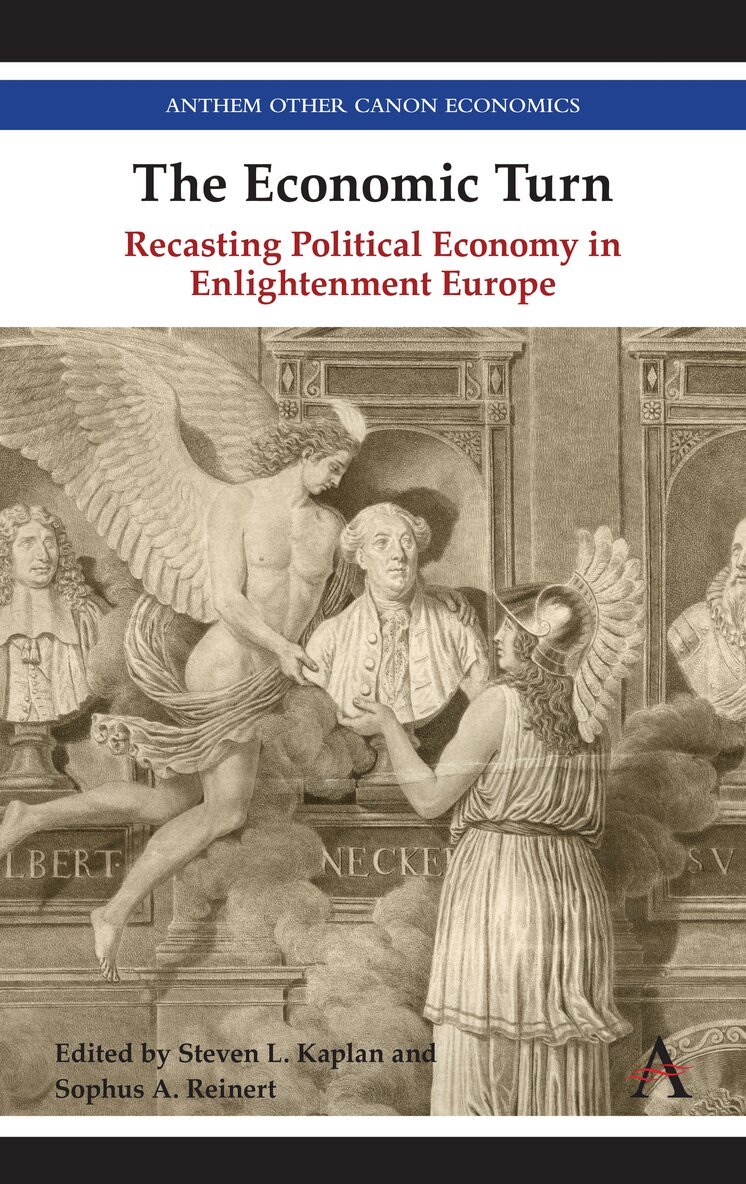
    Economic Turn

    Recasting Political Economy in Enlightenment Europe

    AvSteven Kaplan,Sophus Reinert

    Inbunden, Engelska, 2019

    Del i serien Anthem Other Canon Economics

    3 265 kr

    Beställningsvara. Skickas inom 5-8 vardagar. Fri frakt över 249 kr.

    Beskrivning

    The mid-eighteenth century witnessed what might be dubbed an economic turn that resolutely changed the trajectory of world history. The discipline of economics itself emerged amidst this turn, and it is frequently traced back to the work of François Quesnay and his school of Physiocracy. Though lionized by the subsequent historiography of economics, the theoretical postulates and policy consequences of Physiocracy were disastrous at the time, resulting in a veritable subsistence trauma in France. This galvanized relentless and diverse critiques of the doctrine not only in France but also throughout the European world that have, hitherto, been largely neglected by scholars. Though Physiocracy was an integral part of the economic turn, it was rapidly overcome, both theoretically and practically, with durable and important consequences for the history of political economy. The Economic Turn brings together some of the leading historians of that moment to fundamentally recast our understanding of the origins and diverse natures of political economy in the Enlightenment.

    Produktinformation

    • Utgivningsdatum:2019-01-16
    • Mått:153 x 229 x 26 mm
    • Vikt:454 g
    • Format:Inbunden
    • Språk:Engelska
    • Serie:Anthem Other Canon Economics
    • Antal sidor:792
    • Förlag:Anthem Press
    • ISBN:9781783088553

    Utforska kategorier

    • Ekonomisk historia inom Ekonomi och Ledarskap

    Mer om författaren

    Steven L. Kaplan is the Goldwin Smith Professor of European History Emeritus at Cornell University, USA. His books include Bread, Politics and Political Economy (1976/2015), Farewell Revolution (1995), Le Pain maudit (2008) and Raisonner sur les blés (2017). Sophus A. Reinert is the Marvin Bower Associate Professor at Harvard Business School, USA. His books include Translating Empire (2011) and The Academy of Fisticuffs (2018).

    Recensioner i media

    A major contribution to the history of political economy. Its twenty-one full-size chapters provide an insight into some of the most notable work done in the last decades in the field, but also develop and engage with a thesis of its own. — Koen Stapelbroek, Erasmus University Rotterdam and University of Helsinki, Journal of Modern History (2020)

    Innehållsförteckning

    • Acknowledgments; Notes on Contributors; Chapter One The Economic Turn in Enlightenment Europe, Steven L. Kaplan and Sophus A. Reinert; Chapter TwoThe Physiocratic Movement: A Revision, Loïc Charles and Christine Théré; Chapter Three The Political Economy of Colonization: From Composite Monarchy to Nation, Paul Cheney; Chapter Four Against the Chinese Model: The Debate on Cultural Facts and Physiocratic Epistemology, Stefan Gaarsmand Jacobsen; Chapter Five “Le superfl u, chose très nécessaire”: Physiocracy and Its Discontents in the Eighteenth- Century Luxury Debate, Michael Kwass; Chapter Six François Véron de Forbonnais and the Invention of Antiphysiocracy, Loïc Charles and Arnaud Orain; Chapter Seven Between Mercantilism and Physiocracy: Forbonnais’s ‘Est modus in Rebus’ Vision, Antonella Alimento; Chapter Eight Physiocrat Arithmetic versus Ratios : The Analytical Economics of Jean- Joseph- Louis Graslin, Arnaud Orain; Chapter Nine Galiani: Grain and Governance, Steven L. Kaplan; Chapter Ten “Live and Die Proprietors and Free”: Morellet Dismantles the Dialogues and Defends the Radical Liberal Break, Steven L. Kaplan; Chapter Eleven “Is the Feeling of Humanity not More Sacred than The Right of Property?”: Diderot’s Antiphysiocracy in His Apology of Abbé Galiani, Steven L. Kaplan; Chapter Twelve De facto Policies and Intellectual Agendas of an Eighteenth- Century Milanese Agricultural Academy: Physiocratic Resonances in the Società patriotica, Lavinia Maddaluno; Chapter Thirteen Sensationism, Modern Natural Law and the “Science of Commerce” at the Heart of the Controversy between Mably and the Physiocrats, Julie Ferrand and Arnaud Orain; Chapter Fourteen ‘One Must Make War on the Lunatics’: The Physiocrats’ Attacks on Linguet, the Iconoclast (1767– 1775), Arnaud Orain; Chapter Fifteen The Grain Question as the Social Question: Necker’s Antiphysiocracy, Steven L. Kaplan; Chapter Sixteen Physiocracy in Sweden: A Note on the Problem of Inventing Tradition, Lars Magnusson; Chapter Seventeen Spain and the Economic Work of Jacques Accarias de Serionne, Jesús Astigarraga; Chapter Eighteen Captured by the Commercial Paradigm: Physiocracy Going Dutch, Ida Nijenhuis; Chapter Nineteen Cameralism, Physiocracy and Antiphysiocracy in the Germanies, Andre Wakefield; Chapter Twenty No Way Back to Quesnay: Say’s Opposition to Physiocracy, Philippe Steiner; Chapter Twenty-One “A Sublimely Stupid Idea”: Physiocracy in Italy from the Enlightenment to Fascism, Sophus A. Reinert; Chapter Twenty-Two Epilogue: Political Economy and the Social, Steven L. Kaplan and Sophus A. Reinert; Index.