• Fri frakt över 249 kr
  • •
  • Snabba leveranser
  • •
  • Billiga böcker
Kundservice

Du är på sajten för privatpersoner.

Företag, bibliotek eller offentlig verksamhet?

Du handlar på classic.bokus.com, där alla dina funktioner finns intakta.
Till classic.bokus.com
Bokus logotyp. Gå till startsidan.
  • Erbjudanden
  • Nyheter
  • Student
  • Topplistor
  • Barn & ungdom
  • Bokus Play
  • E-böcker
  • Pocketböcker
  • Spel & pussel

10% rabatt på allt med kod: NYSTART10 →

Sidfot

Mina sidor

    Hjälp

    • Kundservice
    • Vanliga frågor och svar
    • Frakt och leverans
    • Retur vid ångerrätt
    • Reklamera vara
    • Betalning
    • Köpvillkor
    • Allmänna villkor
    • Information om webbplatsens tillgänglighet

    Om Bokus

    • Om oss
    • Pressrum
    • För studenter
    • För företag
    • För bibliotek och offentlig verksamhet
    • För leverantörer
    • Hållbarhet

    Populärt

    • Aktuella erbjudanden
    • Presentkort
    • Studentlitteratur
    • Nya böcker
    • Topplistor
    • Signerade böcker
    • Engelska böcker

    Inspiration

    • Boktips
    • BookTok
    • Populära bokserier
    • Barnbokskaraktärer
    • Populära författare
    Logotyp för Bokus
    Följ oss på Facebook (extern länk)Följ oss på Instagram (extern länk)Följ oss på YouTube (extern länk)Följ oss på TikTok (extern länk)
    bokus @ CookiesAnpassa cookiesIntegritetspolicyKöpvillkor
    Till Citymail hemsida (extern länk)Till Budbee hemsida (extern länk)Till Postnord hemsida (extern länk)Till Schenker hemsida (extern länk)Till Early Bird hemsida (extern länk)Till Walleys hemsida (extern länk)
    1. Ekonomi och Ledarskap
    2. Nationalekonomi
    3. Internationell ekonomi

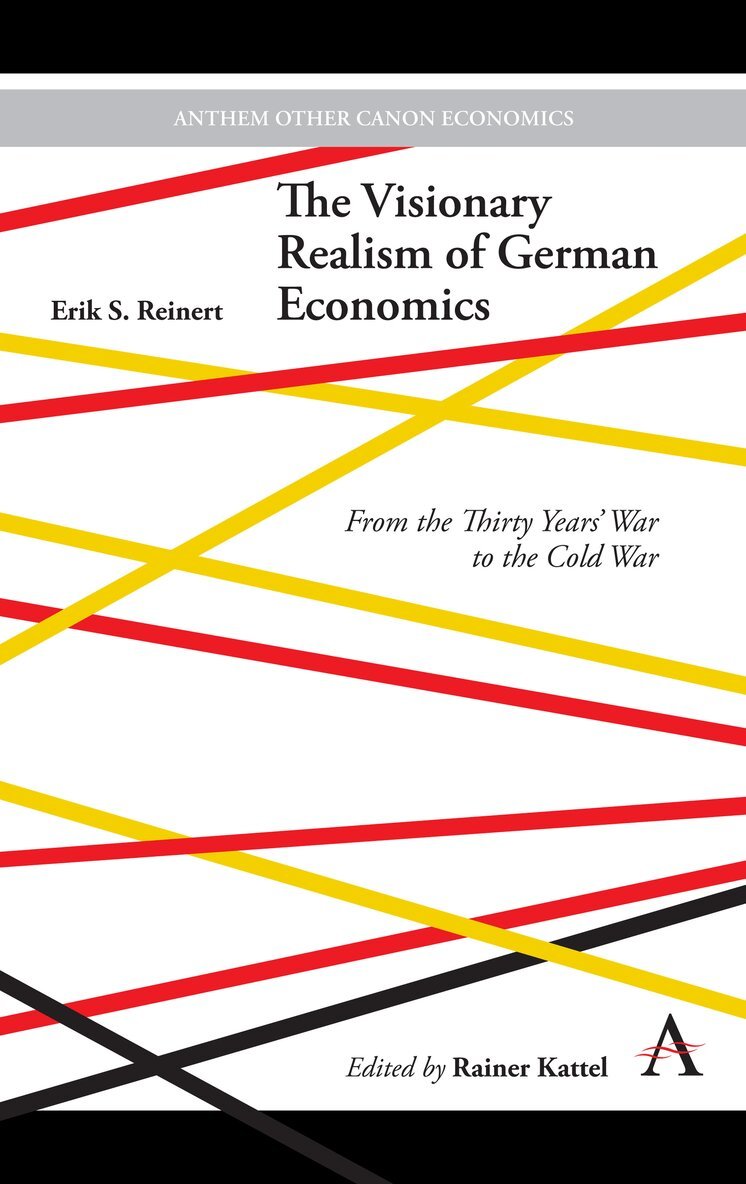
    Visionary Realism of German Economics

    From the Thirty Years' War to the Cold War

    AvErik S. Reinert,Rainer Kattel

    Inbunden, Engelska, 2019

    Del i serien Anthem Other Canon Economics

    1 319 kr

    Beställningsvara. Skickas inom 5-8 vardagar. Fri frakt över 249 kr.

    Beskrivning

    The Visionary Realism of German Economics forms a collection of Erik S. Reinert’s essays bringing the more realistic German economic tradition into focus as an alternative to Anglo-Saxon neoclassical mainstream economics. Together the essays form a holistic theory explaining why economic development—by its very nature—is a very uneven process. Herein lie the important policy implications of the volume.

    Produktinformation

    • Utgivningsdatum:2019-02-15
    • Mått:153 x 229 x 26 mm
    • Vikt:454 g
    • Format:Inbunden
    • Språk:Engelska
    • Serie:Anthem Other Canon Economics
    • Antal sidor:606
    • Förlag:Anthem Press
    • ISBN:9781783089031

    Utforska kategorier

    • Internationell ekonomi inom Ekonomi och Ledarskap

    Mer om författaren

    Erik S. Reinert is Professor of Technology Governance and Development Strategies at Tallinn University of Technology, Estonia, and also Chairman of the Other Canon Foundation in Norway. He holds a BA from Hochschule St. Gallen, Switzerland, an MBA from Harvard University, and a PhD in economics from Cornell University. For almost 20 years he ran a manufacturing company producing in three European countries. This background brought Reinert close to economics as a “science of practice” (Erfahrungswissenschaft). Lecturing in five languages, Reinert’s work has taken him to more than 65 different countries. His book How Rich Countries Got Rich … and Why Poor Countries Stay Poor, published in more than 20 languages, was shortlisted by the World Economics Association in 2016 for inclusion among the 10 most important economics books of the last 100 years.

    Recensioner i media

    Book Launch -- The Visionary Realism of German Economics

    Innehållsförteckning

    • Introduction; Chapter 1 German Economics as Development Economics: From the Thirty Years’ War to World War II; Chapter 2 The Role of the State in Economic Growth; Chapter 3 A Brief Introduction to Veit Ludwig von Seckendorff (1626– 1692); Chapter 4 Exploring the Genesis of Economic Innovations: The Religious Gestalt- Switch and the Duty to Invent as Preconditions for Economic Growth (with Arno Daastøl); Chapter 5 Johann Heinrich Gottlob von Justi (1717– 1771): The Life and Times of an Economist Adventurer; Chapter 6 Jacob Bielfeld’s “On the Decline of States” (1760) and Its Relevance for Today; Chapter 7 Raw Materials in the History of Economic Policy; or, Why List (the Protectionist) and Cobden (the Free Trader) Both Agreed on Free Trade in Corn; Chapter 8 Compensation Mechanisms and Targeted Economic Growth: Lessons from the History of Economic Policy; Chapter 9 Karl Bücher and the Geographical Dimensions of Techno- Economic Change: Production- Based Economic Theory and the Stages of Economic Development; Chapter 10 Austrian Economics and the Other Canon: The Austrians between the Activistic- Idealistic and the Passivistic- Materialistic Traditions of Economics; Chapter 11 Nietzsche and the German Historical School of Economics (with Sophus A. Reinert); Chapter 12 Creative Destruction in Economics: Nietzsche, Sombart, Schumpeter (with Hugo Reinert); Chapter 13 Schumpeter in the Context of Two Canons of Economic Thought; Chapter 14 The Role of Technology in the Creation of Rich and Poor Nations: Underdevelopment in a Schumpeterian System; Chapter 15 Towards an Austro–German Theory of Uneven Economic Development? A Plea for Theorising by Inclusion; Chapter 16 The Qualitative Shift in European Integration: Towards Permanent Wage Pressures and a ‘Latin- Americanization’ of Europe? (with Rainer Kattel); Chapter 17 Primitivization of the EU Periphery: The Loss of Relevant Knowledge; Chapter 18 Mechanisms of Financial Crises in Growth and Collapse: Hammurabi, Schumpeter, Perez, and Minsky; Chapter 19 Full Circle: Economics from Scholasticism through Innovation and Back into Mathematical Scholasticism: Reflections on a 1769 Price Essay: “Why Is It That Economics So Far Has Gained So Few Advantages from Physics and Mathematics?”; Chapter 20 Werner Sombart (1863–1941) and the Swan Song of German Economics; Index.