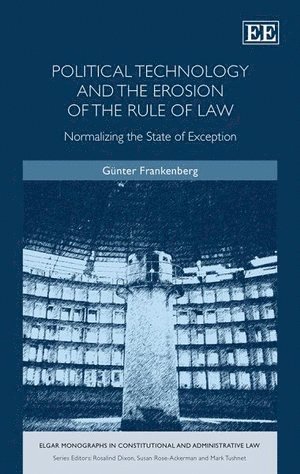
Häftad, Engelska, 2015
Political Technology and the Erosion of the Rule of Law
Normalizing the State of Exception
Del i serien Elgar Monographs in Constitutional and Administrative Law
459 kr
Beställningsvara. Skickas inom 7-10 vardagar. Fri frakt över 249 kr.
Beskrivning
Produktinformation
- Utgivningsdatum: 2015-01-30
- Mått: 156 x 234 x undefined mm
- Format: Häftad
- Språk: Engelska
- Serie: Elgar Monographs in Constitutional and Administrative Law
- Förlag: Edward Elgar Publishing Ltd
- ISBN: 9781783472512
Utforska kategorier
Mer om författaren
Günter Frankenberg, Emeritus Professor of Public Law, Philosophy of Law and Comparative Law, Institute for Public Law, Goethe University Frankfurt am Main, Germany
Recensioner i media
‘Books abound on the question whether states of emergency can be legally controlled. But Frankenberg’s account stands out because of his mastery of the political and legal contexts in which the terms of the debate about states of emergency were framed for us - the situation of Weimar and the constitutional reaction in postwar Germany. In addition, Frankenberg has an astonishing command of the history of political theory from Hobbes to the present. His innovative but scholarly analyses permit him to construct a narrative about the potential of the rule of law to respond to emergencies that includes detailed examinations of Schmitt, Foucault, Habermas, Agamben, and many others. His treatments of these figures seek to draw out the genuine insights they might offer, so that, even though none of the figures escapes the force of his criticism, his argument will challenge the assumptions of all involved in the debate.’
Betyg & recensioner
0 recensioner
Inga recensioner tillgängliga.